


Structure Modulates Similarity-Based Interference in Sluicing: An Eye Tracking study
- PMID: 26733893
- PMCID: PMC4683205
- DOI: 10.3389/fpsyg.2015.01839
Structure Modulates Similarity-Based Interference in Sluicing: An Eye Tracking study
Abstract
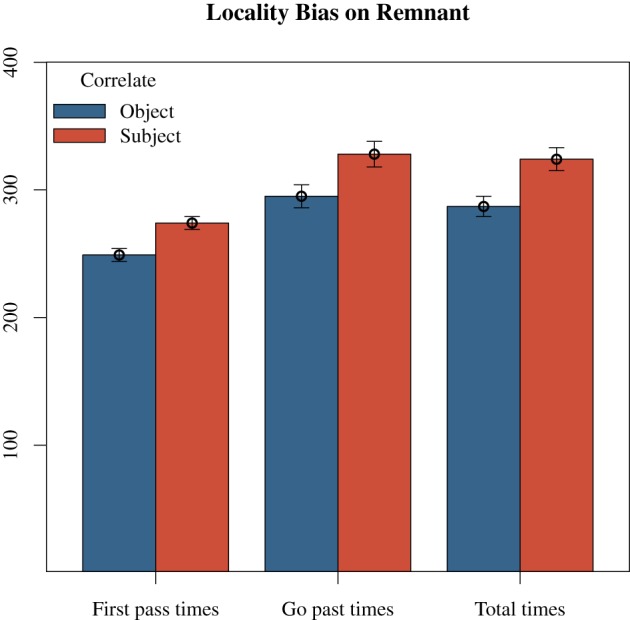
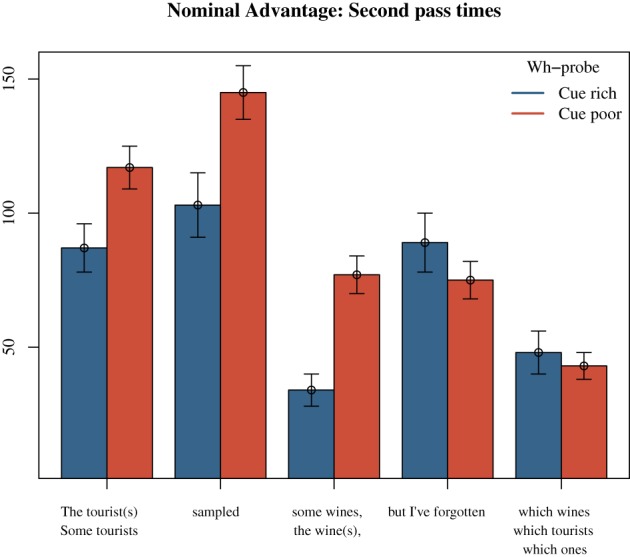
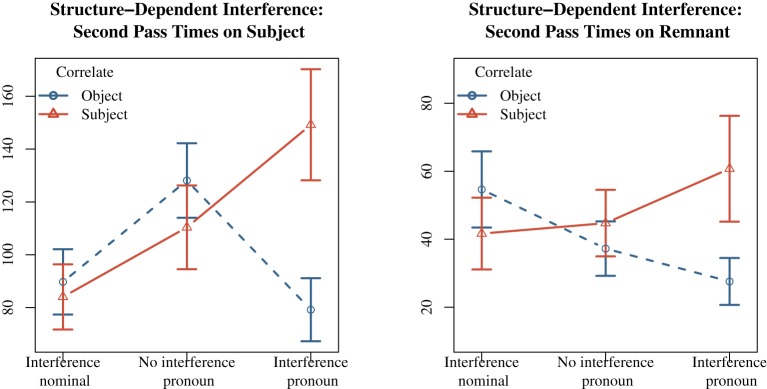
In cue-based content-addressable approaches to memory, a target and its competitors are retrieved in parallel from memory via a fast, associative cue-matching procedure under a severely limited focus of attention. Such a parallel matching procedure could in principle ignore the serial order or hierarchical structure characteristic of linguistic relations. I present an eye tracking while reading experiment that investigates whether the sentential position of a potential antecedent modulates the strength of similarity-based interference, a well-studied effect in which increased similarity in features between a target and its competitors results in slower and less accurate retrieval overall. The manipulation trades on an independently established Locality bias in sluiced structures to associate a wh-remnant (which ones) in clausal ellipsis with the most local correlate (some wines), as in The tourists enjoyed some wines, but I don't know which ones. The findings generally support cue-based parsing models of sentence processing that are subject to similarity-based interference in retrieval, and provide additional support to the growing body of evidence that retrieval is sensitive to both the structural position of a target antecedent and its competitors, and the specificity or diagnosticity of retrieval cues.
Keywords: ellipsis; eye tracking; sentence processing; similarity-based interference; working memory.
Figures
References
-
- Aguilar Guevara A. (2014). Weak Definites. Semantics, Lexicon and Pragmatics. Ph.D. thesis, Utrecht University, The Netherlands.
-
- Alcocer P., Phillips C. (2012). Using Relational Syntactic Constraints in Content-addressable Memory Architectures for Sentence Parsing. College Park, MD: Ms. University of Maryland.
-
- Anderson J. R. (1974). Retrieval of propositional information from long-term memory. Cogn. Psychol. 6, 451–474. 10.1016/0010-0285(74)90021-8 - DOI
-
- Anderson J. R., Reder L. M. (1999). The fan effect: new results and new theories. J. Exp. Psychol. Gen. 128, 186–197. 10.1037/0096-3445.128.2.186 - DOI
LinkOut - more resources
Full Text Sources
Other Literature Sources
