. 2015 Dec 22:6:1416.
doi: 10.3389/fmicb.2015.01416. eCollection 2015.

Methods for Baiting and Enriching Fungus-Feeding (Mycophagous) Rhizosphere Bacteria

Affiliations

Methods for Baiting and Enriching Fungus-Feeding (Mycophagous) Rhizosphere Bacteria

Max-Bernhard Ballhausen et al. Front Microbiol. .

Abstract

Mycophagous soil bacteria are able to obtain nutrients from living fungal hyphae. However, with exception of the soil bacterial genus Collimonas, occurrence of this feeding strategy has not been well examined. Evaluation of the importance of mycophagy in soil bacterial communities requires targeted isolation methods. In this study, we compared two different approaches to obtain mycophagous bacteria from rhizospheric soil. A short-term method based on baiting for bacteria that can rapidly adhere to fungal hyphae and a long-term method based on the enrichment of bacteria on fungal hyphae via repeated transfer. Hyphae-adhering bacteria were isolated, identified by 16S rDNA sequencing and tested for antifungal activity and the ability to feed on fungi as the sole source of carbon. Both methods yielded a range of potentially mycophagous bacterial isolates with little phylogenetic overlap. We also found indications for feeding preferences among the potentially mycophagous bacteria. Our results indicate that mycophagy could be an important growth strategy for rhizosphere bacteria. To our surprise, we found several potential plant pathogenic bacteria among the mycophagous isolates. We discuss the possible benefits that these bacteria might gain from colonizing fungal hyphae.

Keywords: antifungal; cultivable bacteria; fungus-feeding; isolation method; mycophagy; phytagel; rhizosphere.


Figures
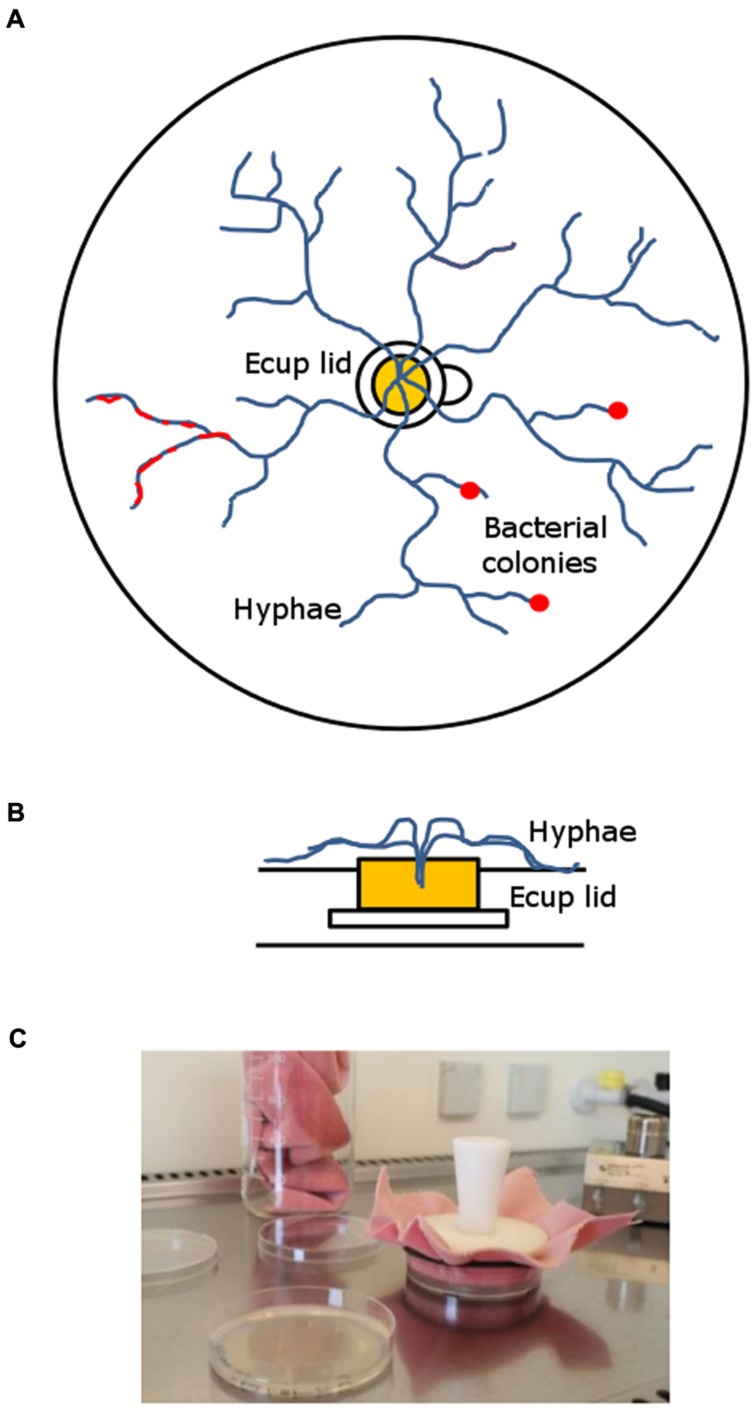
FIGURE 1
FIGURE 1
Long-term hyphal-baiting (“transfer-enrichment”) approach. (A) Top-view and (B) side-view. The fungus was inoculated in the lid of an Eppendorf Cup containing Malt extract agar. It overgrew the plastic rim which separated the nutrient containing compartment (Malt extract agar) in the lid from the nutrient-poor Phytagel in the Petri dish. Subsequently, the microcosm was colonized by the fungal hyphae. Bacteria were distributed over the Phytagel compartment after colonization by the hyphae and strains that became enriched appeared as a biofilm or small colonies along fungal hyphae (red). (C) Regular transfers were done to promote the enrichment of those bacteria that can exploit fungal hyphae for carbon.
FIGURE 2
FIGURE 2
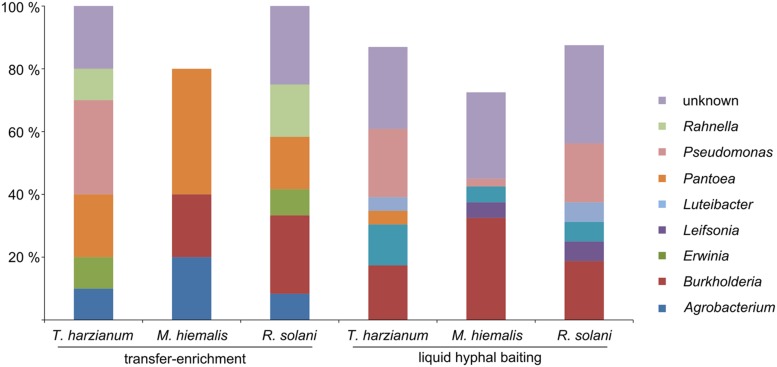
Relative amount of antifungal, hyphae-adhering bacterial isolates grouped by bacterial genus, the three host fungi (T. harzianum, M. hiemalis, R. solani) and the two isolation methods (long-term baiting “transfer-enrichment” and short-term “liquid hyphal-baiting”. Only genera are displayed of which isolates were obtained that colonized more than one fungal species or that were isolated with both methods.
FIGURE 3
FIGURE 3
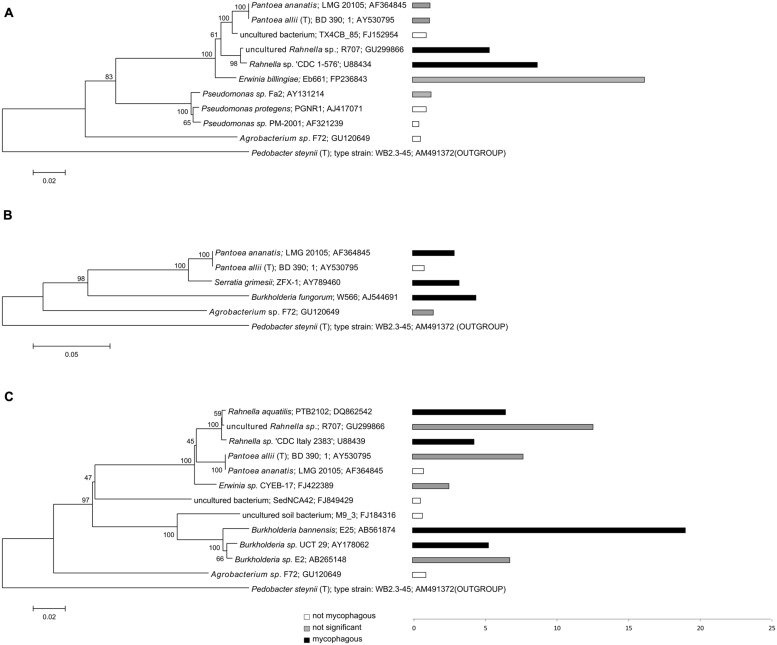
Phylogeny and potential mycophagous ability of antifungal, hyphae-adhering bacteria retrieved with the “transfer-enrichment” approach. The indicated bacterial strains are cultured or uncultured bacteria that have the closest match to one or several of the antifungal, hyphae-adhering bacterial isolates. Separate trees are presented for bacteria associated with (A) T. harzianum, (B) M. hiemalis and (C) R. solani. Bars indicate measured mycophagy ratios: black bars representing bacteria demonstrating significant mycophagous growth (ratio > 1; P < 0.05), gray bars representing bacteria with possible mycophagous growth (ratio > 1; P > 0.05), and white bars represent bacteria with no mycophagous growth (ratio ≤ 1).
FIGURE 4
FIGURE 4
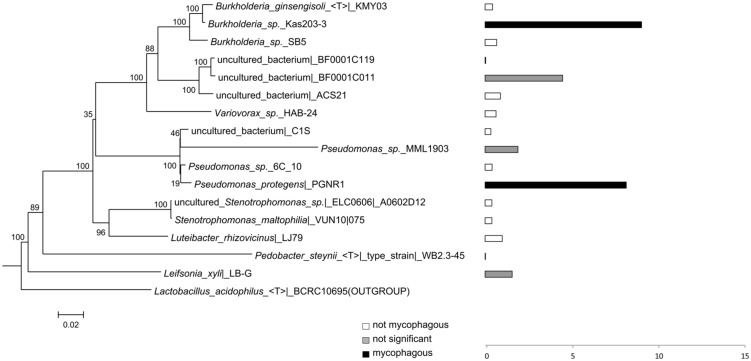
Phylogeny and potential mycophagous ability of antifungal, hyphae-adhering bacteria retrieved with the short-term “liquid hyphal-baiting” approach, associated with R. solani. The indicated bacterial strains are cultured or uncultured bacteria that have the closest match of 16S rDNA sequences to one or several of the antifungal, hyphae-adhering bacterial isolates. Bars indicate measured mycophagy ratios. Black bars show bacteria with significant mycophagous growth (ratio > 1; P < 0.05), grey bars represent bacteria with possible mycophagous growth (ratio > 1; P > 0.05), and white bars indicate bacteria with no mycophagous growth (ratio ≤ 1).
FIGURE 5
FIGURE 5
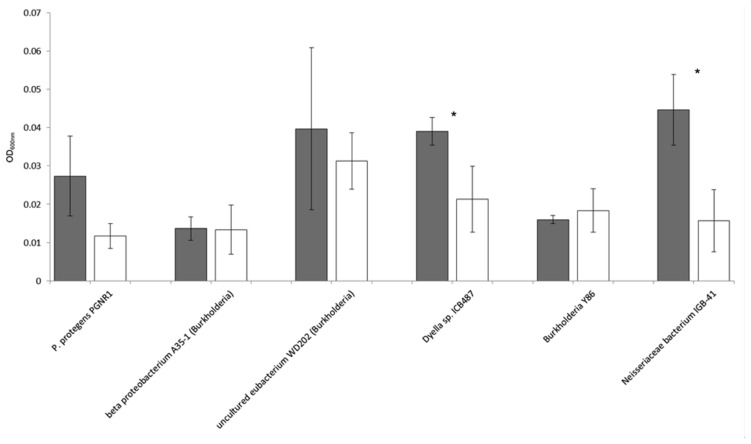
Growth (OD600nm) of six potential mycophagous bacterial strains on liquid extracts obtained from intact fungal hyphae of the fungus M. hiemalis that had colonized Phytagel medium. Gray bars indicate growth on the control (liquid extract of Phytagel only), white bars growth on hyphal extracts. Error bars show standard deviations and stars indicate significant differences between control and treatment, resulting from a two-tailed t-test.

References

    1. Amaradasa B. S., Horvath B. J., Lakshman D. K., Warnke S. E. (2013). DNA fingerprinting and anastomosis grouping reveal similar genetic diversity in Rhizoctonia species infecting turfgrasses in the transition zone of USA. Mycologia 105 1190–1201. 10.3852/12-368 - DOI - PubMed
    1. Bécard G., Fortin J. A. (1988). Early events of vesicular arbuscular mycorrhiza formation on Ri T-DNA transformed roots. New Phytol. 108 211–218. 10.1111/j.1469-8137.1988.tb03698.x - DOI - PubMed
    1. De Boer W., Klein Gunnewiek P. J. K., Kowalchuk G. A., Van Veen J. A. (2001). Growth of chitinolytic dune soil beta-subclass Proteobacteria in response to invading fungal hyphae. Appl. Environ. Microbiol. 67 3358–3362. 10.1128/AEM.67.8.3358-3362.2001 - DOI - PMC - PubMed
    1. De Boer W., Wagenaar A.-M., Gunnewiek P. J. A. K., Veen J. A. (2007). In vitro suppression of fungi caused by combinations of apparently non-antagonistic soil bacteria. FEMS Microbiol. Ecol. 59 177–185. 10.1111/j.1574-6941.2006.00197.x - DOI - PubMed
    1. Dijksterhuis J., Sanders M., Gorris L. G., Smid E. J. (1999). Antibiosis plays a role in the context of direct interaction during antagonism of Paenibacillus polymyxa towards Fusarium oxysporum. J. Appl. Microbiol. 86 13–21. 10.1046/j.1365-2672.1999.t01-1-00600.x - DOI - PubMed

LinkOut - more resources