. 2015 Sep 29;2(11):1032-7.
doi: 10.1002/acn3.255. eCollection 2015 Nov.

JAML mediates monocyte and CD8 T cell migration across the brain endothelium

Affiliations

JAML mediates monocyte and CD8 T cell migration across the brain endothelium

Jorge Iván Alvarez et al. Ann Clin Transl Neurol. .

Erratum in

  • Corrigendum.
    [No authors listed] [No authors listed] Ann Clin Transl Neurol. 2018 May 10;5(5):664. doi: 10.1002/acn3.576. eCollection 2018 May. Ann Clin Transl Neurol. 2018. PMID: 29761129 Free PMC article.

Abstract

Leukocyte transmigration into the central nervous system promotes multiple sclerosis pathogenesis, yet ambiguity remains regarding the mechanisms controlling the migration of distinct immune cell subsets. Using in vitro, ex vivo and postmortem human materials, we identified a significant upregulation of junctional adhesion molecule-like expression at the blood-brain barrier, monocytes, and CD8 T cells of multiple sclerosis patients. We also detected junctional adhesion molecule-like(+) trans-migratory cups when monocytes/CD8 T cells adhered to the blood-brain barrier, however, their migratory capacity was significantly compromised when junctional adhesion molecule-like was blocked. These findings highlight a novel role for junctional adhesion molecule-like in leukocyte transmigration and its potential as a promising therapeutic target.


Figures
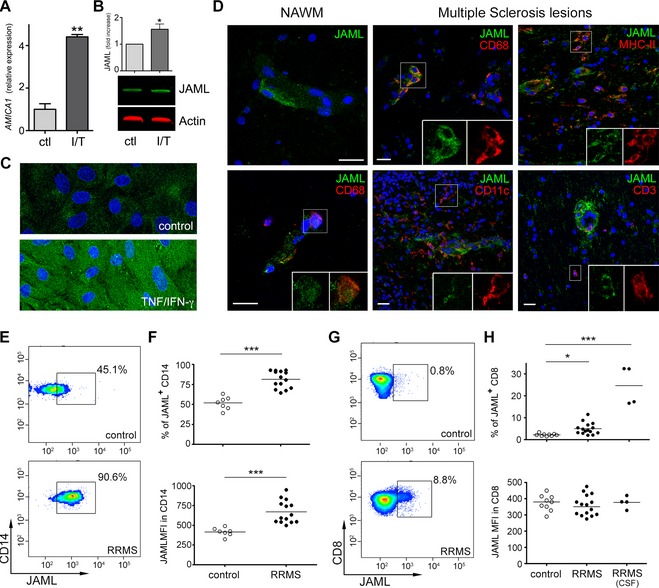
Figure 1
Figure 1
JAML expression on the BBB and immune cells during MS. qPCR (A) western blot (B) and immunocytofluorescent analysis (C) expression of JAML in primary cultures of resting and inflamed (TNF/IFN‐γ) human BBB‐ECs. Gene nomenclature for JAML is AMICA1. Data shown are representative of two to three independent experiments (n = 2–3 EC preparations), Scale bar: 10 μm (D) JAML expression was evaluated in MS tissues (both NAWM and lesions) and costained with the immune markers CD68 (macrophages/microglia), CD11c (dendritic cells), MHC‐II (antigen‐presenting cells) and CD3 (T cells), scale bars: 20 μm. (E and F) Representative flow cytometry dot plot showing the expression of JAML on human ex vivo CD14 monocytes and CD8 T cells in the peripheral blood of RRMS patients and controls. (G and H) MFI and percentage of JAML‐expressing CD14 monocytes and CD8 T cells in the peripheral blood of controls and RRMS patients and in the CSF of patients with active disease. (*P < 0.05, **P < 0.01, ***P < 0.001). JAML, junctional adhesion molecule‐like; BBB‐ECs, blood–brain barrier endothelial cells; MS, multiple sclerosis; NAWM, normal appearing white matter; CSF, cerebrospinal fluid; MFI, mean fluorescent intensity.
Figure 2
Figure 2
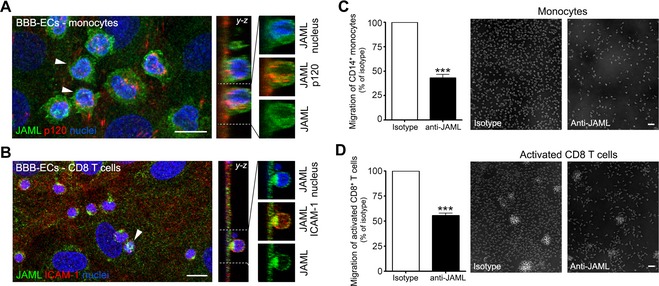
JAML support leukocyte migration across the BBB. (A and B) Expression of JAML (green) on CD14+ monocytes and CD8 T cells adhering to primary cultures of human BBB‐ECs. Costaining for p120 – ICAM‐1 (red) and nuclei (blue) are included. Y‐Z projections show JAML enhancement surrounding the leukocytes in transmigratory cups. Data shown are representative of four independent experiments. Scale bar = 10 μm. (C and D) Human ex vivo CD14 monocytes and activated CD8 T cells were allowed to migrate for 18 h across a monolayer of primary human BBB‐ECs pretreated with isotype control or anti‐JAML antibody. JAML blockade significantly restricted the migration of CD14 monocytes and activated CD8 T cells across BBB‐ECs. Data shown are representative of three independent experiments (n = 3 and 6 blood donors) performed in triplicate using two distinct BBB‐EC preparations (***P < 0.001). JAML, junctional adhesion molecule‐like; BBB‐ECs, blood–brain barrier endothelial cells.

References

    1. Alvarez JI, Cayrol R, Prat A. Disruption of central nervous system barriers in multiple sclerosis. Biochim Biophys Acta 2011;1812:252–264. - PubMed
    1. Abbott NJ, Ronnback L, Hansson E. Astrocyte‐endothelial interactions at the blood‐brain barrier. Nat Rev Neurosci 2006;7:41–53. - PubMed
    1. Arcangeli ML, Frontera V, Aurrand‐Lions M. Function of junctional adhesion molecules (JAMs) in leukocyte migration and homeostasis. Arch Immunol Ther Exp 2013;61:15–23. - PubMed
    1. Zen K, Liu Y, McCall IC, et al. Neutrophil migration across tight junctions is mediated by adhesive interactions between epithelial coxsackie and adenovirus receptor and a junctional adhesion molecule‐like protein on neutrophils. Mol Biol Cell 2005;16:2694–2703. - PMC - PubMed
    1. Moog‐Lutz C, Cave‐Riant F, Guibal FC, et al. JAML, a novel protein with characteristics of a junctional adhesion molecule, is induced during differentiation of myeloid leukemia cells. Blood 2003;102:3371–3378. - PubMed

LinkOut - more resources