Modeling Multisystem Physiological Dysregulation
- PMID: 26734956
- PMCID: PMC4844860
- DOI: 10.1097/PSY.0000000000000288
Modeling Multisystem Physiological Dysregulation
Abstract
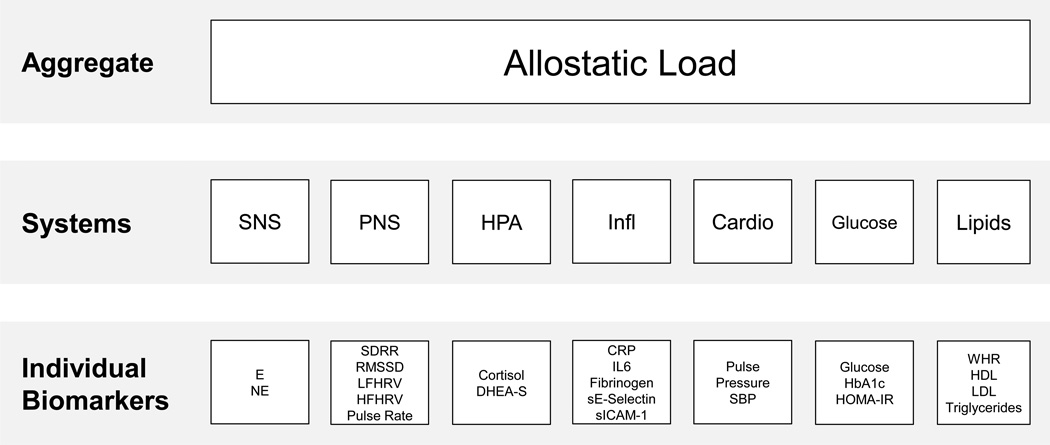
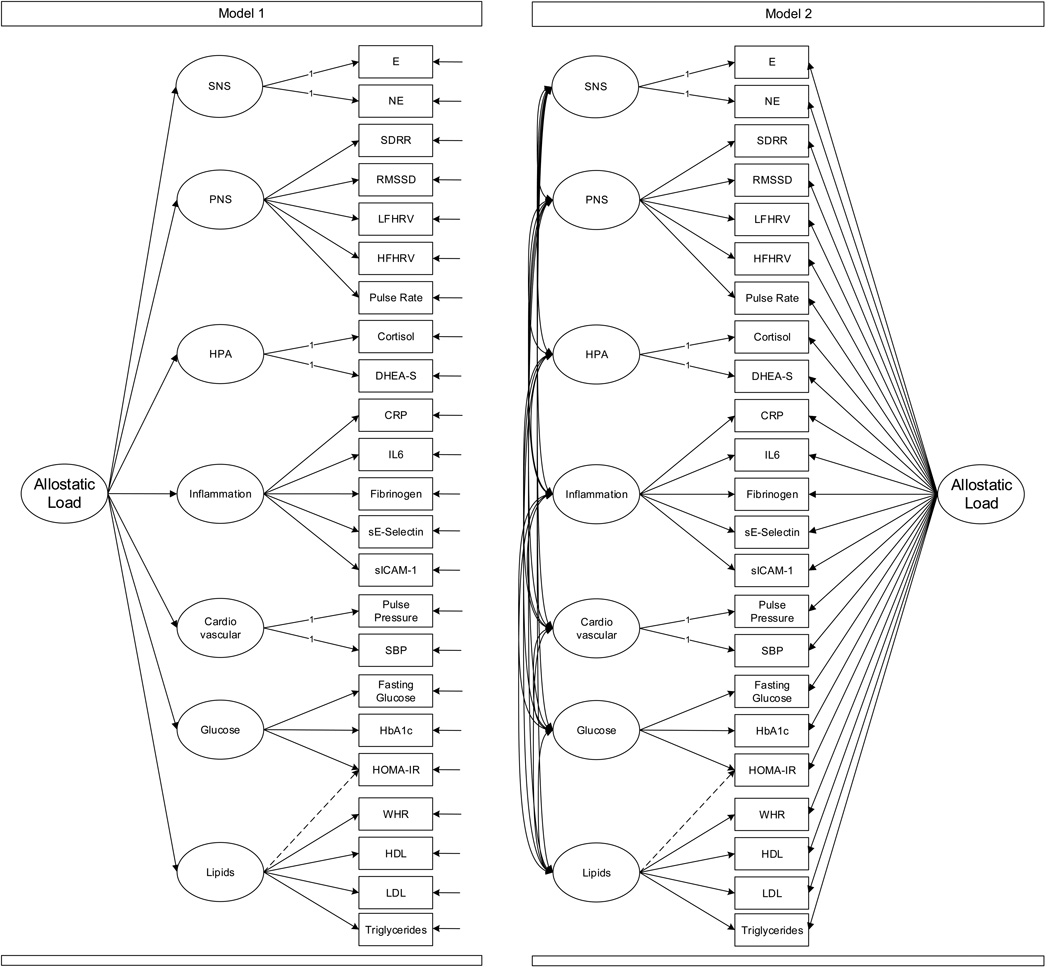
Objectives: The purposes of this study were to compare the relative fit of two alternative factor models of allostatic load (AL) and physiological systems, and to test factor invariance across age and sex.
Methods: Data were from the Midlife in the United States II Biomarker Project, a large (n = 1255) multisite study of adults aged 34 to 84 years (56.8% women). Specifically, 23 biomarkers were included, representing seven physiological systems: metabolic lipids, metabolic glucose, blood pressure, parasympathetic nervous system, sympathetic nervous system, hypothalamic-pituitary-adrenal axis, and inflammation. For factor invariance tests, age was categorized into three groups (≤45, 45-60, and >60 years).
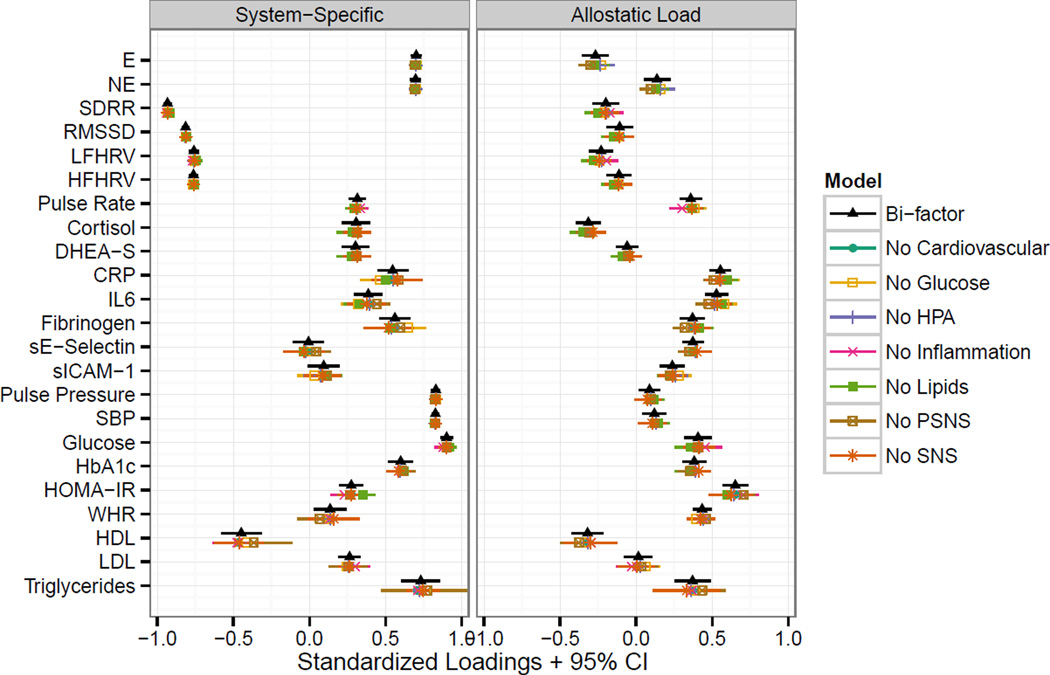
Results: A bifactor model where biomarkers simultaneously load onto a common AL factor and seven unique system-specific factors provided the best fit to the biomarker data (comparative fit index = 0.967, root mean square error of approximation = 0.043, standardized root mean square residual = 0.028). Results from the bifactor model were consistent with invariance across age groups and sex.
Conclusions: These results support the theory that represents and operationalizes AL as multisystem physiological dysregulation and operationalizing AL as the shared variance across biomarkers. Results also demonstrate that in addition to the variance in biomarkers accounted for by AL, individual physiological systems account for unique variance in system-specific biomarkers. A bifactor model allows researchers greater precision to examine both AL and the unique effects of specific systems.
Conflict of interest statement
The authors declare no conflicts of interest.
Figures
Comment in
-
Considering the Appropriateness of the Factor Analytic Operationalization of Allostatic Load.Psychosom Med. 2017 Jan;79(1):117-119. doi: 10.1097/PSY.0000000000000415. Psychosom Med. 2017. PMID: 27806020 Free PMC article. No abstract available.
-
Mitochondrial Nexus to Allostatic Load Biomarkers.Psychosom Med. 2017 Jan;79(1):114-117. doi: 10.1097/PSY.0000000000000414. Psychosom Med. 2017. PMID: 27806021 Free PMC article. No abstract available.
-
The Authors Reply: Pursuing the Optimal Operationalization of Allostatic Load.Psychosom Med. 2017 Jan;79(1):119-121. doi: 10.1097/PSY.0000000000000416. Psychosom Med. 2017. PMID: 27806022 Free PMC article. No abstract available.
References
-
- Cohen S, Herbert TB. Health psychology: Psychological factors and physical disease from the perspective of human psychoneuroimmunology. Annu Rev Psychol. 1996;47:113–142. - PubMed
-
- Uchino BN, Cacioppo JT, Kiecolt-Glaser JK. The relationship between social support and physiological processes: A review with emphasis on underlying mechanisms and implications for health. Psychological Bulletin. 1996;119:488–531. - PubMed
-
- Krantz DS, Manuck SB. Acute psychophysiologic reactivity and risk of cardiovascular disease: A review and methodologic critique. Psychological Bulletin. 1984;96:435. - PubMed
-
- Karlamangla AS, Singer BH, Seeman TE. Reduction in allostatic load in older adults is associated with lower all-cause mortality risk: MacArthur studies of successful aging. Psychosomatic Medicine. 2006;68:500–507. - PubMed
Publication types
MeSH terms
Substances
Grants and funding
LinkOut - more resources
Full Text Sources
Other Literature Sources