Comparative Study
. 2016 Jan 26;7(4):4414-27.
doi: 10.18632/oncotarget.6780.

GNA13 as a prognostic factor and mediator of gastric cancer progression

Affiliations
Comparative Study

GNA13 as a prognostic factor and mediator of gastric cancer progression

Jia-Xing Zhang et al. Oncotarget. .

Abstract

Guanine nucleotide binding protein (G protein), alpha 13 (GNA13) has been implicated as an oncogenic protein in several human cancers. In this study, GNA13 was characterized for its role in gastric cancer (GC) progression and underlying molecular mechanisms. The expression dynamics of GNA13 were examined by immunohistochemistry (IHC) in two independent cohorts of GC samples. A series of in-vivo and in-vitro assays was performed to elucidate the function of GNA13 in GC and its underlying mechanisms. In both two cohorts of GC samples, we observed that GNA13 was markedly overexpressed in GC tissues and associated closely with aggressive magnitude of GC progression and poor patients' survival. Further study showed that upregulation of GNA13 expression increased the proliferation and tumorigenicity of GC cells in vitro and in vivo, by promoting cell growth rate, colony formation, and tumor formation in nude mice. By contrast, knockdown of GNA13 effectively suppressed the proliferation and tumorigenicity of GC cells in vitro and in vivo. Our results also demonstrated that the molecular mechanisms of the effect of GNA13 in GC included promotion of G1/S cell cycle transition through upregulation of c-Myc, activation of AKT and ERK activity, suppression of FOXO1 activity, upregulation of cyclin-dependent kinase (CDK) regulator cyclin D1 and downregulation of CDK inhibitor p21Cip1 and p27Kip1. Our present study illustrated that GNA13 has an important role in promoting proliferation and tumorigenicity of GC, and may represent a novel prognostic biomarker and therapeutic target for this disease.

Keywords: GNA13; gastric cancer; proliferation; tumorigenicity.


Conflict of interest statement

CONFLICTS OF INTEREST

No conflicts of interest were declared

Figures
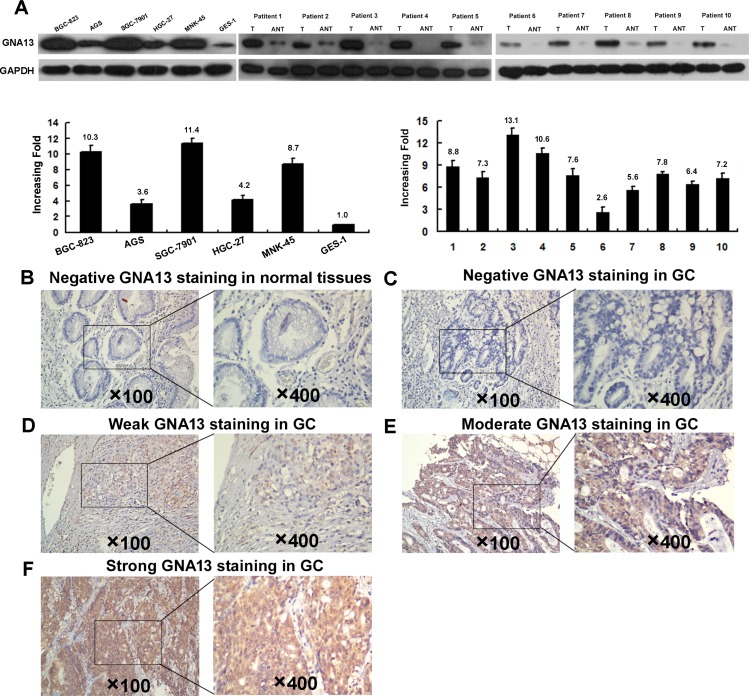
Figure 1
Figure 1. Western blotting, qPCR and IHC assay of the expression pattern of GNA13 in GC tissues and cell lines
(A) Left panel: Western blotting (upper) and qPCR (lower) assay of GNA13 expression in GSE1 and 5 GC cell lines; Right panle: Western blotting (upper) and qPCR (lower) analysis of GNA13 protein expression in 10 pairs of matched GC tissues (T) and adjacent noncancerous tissues (ANT). GAPDH was used as a loading control. Representative image of negative GNA13 IHC staining (Scoring intensity = 0) (B) in normal gastric tissues. Representative images of weak (Scoring intensity = 1) (C), moderate (Scoring intensity = 2) (D) and strong (Scoring intensity = 3) (E) GNA13 IHC staining in GC tissues is shown.
Figure 2
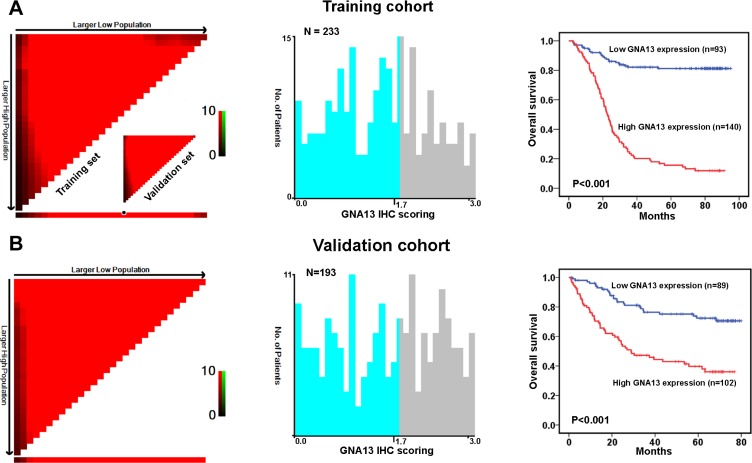
Figure 2. X-tile plots of the prognostic marker of GNA13 in the GC cohorts
X-tile analysis was carried out on patient data from the training cohort, equally subdivided into training and validation subsets. X-tile plots of training sets are displayed in the left panels, with matched validation sets in the smaller inset. The plot showed the χ2 log-rank values created when the cohort was divided into two populations. The cut point was demonstrated on a histogram of the entire cohort (middle panels) and a Kaplan–Meier plot (right panels). P values were defined by using the cut point derived from a training subset to parse a separate validation subset. (A) GNA13 expression was divided at the optimal cut point, as defined by the most significant on the plot (with positive staining of GNA13; P < 0.001). (B) The optimal cut point for GNA13 expression determined by X-tile plot of the testing cohort was applied to the validation cohort and reached high statistical significance (P < 0.001).
Figure 3
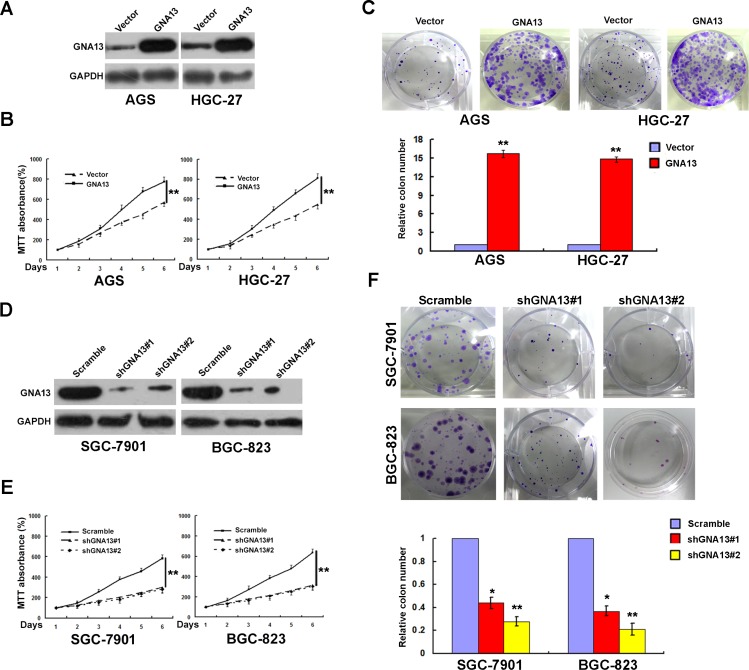
Figure 3. GNA13 promotes human GC cell growth and proliferation in vitro
(A) Ectopic expression of GNA13 in AGS and HGC-27 cells analyzed by western blotting. (B and C) Ectopic expression of GNA13 promoted proliferation ability of AGS and HGC-27 cell as determined by MTT assays (B) and colony formation assays (C). (D) Knockdown of endogenous GNA13 in specific shRNA transduced stable SGC-7901 and BGC-823 cells. (E and F), knockdown of GNA13 inhibits cell growth as determined by MTT assays (E) and colony formation assays (F). *P < 0.05; **P < 0.01.
Figure 4
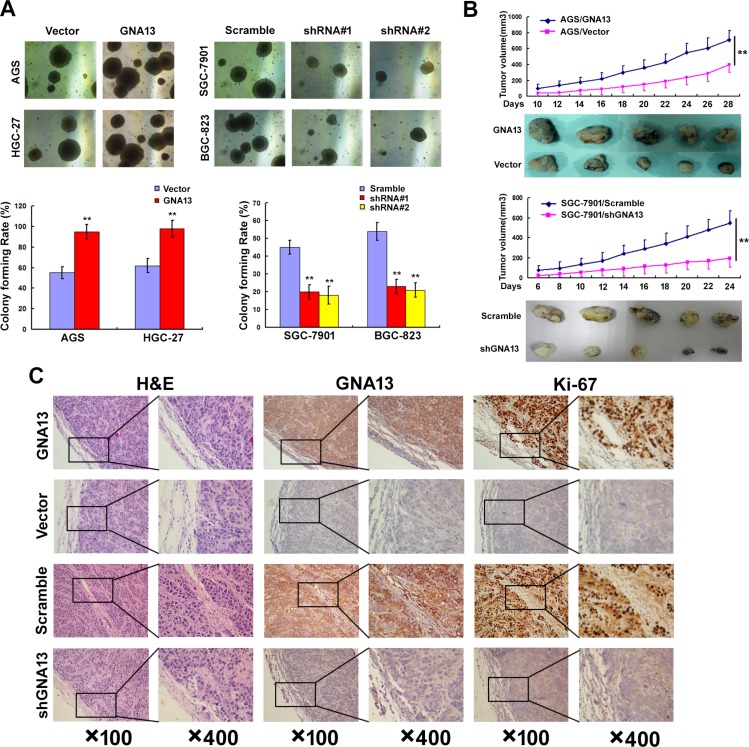
Figure 4. GNA13 promotes the tumorigenicity of GC cells in vitro and in vivo
(A) Anchorage-independent growth assay in GNA13-overexpressing cells (Left) and GNA13-silenced cells (Right). Soft agar colony formation (colonies larger than 0.1 mm diameter) was quantified after 14 days of culture (Lower panel). (B) AGS/GNA13 and AGS/Vector cells, and SGC-7901/shGNA13 and SGC-7901/scramble cells were injected in the hindlimbs of nude mice (n = 5). Tumor volumes were measured on the indicated days. (C) Histopathology of xenograft tumors. The tumor sections were under H&E staining and IHC staining using antibodies against GNA13 and Ki-67. *P < 0.05; **P < 0.01.
Figure 5
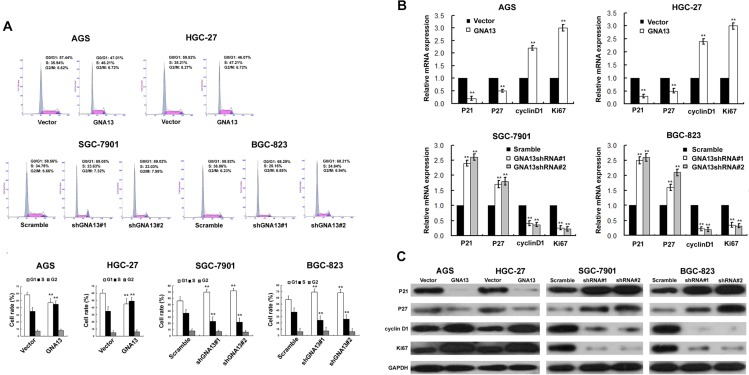
Figure 5. The effect of GNA13 on cell cycle of distribution and G1–S-phase regulators of GC cells
(A) Upper: representative histograms depicting cell cycle profiles of indicated cells. Cells were stained with PI and analyzed by flow cytometry. Lower: proportion of cells in various phases of the cell cycle. (B) Real-time PCR analysis of p21Cip1, p27Kip1, Ki67, and cyclinD1 mRNA expression in GNA13-transduced cells (upper panel) or GNA13 shRNA–infected cells (lower panel). Expression levels were normalized to GAPDH. (C) Western blot analysis of p21Cip1, p27Kip1, cyclin D1, and Ki67 proteins in GNA13-transduced cells or GNA13 shRNA–infected cells. GAPDH was used as a loading control. *P < 0.05; **P < 0.01.
Figure 6
Figure 6. GNA13 downregulates FOXO1 transcriptional activity via activation of the PI3K/AKT and MAPK/ERK signaling pathway
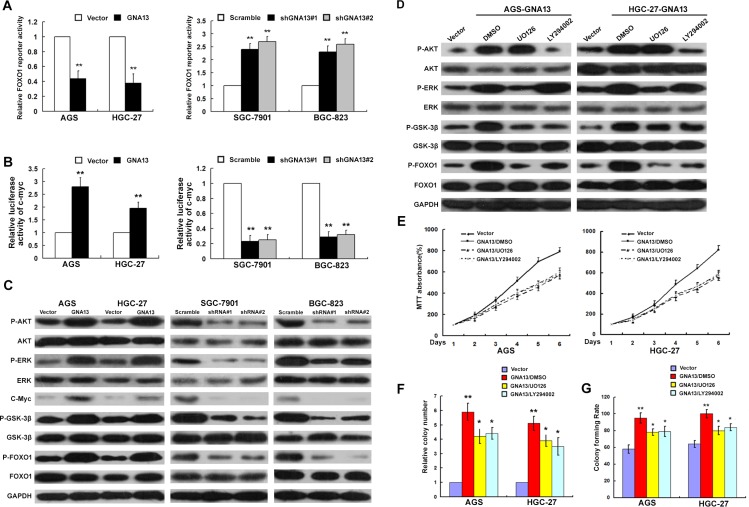
(A and B) Related FOXO1 reporter activity (A) and c-Myc reporter activity (B) in GNA13-transduced cells or GNA13 shRNA–infected cells. (C), Western blot analysis of p-AKT, total AKT, p-ERK, total ERK, c-Myc, p-GSK-3β, total GSK-3β, p-FOXO1, and total FOXO1 in GNA13-transduced cells or GNA13 shRNA–infected cells. (D) AGS/GNA13 and HGC-27/GNA13 cells were treated with the AKT inhibitor LY294002 (20 lM), the ERK kinase inhibitor U0126 (20 lM) or DMSO for 24 h, then harvested to examine the expression levels of the indicated proteins by Western blotting. (E, F and G) AGS/GNA13 and HGC-27/GNA13 proliferation and tumorigenicity were determined by MTT (E), colony formation assays (F) and anchorage-independent growth assay (G) after treatment with LY294002, U0126 or DMSO. *P < 0.05; **P < 0.01.

References

    1. Jemal A, Bray F, Center MM, Ferlay J, Ward E, Forman D. Global cancer statistics. CA. 2011;61:69–90. - PubMed
    1. Lee KJ, Inoue M, Otani T, Iwasaki M, Sasazuki S, Tsugane S, Group JS. Gastric cancer screening and subsequent risk of gastric cancer: a large-scale population-based cohort study, with a 13-year follow-up in Japan. International journal of cancer. 2006;118:2315–2321. - PubMed
    1. Coupland VH, Lagergren J, Luchtenborg M, Jack RH, Allum W, Holmberg L, Hanna GB, Pearce N, Moller H. Hospital volume, proportion resected and mortality from oesophageal and gastric cancer: a population-based study in England, 2004–2008. Gut. 2013;62:961–966. - PubMed
    1. Chen CN, Lin JJ, Chen JJ, Lee PH, Yang CY, Kuo ML, Chang KJ, Hsieh FJ. Gene expression profile predicts patient survival of gastric cancer after surgical resection. Journal of clinical oncology. 2005;23:7286–7295. - PubMed
    1. Li S, Zhu X, Liu B, Wang G, Ao P. Endogenous molecular network reveals two mechanisms of heterogeneity within gastric cancer. Oncotarget. 2015;6:13607–13627. doi: 10.18632/oncotarget.3633. - DOI - PMC - PubMed

Publication types

MeSH terms

Substances