


Blood Lead and Other Metal Biomarkers as Risk Factors for Cardiovascular Disease Mortality
- PMID: 26735529
- PMCID: PMC4706249
- DOI: 10.1097/MD.0000000000002223
Blood Lead and Other Metal Biomarkers as Risk Factors for Cardiovascular Disease Mortality
Erratum in
- Medicine (Baltimore). 2016 Jan;95(4):e66b6
-
Erratum: Blood Lead and Other Metal Biomarkers as Risk Factors for Cardiovascular Disease Mortality: Erratum.Medicine (Baltimore). 2016 Jan 29;95(4):e66b6. doi: 10.1097/01.md.0000479945.79166.b6. eCollection 2016 Jan. Medicine (Baltimore). 2016. PMID: 31265642 Free PMC article.
-
Erratum: Blood lead and other metal biomarkers as risk factors for cardiovascular disease mortality: Erratum.Medicine (Baltimore). 2017 Sep 1;96(35):e7997. doi: 10.1097/MD.0000000000007997. eCollection 2017 Sep. Medicine (Baltimore). 2017. PMID: 31305710 Free PMC article.
Abstract
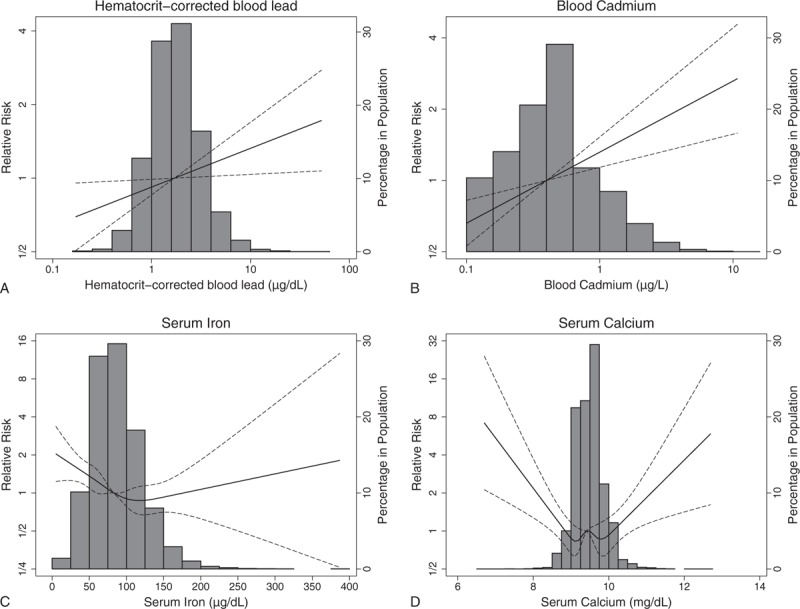
Analyses of the Third National Health and Nutrition Examination Survey (NHANES III) in 1988 to 1994 found an association of increasing blood lead levels < 10 μg/dL with a higher risk of cardiovascular disease (CVD) mortality. The potential need to correct blood lead for hematocrit/hemoglobin and adjust for biomarkers for other metals, for example, cadmium and iron, had not been addressed in the previous NHANES III-based studies on blood lead-CVD mortality association. We analyzed 1999 to 2010 NHANES data for 18,602 participants who had a blood lead measurement, were ≥ 40 years of age at the baseline examination and were followed for mortality through 2011. We calculated the relative risk for CVD mortality as a function of hemoglobin- or hematocrit-corrected log-transformed blood lead through Cox proportional hazard regression analysis with adjustment for serum iron, blood cadmium, serum C-reactive protein, serum calcium, smoking, alcohol intake, race/Hispanic origin, and sex. The adjusted relative risk for CVD mortality was 1.44 (95% confidence interval = 1.05, 1.98) per 10-fold increase in hematocrit-corrected blood lead with little evidence of nonlinearity. Similar results were obtained with hemoglobin-corrected blood lead. Not correcting blood lead for hematocrit/hemoglobin resulted in underestimation of the lead-CVD mortality association while not adjusting for iron status and blood cadmium resulted in overestimation of the lead-CVD mortality association. In a nationally representative sample of U.S. adults, log-transformed blood lead was linearly associated with increased CVD mortality. Correcting blood lead for hematocrit/hemoglobin and adjustments for some biomarkers affected the association.
Conflict of interest statement
The authors have no funding and conflicts of interest to disclose.
Figures
References
-
- ATSDR. Toxicological Profile for Lead. http://www.atsdr.cdc.gov/toxprofiles/tp13.pdf. Published August, 2007. Accessed November 14, 2014.
-
- Menke A, Muntner P, Batuman V, et al. Blood lead below 0.48 micromol/L (10 microg/dL) and mortality among US adults. Circulation 2006; 114:1388–1394. - PubMed
-
- Sarnak MJ, Tighiouart H, Manjunath G, et al. Anemia as a risk factor for cardiovascular disease in The Atherosclerosis Risk in Communities (ARIC) study. J Am Coll Cardiol 2002; 40:27–33. - PubMed
-
- deSilva PE. Blood lead levels and the haematocrit correction. Ann Occup Hygiene 1984; 28:417–428. - PubMed
Publication types
MeSH terms
Substances
LinkOut - more resources
Full Text Sources
Other Literature Sources
Research Materials
