. 2016 Jul;41(8):2052-61.
doi: 10.1038/npp.2016.2. Epub 2016 Jan 7.

An mGlu5-Positive Allosteric Modulator Rescues the Neuroplasticity Deficits in a Genetic Model of NMDA Receptor Hypofunction in Schizophrenia

Affiliations

An mGlu5-Positive Allosteric Modulator Rescues the Neuroplasticity Deficits in a Genetic Model of NMDA Receptor Hypofunction in Schizophrenia

Darrick T Balu et al. Neuropsychopharmacology. 2016 Jul.

Abstract

There is substantial evidence that NMDA receptor (NMDAR) hypofunction contributes to the pathophysiology of schizophrenia (SCZ). A recent large-scale genome-wide association study identified serine racemase (SR), the enzyme that produces the NMDAR co-agonist D-serine, as a risk gene for SCZ. Serine racemase knockout (SR-/-) mice, which lack D-serine, exhibit many of the neurochemical and behavioral abnormalities observed in SCZ. Metabotropic glutamate receptor 5 (mGlu5)-positive allosteric modulators (PAMs) are currently being developed to treat cognitive dysfunction. We used in vitro electrophysiology to determine whether the mGlu5 PAM VU0409551 directly enhances NMDAR function in hippocampal slices from adult male SR-/- mice. We administered VU0409551 systemically for 5 days to adult male wild-type C57BL/6 animals to determine the optimal dose to test in SR-/- mice. We used western blot analyses and trace-fear conditioning to determine whether 5 days of VU0409551 treatment could reverse the neuroplasticity and learning deficits, respectively, in SR-/- mice. We show that VU0409551 enhances NMDAR function and rescues long-term potentiation in hippocampal slices obtained from SR-/- mice. Systemic treatment with VU0409551 (10 and 30 mg/kg) to wild-type mice causes a dose-dependent increase in the Akt/GS3Kα/β signaling pathway, which is reduced in SR-/- mice and in SCZ. Furthermore, the administration of VU0409551 to SR-/- mice reverses their deficits in several neuroplasticity signaling pathways and improves their contextual fear memory. These results support positive allosteric modulation of mGlu5, particularly with VU0409551, as a viable mechanism to reverse the deficits in NMDAR function, synaptic plasticity, and memory that are known to be impaired in SCZ.


Figures
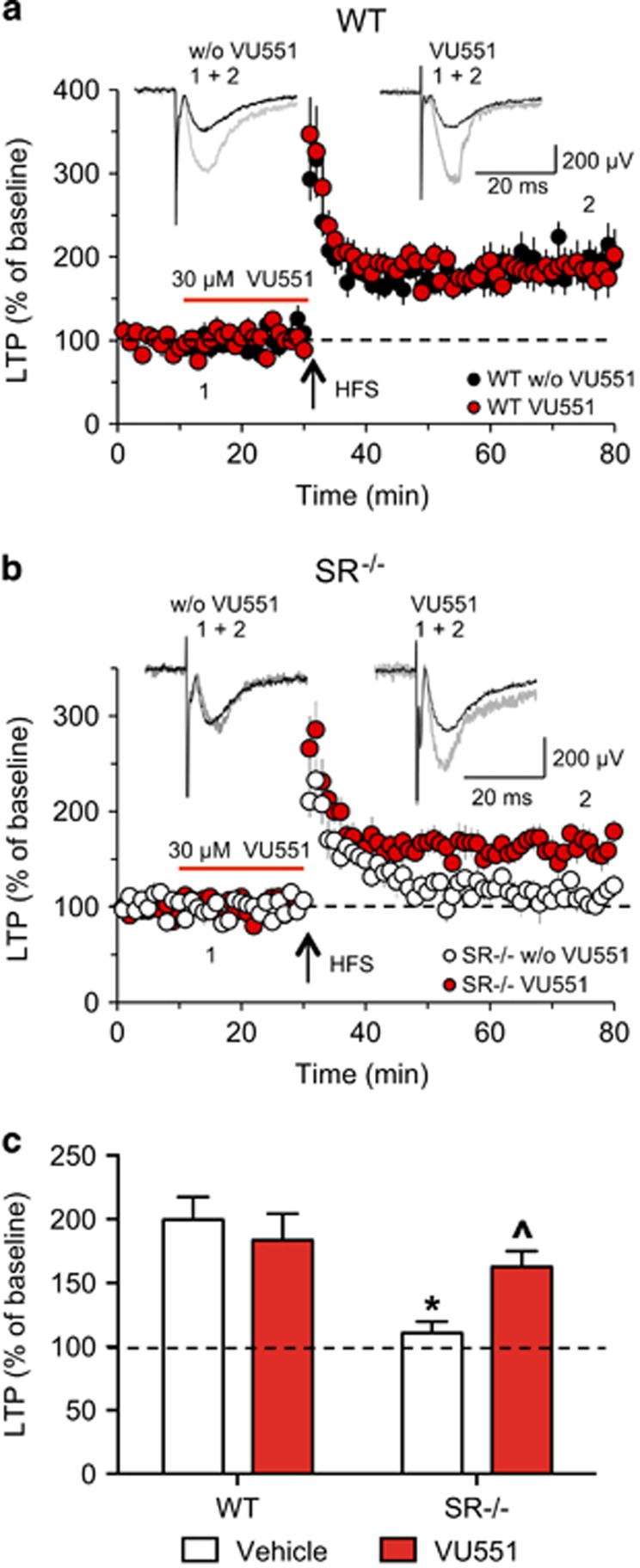
Figure 1
Figure 1
VU0409551 rescues synaptic plasticity deficits in the hippocampus of SR−/− mice. (a) Averaged graphs showing results of LTP experiments performed in slices from WT mice under control conditions (solid black circles, n=6 slices from two WT mice) and after VU551 treatment (red circles, n=7 slices from three WT mice). Insets show averages of 40 fEPSPs before (black trace) and 10 fEPSPs (thick gray trace) 45 min after LTP induction. (b) Results of LTP experiments in untreated slices (open circles, n=7 slices from four SR−/− mice) or slices treated with 30 μm VU0409551 (VU551; red filled circles, n=9 slices from five SR−/− mice). Insets show averages of 60 fEPSPs (black trace) before and 10 fEPSPs (gray trace) 45 min after LTP induction under both conditions (with or without the treatment of slices with VU551). (c) Summary of LTP results for the four experimental groups (white bars, vehicle; red bars, VU551). Data are presented as the mean±SEM. Significant two-way ANOVA results were followed up with Newman–Keuls multiple comparisons tests. Asterisk (*) indicates significant difference from the WT vehicle group (P<0.05) and ^ indicates significant difference from the SR−/− vehicle group. A full color version of this figure is available at the Neuropsychopharmacology journal online.
Figure 2
Figure 2
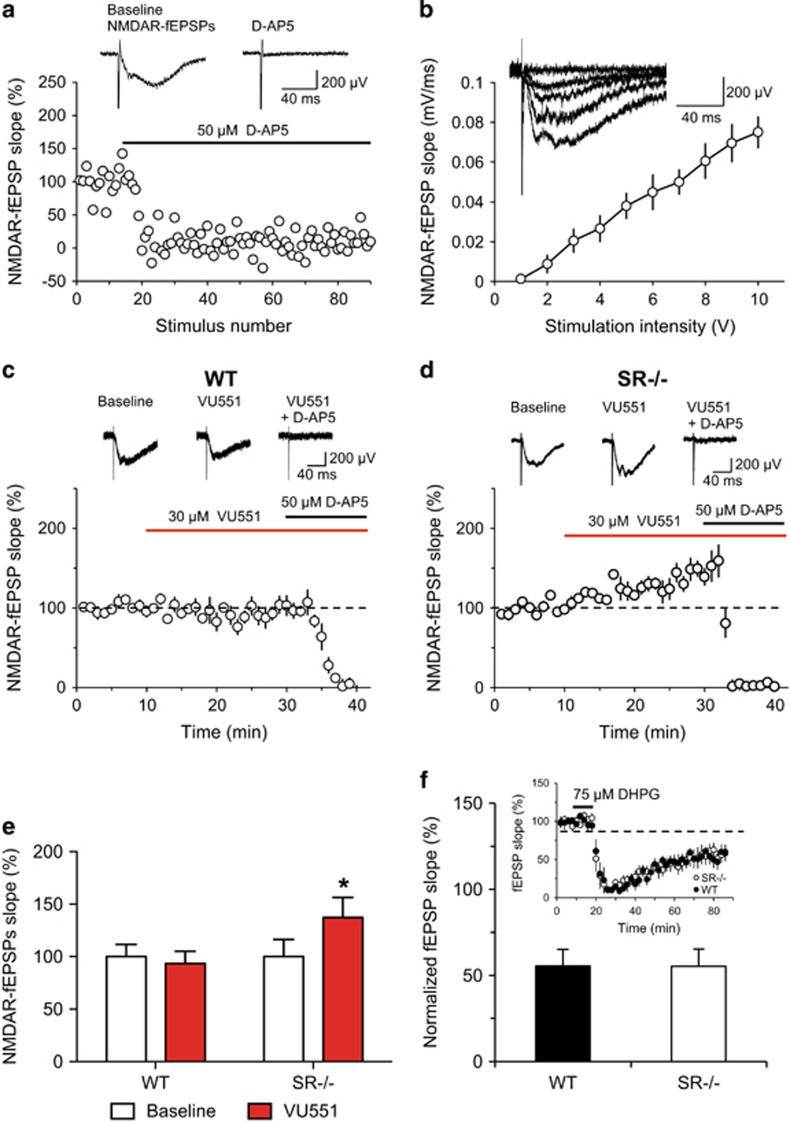
VU0409551 potentiates NMDAR-fEPSPs in SR−/− mice, but not WT mice. (a) Recorded NMDAR-fEPSPs were abolished by the specific NMDAR antagonist D-AP5 (50 μM). Insets show averages 15 NMDAR-fEPSPs during baseline recording (left) and 15 NMDAR-fEPSPs 5 min after the application of NMDAR antagonist (right). (b) The synaptic input–output curve for NMDAR-fEPSPs obtained at CA3–CA1 synapses by presynaptic stimuli of increasing intensity in slices from WT mice (n=5 slices). Inset shows averaged NMDAR-fEPSPs (10 traces) at stimulation intensities of 1, 3, 4, 5 and 7 V. (c) Insets show averages of 20 NMDAR-fEPSPs before (left), 10 fEPSPs 15 min after (middle) the application of VU551, and 10 NMDAR-fEPSPs 5 min after (right) the addition of D-AP5 (50 μM). Summary of VU551 (30 μM) tests in WT mice (n=5 slices from two WT mice). (d) Insets show averages of 20 NMDAR-fEPSPs before (left), 10 NMDAR-fEPSPs 15 min after (middle) the application of VU0409551 (VU551), and 10 NMDAR-fEPSPs 5 min after (right) the addition of the NMDAR antagonist D-AP5 (50 μM). Summary of VU551 (30 μM) tests in SR−/− mice (n=7 slices from three SR−/− mice). (e) Summary of the results for all four groups is shown in c and d; white bars, baseline; red bars, VU551. Significant two-way repeated measures ANOVA results were followed up by Bonferroni's multiple comparisons test to compare groups. (f) Time course of DHPG-induced depression of fEPSPs at CA3–CA1 synapses in slices from WT (n=4 slices from three mice; black bar) and SR−/− mice (n=5 slices from two mice; white bar). Summary of the experiments is shown in inset (averages of fEPSP amplitudes during the last 6 min of recordings). Data are presented as the mean±SEM. Asterisk (*) indicates significant difference from the SR −/− baseline group (P<0.05). A full color version of this figure is available at the Neuropsychopharmacology journal online.
Figure 3
Figure 3
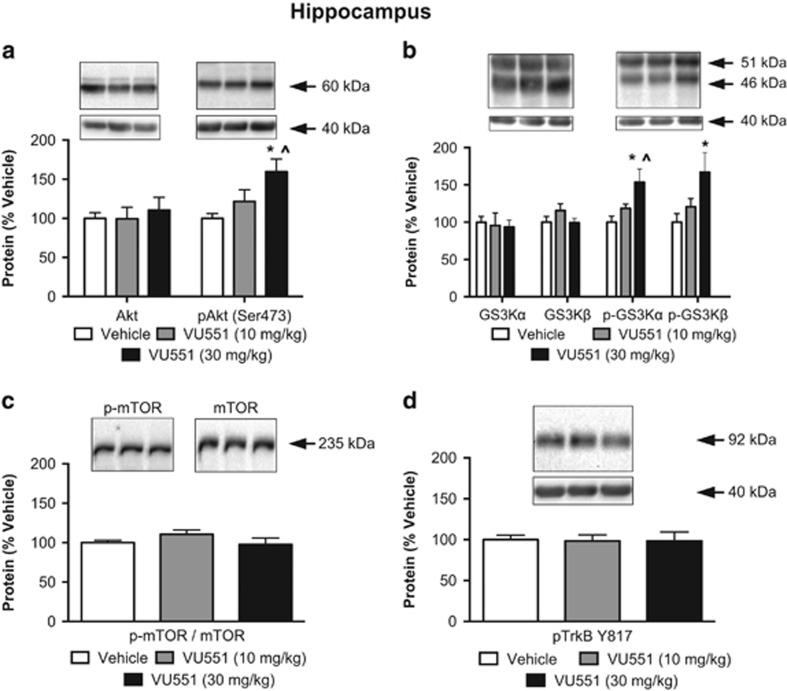
VU0409551 dose-dependently enhances Akt/GS3K signaling in the hippocampus of WT mice. WT mice received 5 days of either vehicle (white bars, n=5) or VU0409551 (VU551: 10 mg/kg, gray bars, n=6; 30 mg/kg, black bars, n=5) and were killed 2 h after the last injection. Protein levels of (a) Akt and p-Akt, Ser 473, (b) glycogen synthase kinase 3 (GS3K) α/β and p-GS3K α/β (α=51 kDa, β=46 kDa), (c) p-mTOR/mTOR, and (d) pTrkB Y817 in the hippocampus. Values are expressed as the optical density (OD) normalized to WT values (%WT). Each western blot image includes a representative band of the protein of interest and β-actin (41 kDa) from each of the experimental groups: vehicle, VU551 (10 mg/kg), VU551 (30 mg/kg), respectively. Significant one-way ANOVA results were followed up by Newman–Keuls multiple comparison test. Asterisk (*) indicates significant differences from the vehicle group (P<0.05) and ^indicates difference from 10 mg/kg VU551. All values represent the mean±SEM.
Figure 4
Figure 4
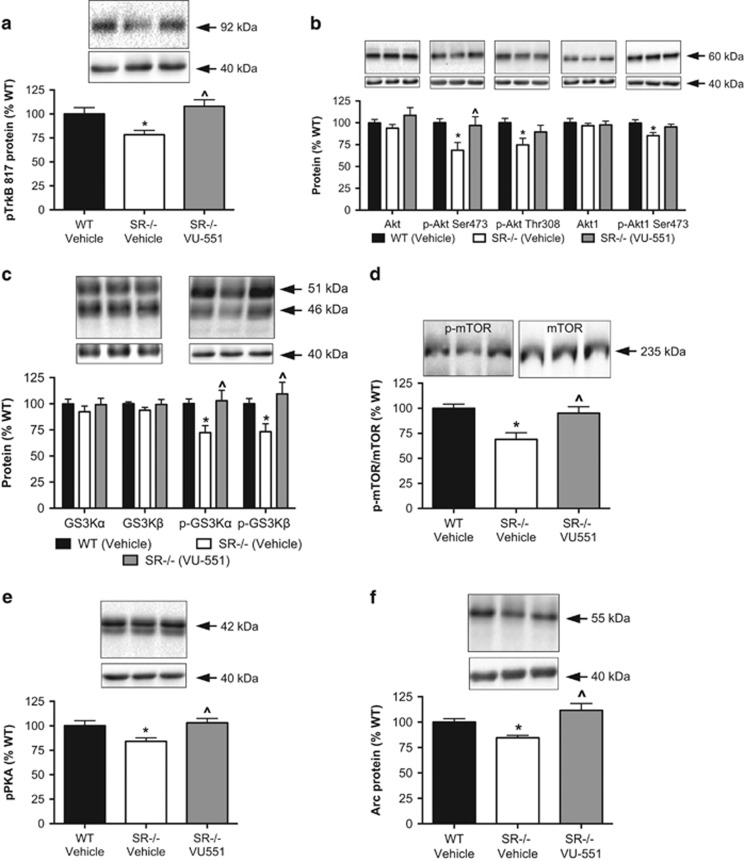
Chronic VU0409551 treatment rescues the hippocampal neurochemical deficits in SR−/− mice. WT (n=10) and SR−/− (n=7–8) mice received 5 days of either vehicle or VU0409551 (VU551; 30 mg/kg; i.p.) and were killed 2 h after the last injection. Protein levels of (a) phosphorylated tropomysin receptor kinase B (pTrkB) Tyr817, (b) Akt, p-Akt Ser473, and p-Akt Thr308, Akt1, p-Akt1 Ser473, (c) glycogen synthase kinase 3 (GS3K) α/β and p-GS3K α/β (α=51 kDa, β=46 kDa), (d) p-mTOR Ser2448/mTOR, (e) p-protein kinase A (PKA), and (f) activity-regulated cytoskeleton-associated protein (Arc) were measured in the hippocampus of WT mice (black bars), SR−/− mice (vehicle; white bars), or SR−/− mice treated with VU551 (gray bars) as the optical density normalized to WT values (%WT). Each western blot image includes a representative band of the protein of interest and β-actin (41 kDa) from each of the experimental groups: WT (vehicle), SR−/− 551 (vehicle), SR−/− (VU551), respectively. Asterisk (*) indicates significant difference from the WT vehicle group (P<0.05) and ^ indicates significant difference from the SR−/− vehicle group. Significant one-way ANOVA results were followed up by Newman–Keuls multiple comparison test. All values represent the mean±SEM.
Figure 5
Figure 5
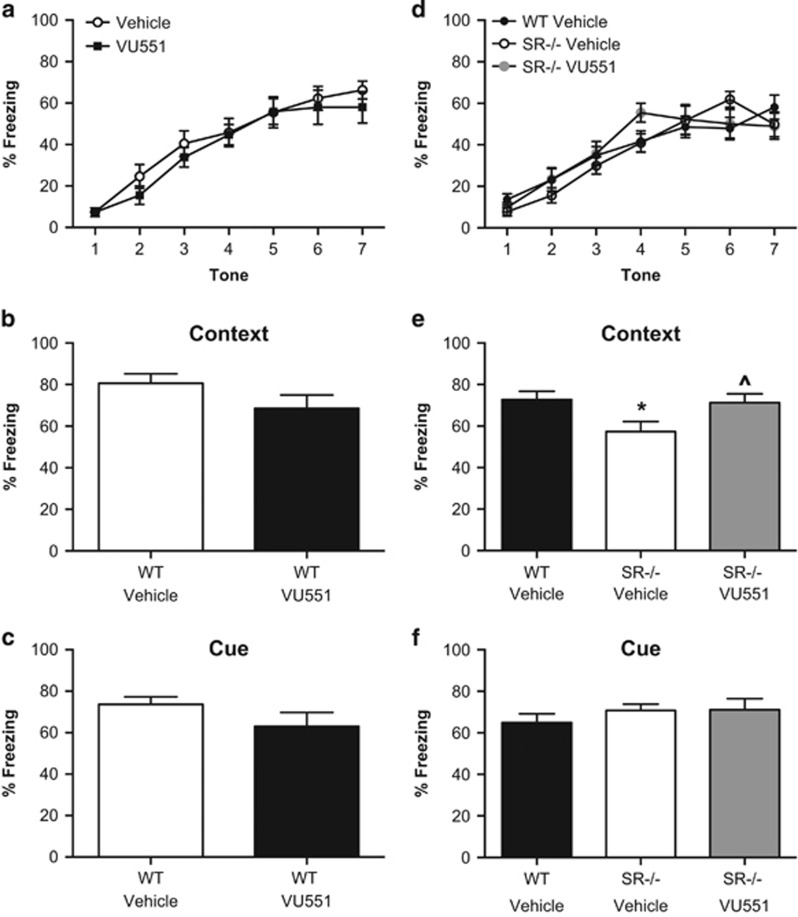
Chronic VU0409551 treatment improves memory in SR−/− mice. WT mice received 5 days of either vehicle (white; n=8) or VU0409551 (VU551; 30 mg/kg, black, n=8) and were subjected to a trace fear-conditioning paradigm during the last 3 days of treatment. Injections were given 2 h before behavioral testing. (a) The amount of freezing during each of the seven tone presentations was measured for each group. (b) The average time animals froze during the first 4 min of being placed in the chamber on day 2. (c) The average time animals froze during the first three tone presentations on day 3. WT (vehicle, black, n=19), SR−/− (vehicle, white, n=13), and SR−/− mice treated with VU551 (30 mg/kg, gray, n=12) were subjected to a trace fear-conditioning paradigm during the last 3 days of treatment. Injections were given 2 h before behavioral testing. (d) The amount of freezing during each of the seven tone presentations was measured for each group. (e) The average time animals froze during the first 4 min of being placed in the chamber on day 2. (f) The average time animals froze during the first three tone presentations on day 3. Significant one-way ANOVA results were followed up by Newman–Keuls multiple comparison test. Asterisk (*) indicates significant difference from the WT vehicle group (P<0.05) and ^ indicates significant difference from the SR−/− vehicle group. All values represent the mean±SEM.

References

    1. Balu DT, Coyle JT (2011. a). Glutamate receptor composition of the post-synaptic density is altered in genetic mouse models of NMDA receptor hypo- and hyperfunction. Brain Res 1392: 1–7. - PMC - PubMed
    1. Balu DT, Coyle JT (2011. b). Neuroplasticity signaling pathways linked to the pathophysiology of schizophrenia. Neurosci Biobehav Rev 35: 848–870. - PMC - PubMed
    1. Balu DT, Coyle JT (2012). Neuronal D-serine regulates dendritic architecture in the somatosensory cortex. Neurosci Lett 517: 77–81. - PMC - PubMed
    1. Balu DT, Coyle JT (2014). Chronic D-serine reverses arc expression and partially rescues dendritic abnormalities in a mouse model of NMDA receptor hypofunction. Neurochem Int 75C: 76–78. - PMC - PubMed
    1. Balu DT, Coyle JT (2015). The NMDA receptor 'glycine modulatory site' in schizophrenia: D-serine, glycine, and beyond. Curr Opin Pharmacol 20C: 109–115. - PMC - PubMed

Publication types

MeSH terms