


How Generalizable Are the Results From Trials of Direct Antiviral Agents to People Coinfected With HIV/HCV in the Real World?
- PMID: 26743093
- PMCID: PMC4787608
- DOI: 10.1093/cid/civ1222
How Generalizable Are the Results From Trials of Direct Antiviral Agents to People Coinfected With HIV/HCV in the Real World?
Abstract
Background: Direct-acting antivirals (DAAs) against hepatitis C virus (HCV) have been described as revolutionary. However, it remains uncertain how effective these drugs will be for individuals coinfected with human immunodeficiency virus (HIV)-HCV. Bridging this gap between efficacy and effectiveness requires a focus on the generalizability of clinical trials.
Methods: Generalizability of DAA trials was assessed by applying the eligibility criteria from 5 efficacy trials: NCT01479868, PHOTON-1 (NCT01667731), TURQUOISE-I (NCT01939197), ION-4 (NCT02073656), and ALLY-2 (NCT02032888) that evaluated simeprevir; sofosbuvir; ombitasvir, paritaprevir/ritonavir/dasabuvir; sofosbuvir/ledipasvir; and daclatasvir/sofosbuvir, respectively, to the Canadian Coinfection Cohort, representing approximately 23% of the total coinfected population in care in Canada.
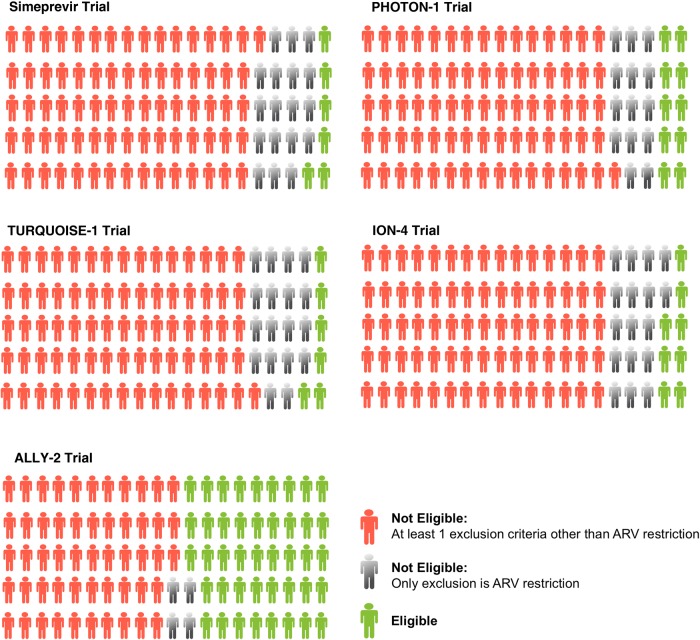
Results: Of 874 active participants, 70% had chronic HCV, of whom 410, 26, 94, and 11 had genotypes 1, 2, 3, and 4, respectively. After applying trial eligibility criteria, only 5.9% (24/410) would have been eligible for enrollment in the simeprevir trial, 9.8% (52/530) in PHOTON-1, 6.3% (26/410) in TURQUOISE-I, and 8.1% (34/421) in ION-4. The ALLY-2 study was more inclusive; 43% (233/541) of the cohort would have been eligible. The most exclusive eligibility criteria across all trials with the exception of ALLY-2 were restriction to specific antiretroviral therapies (63%-79%) and active illicit drug use (53%-55%).
Conclusions: DAA trial results may have limited generalizability, since the majority of coinfected individuals were not eligible to participate. Exclusions appeared to be related to improving treatment outcomes by not including those at higher risk of poor adherence and reinfection--individuals for whom real-world data are urgently needed.
Keywords: HIV–hepatitis C coinfection; clinical trials; direct-acting antivirals; generalizability; people who inject drugs.
© The Author 2016. Published by Oxford University Press for the Infectious Diseases Society of America.
Figures
Comment in
-
Editorial Commentary: Interferon-free Hepatitis C Treatment Efficacy From Clinical Trials Will Translate to "Real World" Outcomes.Clin Infect Dis. 2016 Apr 1;62(7):927-8. doi: 10.1093/cid/civ1227. Epub 2016 Jan 6. Clin Infect Dis. 2016. PMID: 26743092 No abstract available.
-
Treatment of Hepatitis C Virus in HIV-Coinfected Individuals in Real-world Clinical Settings: Results From 2 Large HIV Care Clinics.Clin Infect Dis. 2016 Oct 1;63(7):994-5. doi: 10.1093/cid/ciw447. Epub 2016 Jul 1. Clin Infect Dis. 2016. PMID: 27369322 No abstract available.
-
Evaluating the generalizability of clinical trials of direct-acting antivirals for HIV-hepatitis C virus coinfection.AIDS. 2017 Mar 27;31(6):N11-N12. doi: 10.1097/QAD.0000000000001439. AIDS. 2017. PMID: 28252531 No abstract available.
References
-
- Soriano V, Barreiro P, Sherman KE. The changing epidemiology of liver disease in HIV patients. AIDS Rev 2013; 15:25–31. - PubMed
-
- Weber R, Sabin CA, Friis-Moller N et al. . Liver-related deaths in persons infected with the human immunodeficiency virus: the D:A:D study. Arch Intern Med 2006; 166:1632–41. - PubMed
-
- Salmon-Ceron D, Rosenthal E, Lewden C et al. . Emerging role of hepatocellular carcinoma among liver-related causes of deaths in HIV-infected patients: the French national mortality 2005 study. J Hepatol 2009; 50:736–45. - PubMed
-
- Klein MB, Rollet KC, Saeed S et al. . HIV and hepatitis C virus in Canada: challenges and opportunities for reducing preventable morbidity and mortality. HIV Med 2013; 14:10–20. - PubMed
-
- Labarga P, Soriano V, Vispo ME et al. . Hepatotoxicity of antiretroviral drugs is reduced after successful treatment of chronic hepatitis C in HIV-infected patients. J Infect Dis 2007; 196:670–6. - PubMed
Publication types
MeSH terms
Substances
Associated data
Grants and funding
LinkOut - more resources
Full Text Sources
Other Literature Sources
Medical
Miscellaneous
