


What do pharmaceutical industry professionals in Europe believe about involving patients and the public in research and development of medicines? A qualitative interview study
- PMID: 26743701
- PMCID: PMC4716253
- DOI: 10.1136/bmjopen-2015-008928
What do pharmaceutical industry professionals in Europe believe about involving patients and the public in research and development of medicines? A qualitative interview study
Abstract
Objectives: To explore European-based pharmaceutical industry professionals' beliefs about patient and public involvement (PPI) in medicines research and development (R&D).
Setting: Pharmaceutical companies in the UK, Poland and Spain.
Participants: 21 pharmaceutical industry professionals, four based in the UK, five with pan-European roles, four based in Spain and eight based in Poland.
Method: Qualitative interview study (telephone and face-to-face, semistructured interviews). All interviews were audio taped, translated (where appropriate) and transcribed for analysis using the Framework approach.
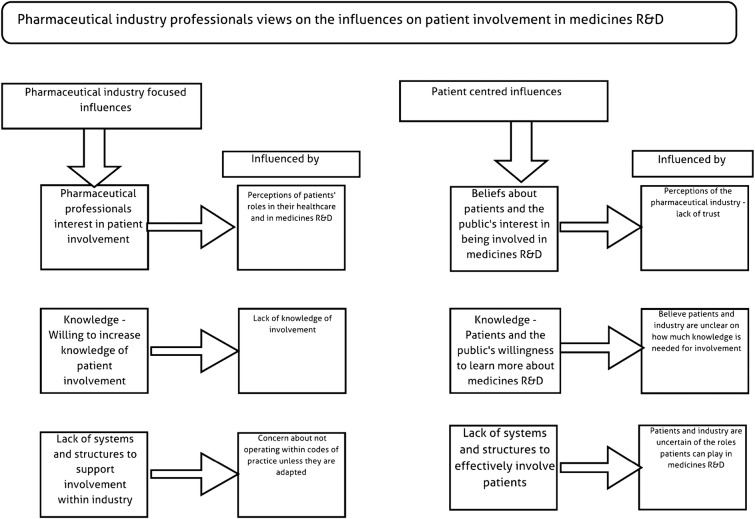
Results: 21 pharmaceutical industry professionals participated. Key themes were: beliefs about (1) whether patients and the public should be involved in medicines R&D; (2) the barriers and facilitators to PPI in medicines R&D and (3) how the current relationships between the pharmaceutical industry, patient organisations and patients influence PPI in medicines R&D.
Conclusions: Although interviewees appeared positive about PPI, many were uncertain about when, how and which patients to involve. Patients and the public's lack of knowledge and interest in medicines R&D, and the pharmaceutical industry's lack of knowledge, interest and receptivity to PPI were believed to be key challenges to increasing PPI. Interviewees also believed that relationships between the pharmaceutical industry, patient organisations, patients and the public needed to change to facilitate PPI in medicines R&D. Existing pharmaceutical industry codes of practice and negative media reporting of the pharmaceutical industry were also seen as negative influences on these relationships.
Keywords: PUBLIC HEALTH; QUALITATIVE RESEARCH; SOCIAL MEDICINE.
Published by the BMJ Publishing Group Limited. For permission to use (where not already granted under a licence) please go to http://www.bmj.com/company/products-services/rights-and-licensing/
Figures
References
-
- Coulter A, Askham J, Parsons S. Where are the patients in decision making about their own care? WHO Regional Office for Europe, 2008:1–14.
Publication types
MeSH terms
LinkOut - more resources
Full Text Sources
Other Literature Sources
