Comparative Study
. 2016 Jan;28(1):146-59.
doi: 10.1105/tpc.15.00303. Epub 2016 Jan 7.

Comparative Analysis of the Flax Immune Receptors L6 and L7 Suggests an Equilibrium-Based Switch Activation Model

Affiliations
Comparative Study

Comparative Analysis of the Flax Immune Receptors L6 and L7 Suggests an Equilibrium-Based Switch Activation Model

Maud Bernoux et al. Plant Cell. 2016 Jan.

Abstract

NOD-like receptors (NLRs) are central components of the plant immune system. L6 is a Toll/interleukin-1 receptor (TIR) domain-containing NLR from flax (Linum usitatissimum) conferring immunity to the flax rust fungus. Comparison of L6 to the weaker allele L7 identified two polymorphic regions in the TIR and the nucleotide binding (NB) domains that regulate both effector ligand-dependent and -independent cell death signaling as well as nucleotide binding to the receptor. This suggests that a negative functional interaction between the TIR and NB domains holds L7 in an inactive/ADP-bound state more tightly than L6, hence decreasing its capacity to adopt the active/ATP-bound state and explaining its weaker activity in planta. L6 and L7 variants with a more stable ADP-bound state failed to bind to AvrL567 in yeast two-hybrid assays, while binding was detected to the signaling active variants. This contrasts with current models predicting that effectors bind to inactive receptors to trigger activation. Based on the correlation between nucleotide binding, effector interaction, and immune signaling properties of L6/L7 variants, we propose that NLRs exist in an equilibrium between ON and OFF states and that effector binding to the ON state stabilizes this conformation, thereby shifting the equilibrium toward the active form of the receptor to trigger defense signaling.


Figures

Figure 1.
Figure 1.
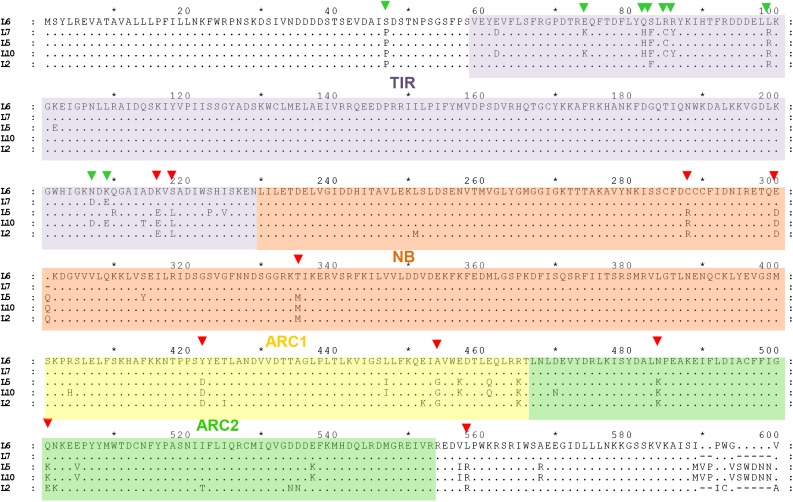
Sequence Alignment of TIR and NB-ARC Domains of L Proteins from Flax. Comparison of L6, L7, L10, L5, and L2 amino acid sequences. Residues identical to the L6 sequence are represented as dots and deleted residues as dashes. TIR, NB, ARC1, and ARC2 domains are defined by purple, orange, yellow, and green boxes, respectively, according to L6 TIR domain and APAF-1 NB-ARC domain structures and sequence alignments with other plant R proteins (Riedl et al., 2005; van Ooijen et al., 2008; Bernoux et al., 2011b). L6/L7 polymorphic residues targeted for mutagenesis are indicated by green arrowheads, and other targeted L polymorphic residues are indicated by red arrowheads.
Figure 2.
Figure 2.
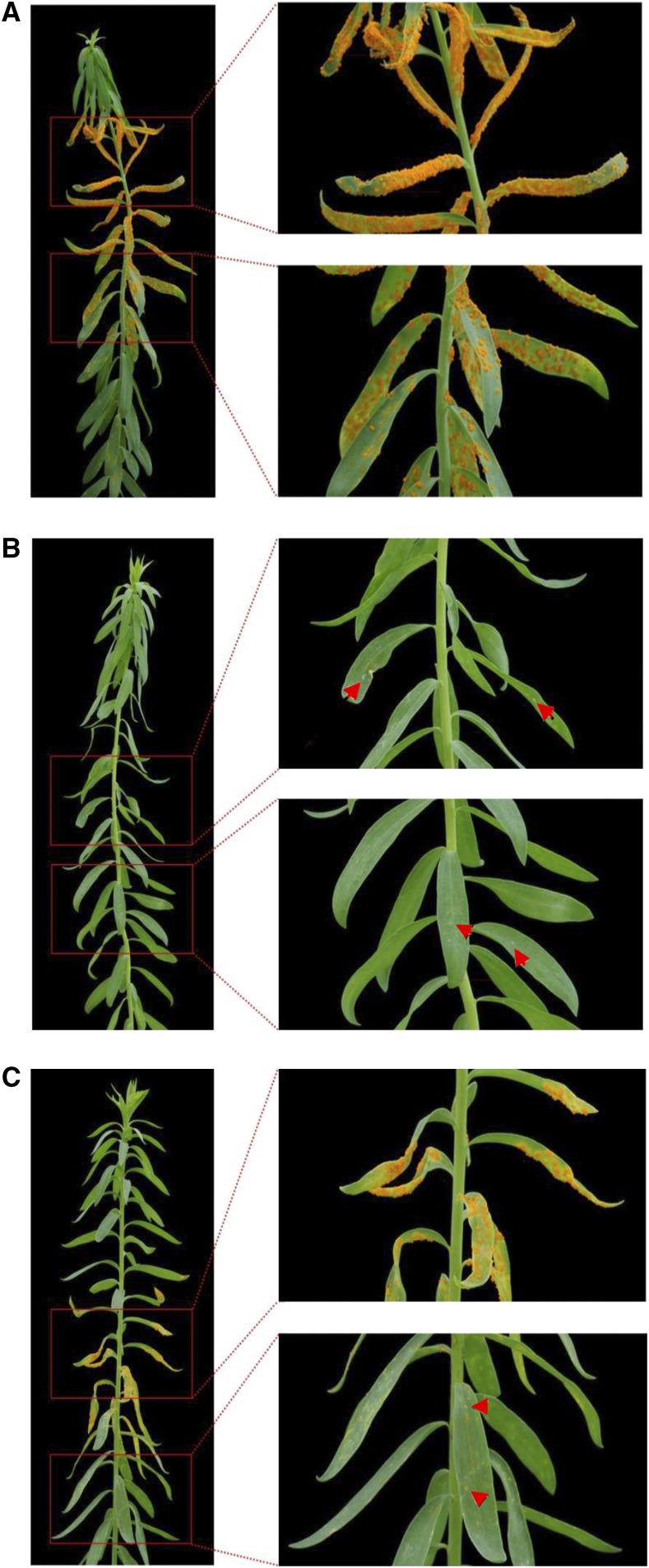
Phenotype Comparison of Rust-Infected L6- and L7-Carrying Flax Plants. Rust disease or resistance phenotype on the flax cultivar Bison (A), a Bison backcross line (x12) containing the L6 gene from Birio (B), and a Bison backcross line (x12) containing the L7 gene from Barnes (C) 14 d after inoculation by the flax rust strain CH5F2-138, which carries an allele of AvrL567, the product of which is recognized by L6 and L7. Zoomed regions of upper leaves and lower leaves (outlined in red) on the right side of each plant show differences in leaf reaction after rust infection (disease = orange pustule development or resistance = hypersensitive white flecks, indicated by red arrowheads).
Figure 3.
Figure 3.
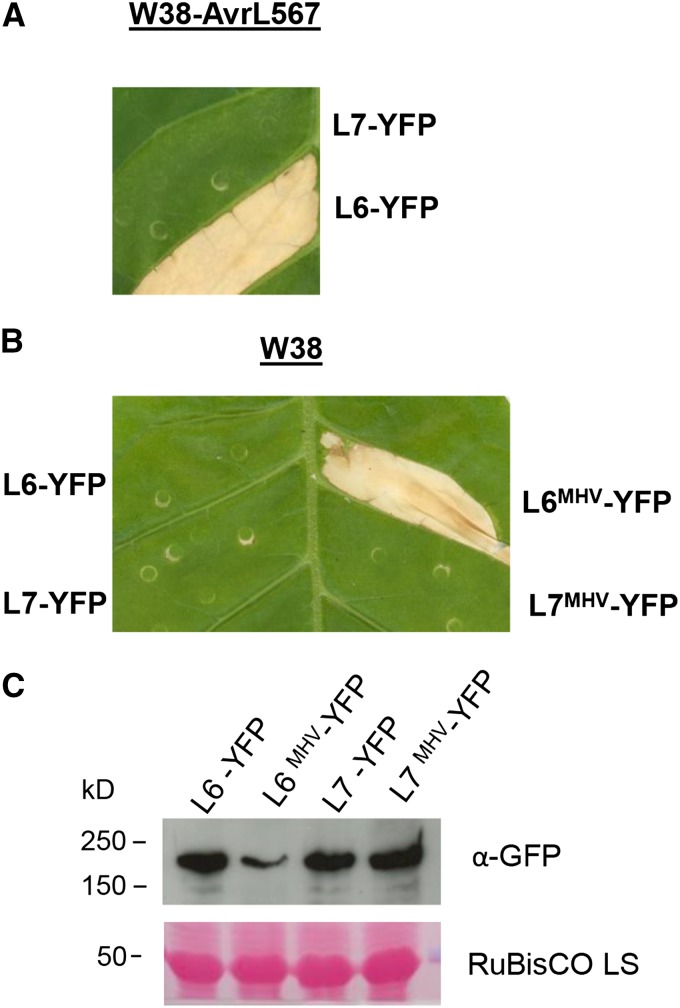
L7 TIR Domain Polymorphisms Prevent Effector-Dependent and -Independent Cell Death Activation. (A) Representative cell death phenotype of L6 and L7 fused to YFP 4 d after agroinfiltration in transgenic tobacco W38 expressing AvrL567. Effector-dependent cell death caused by L6 was visible 30 to 35 h after infiltration. Total number of repeats is indicated in Figure 4B. (B) Representative cell death phenotype of L6MHV and L7MHV fused to YFP 4 d after agroinfiltration in wild-type tobacco W38. Effector-independent cell death caused by L6MHV was visible 30 to 35 h after infiltration. Total number of repeats is indicated in Figure 5A. (C) Immunoblot detection of YFP protein fusions using anti-GFP antibodies. Proteins samples were taken 28 h after agroinfiltration in tobacco W38. Protein loading is indicated by red Ponceau staining of the Rubisco large subunit (LS).
Figure 4.
Figure 4.
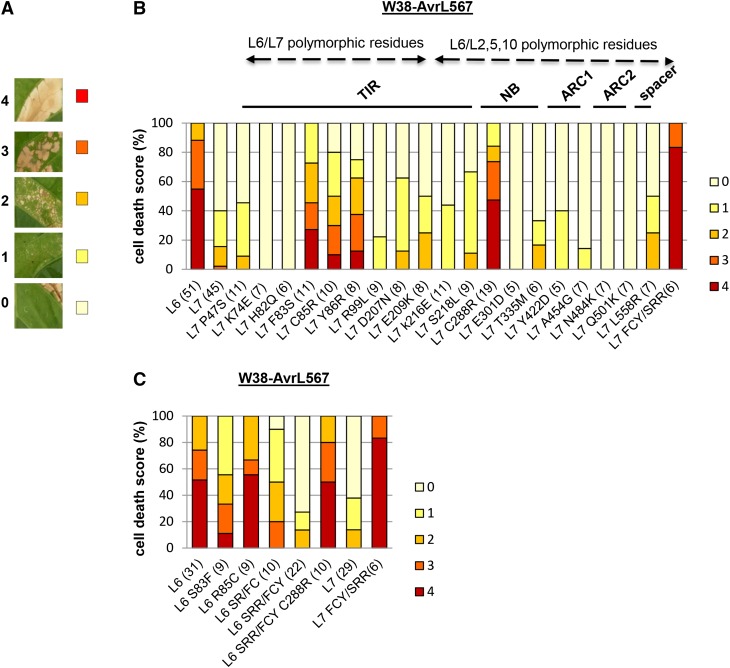
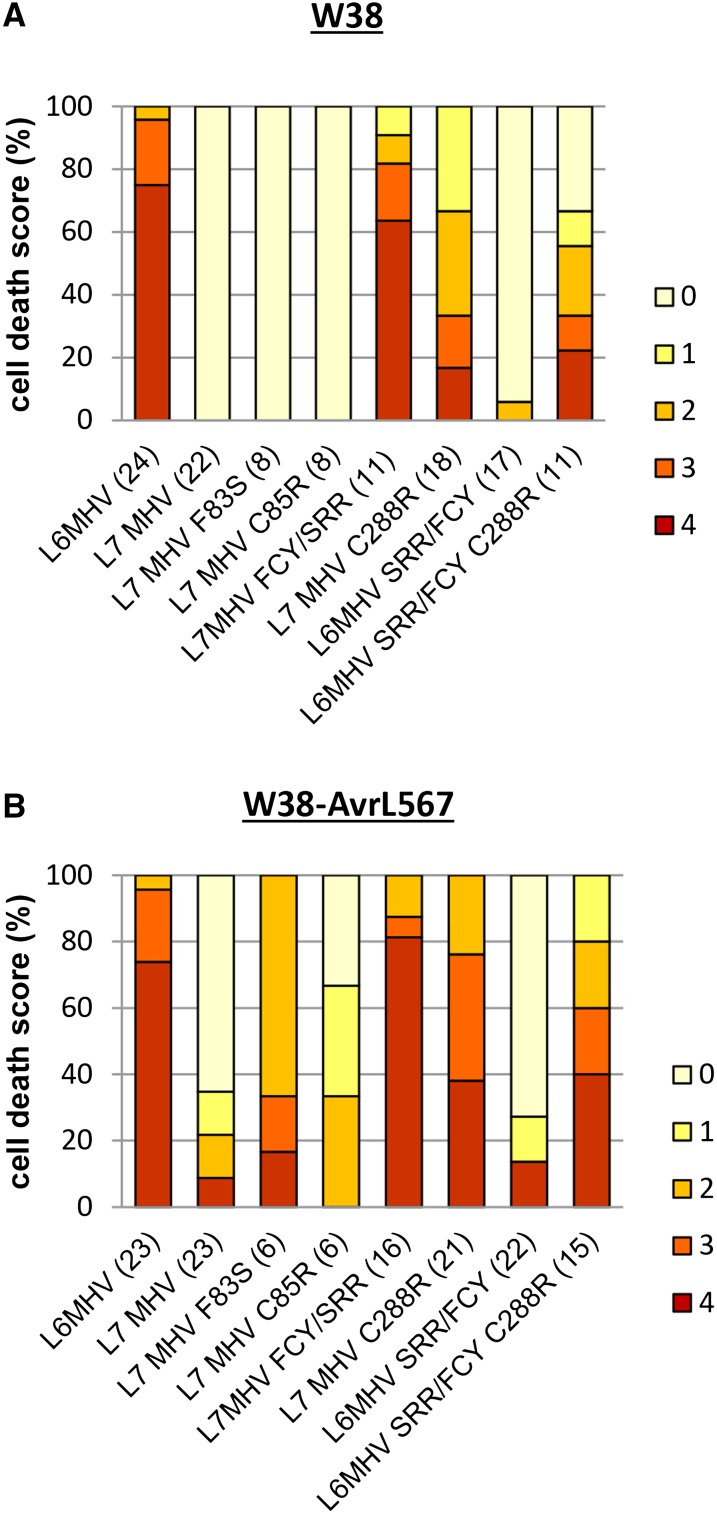
Reciprocal Mutations in the TIR(83,85,86) and NB(288) Regions of L7 and L6 Have Complementary Effects on Effector-Dependent Signaling Activity. (A) Cell death scoring scale from 0 (no cell death, pale-yellow color) to 4 (confluent cell death, red color). (B) Cell death activity of L7 mutants. (C) Cell death activity of L6 mutants. (B) and (C) Graphs representing effector-dependent cell death activity of L7 and L6 mutants, fused to YFP, represented as a percentage of infiltrated panels producing each cell death score (color-coded bars as indicated in [A]) 3 d after infiltration. Each mutant was tested in at least three independent infiltration experiments in transgenic tobacco W38 expressing AvrL567 together with L6 and L7 as controls on the same leaf. For each mutant, the total number of scored leaves is indicated in parentheses following each corresponding construct on the abscissa axis. Location of mutations is indicated above the scoring bars with black straight line defining mutations within the TIR, NB, ARC1, and ARC2 domains or ARC2/LRR spacer region and dashed arrows defining mutations in residues polymorphic between L6 and L7 or polymorphic between L6 and L2, L5, and L10.
Figure 5.
Figure 5.
Reciprocal Mutations in the TIR(83,85,86) and NB(288) Regions of L7 and L6 Have Complementary Effects on Effector-Independent Signaling Activity. Autoactive cell death activity of L6MHV and L7MHV mutants, fused to YFP, represented as a percentage of infiltrated panels producing cell death score (color-coded bars as in Figure 4) 3 d after infiltration. Each mutant was tested in at least six independent infiltration experiments in wild-type W38 tobacco (A) or in transgenic tobacco W38 expressing AvrL567 (B), together with L6MHV and L7MHV as controls on the same leaf. For each mutant, the total number of scored leaves is indicated in parentheses following each corresponding construct on the abscissa axis.
Figure 6.
Figure 6.
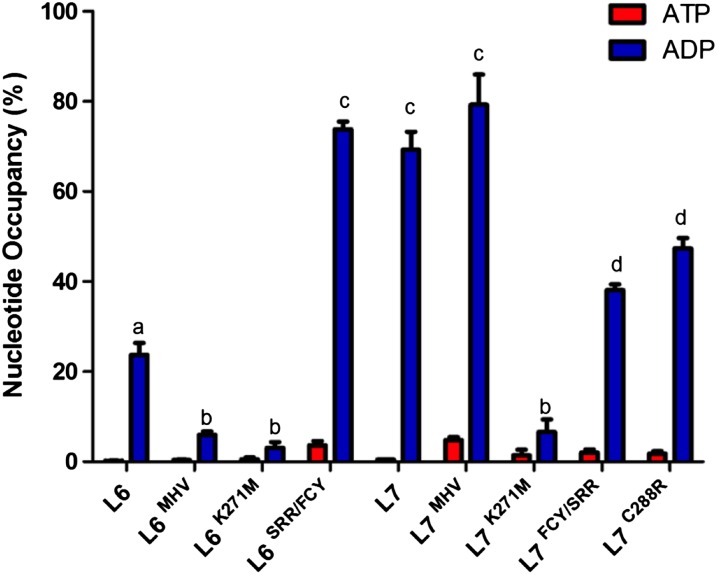
ATP/ADP Quantification of L6, L7, and Their Mutants. The percentage of L6, L7, and mutant proteins occupied by ATP and ADP was determined after NiA purification and concentration. L6K271M and L7K271M P-loop mutants were used as negative controls and confirmed that other copurifying proteins did not contribute to measurements of ATP and ADP. Nucleotide occupancy measurements of all proteins were done in triplicate and recorded with error bars representing 1 sd from the mean. One-way ANOVA, Tukey’s HSD post hoc test, and tests for normality and equal variances have been run and revealed the presence of four statistically different groups for ADP values (a to d). ATP occupancy was negligible in all samples and not significantly different from each other.
Figure 7.
Figure 7.
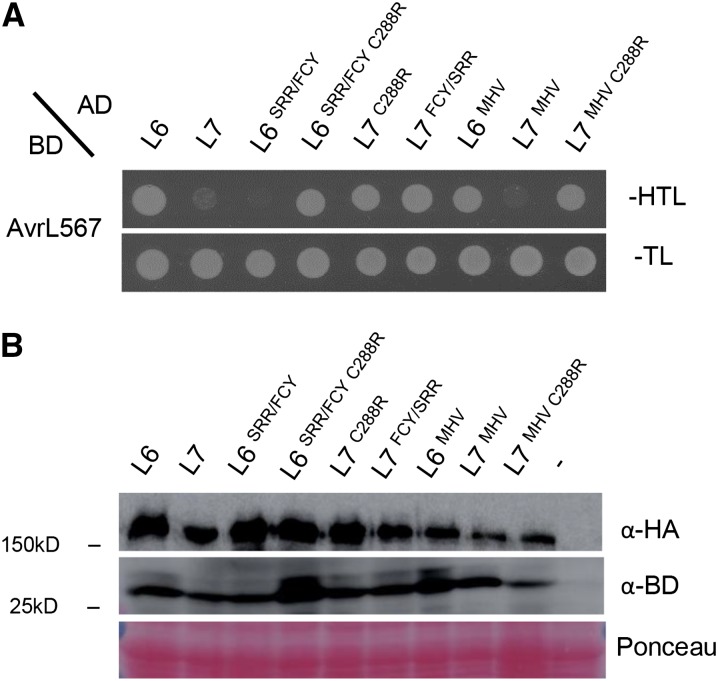
R/Avr Physical Interaction in Yeast. (A) Growth of yeast cells expressing GAL4-BD-AvrL567-A and GAL4-AD fusions of L6 or L7 mutants on nonselective medium lacking tryptophan and leucine (-TL) or selective medium additionally lacking histidine (-HTL). (B) Immunoblot detection of GAL4-BD-AvrL567 fusions and GAL4-AD fusions of L6 or L7 mutants using anti-BD and anti-HA antibodies, respectively. Protein loading is indicated by red Ponceau staining. The negative control is indicated by a dash and corresponds to untransformed yeast.
Figure 8.
Figure 8.
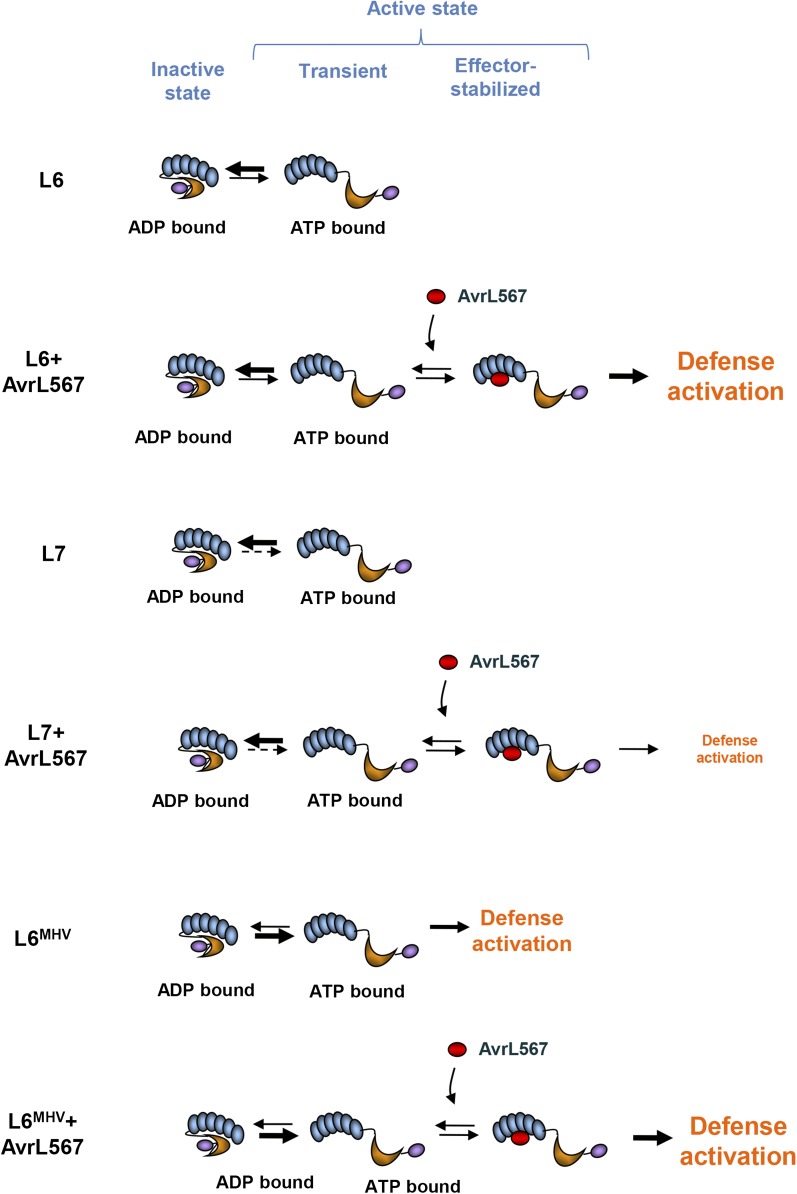
The Equilibrium-Based Switch Activation Model. Cartoon representation of L6 activation compared with L7 and the autoactive mutant L6MHV. The N-terminal TIR domain is represented by a purple oval, the NB-ARC domain by an orange crescent, and LRRs by a series of blue ovals. In the absence of effector, L6 can cycle between an OFF/ADP-bound and ON/ATP-bound state. To avoid inappropriate defense activation, this equilibrium strongly favors the inactive ADP-bound state but allows a small amount of activated ATP-bound receptor (transient state) to be available for effector binding/recognition. Upon effector recognition, effector binding would thus stabilize the active state and shift the equilibrium toward this side of the reaction, thereby leading to defense signaling. In the case of L7, negative interactions between the TIR and NB domains favor the OFF state of the equilibrium relative to that of L6, decreasing the amount of active receptor available and thus inhibiting the defense activation in the presence of the effector. The L6MHV mutant is constitutively active, indicating that the OFF/ON equilibrium is shifted toward the ON state. However, binding of the effector to the transient active state shifts this equilibrium even further to induce a stronger cell death response. The rate of the forward and reverse reactions of the OFF/ON equilibrium are schematically represented by different arrow weights and styles, with bold being greater than solid and solid greater than dashed arrows.

References

    1. Axtell M.J., Staskawicz B.J. (2003). Initiation of RPS2-specified disease resistance in Arabidopsis is coupled to the AvrRpt2-directed elimination of RIN4. Cell 112: 369–377. - PubMed
    1. Bao Q., Riedl S.J., Shi Y. (2005). Structure of Apaf-1 in the auto-inhibited form: a critical role for ADP. Cell Cycle 4: 1001–1003. - PubMed
    1. Bendahmane A., Farnham G., Moffett P., Baulcombe D.C. (2002). Constitutive gain-of-function mutants in a nucleotide binding site-leucine rich repeat protein encoded at the Rx locus of potato. Plant J. 32: 195–204. - PubMed
    1. Bent A.F., Kunkel B.N., Dahlbeck D., Brown K.L., Schmidt R., Giraudat J., Leung J., Staskawicz B.J. (1994). RPS2 of Arabidopsis thaliana: a leucine-rich repeat class of plant disease resistance genes. Science 265: 1856–1860. - PubMed
    1. Bernoux M., Ellis J.G., Dodds P.N. (2011a). New insights in plant immunity signaling activation. Curr. Opin. Plant Biol. 14: 512–518. - PMC - PubMed

Publication types

MeSH terms

LinkOut - more resources