Review
. 2016 Feb;131(2):185-209.
doi: 10.1007/s00401-015-1531-z. Epub 2016 Jan 7.

Host-pathogen interactions in bacterial meningitis

Affiliations
Review

Host-pathogen interactions in bacterial meningitis

Kelly S Doran et al. Acta Neuropathol. 2016 Feb.

Abstract

Bacterial meningitis is a devastating disease occurring worldwide with up to half of the survivors left with permanent neurological sequelae. Due to intrinsic properties of the meningeal pathogens and the host responses they induce, infection can cause relatively specific lesions and clinical syndromes that result from interference with the function of the affected nervous system tissue. Pathogenesis is based on complex host-pathogen interactions, some of which are specific for certain bacteria, whereas others are shared among different pathogens. In this review, we summarize the recent progress made in understanding the molecular and cellular events involved in these interactions. We focus on selected major pathogens, Streptococcus pneumonia, S. agalactiae (Group B Streptococcus), Neisseria meningitidis, and Escherichia coli K1, and also include a neglected zoonotic pathogen, Streptococcus suis. These neuroinvasive pathogens represent common themes of host-pathogen interactions, such as colonization and invasion of mucosal barriers, survival in the blood stream, entry into the central nervous system by translocation of the blood-brain and blood-cerebrospinal fluid barrier, and induction of meningeal inflammation, affecting pia mater, the arachnoid and subarachnoid spaces.

Keywords: Bacterial meningitis; Escherichia coli K1; Group B Streptococcus; Meningococci; Neuroinfectiology; Pneumococci; Streptococcus suis.


Figures

Fig. 1
Fig. 1
Inflammation and neuronal injury in human bacterial meningitis. a Strong infiltration of the right lateral ventricle by granulocytes and monocytes in Neisseria meningitidis meningitis. The double-strand DNA breaks in the nuclei of apoptotic granulocytes are stained black (in situ tailing counterstained with nuclear fast red, ×10). b Macrophage after phagocytosis of apoptotic granulocytes (black, arrowheads) and granulocyte at the beginning of the apoptotic process indicated by partial staining of its nucleus (arrow) (N. meningitidis meningitis, in situ tailing counterstained with nuclear fast red, ×100). c Thrombosis of two small vessels (arrows) and strong perivascular mainly granulocytic infiltrates in the thalamus, Streptococcus pneumoniae meningitis (haematoxylin–eosin, ×20). d Apoptosis of granule cells in the dentate gyrus of the hippocampal formation, otogenic bacterial meningitis (in situ tailing counterstained with nuclear fast red, ×40). e Diffuse axonal injury, S. pneumoniae meningitis (amyloid precursor protein immunohistochemistry, counterstaining with hemalum, ×20). Bars represent 120 μm (a), 12 μm (b), 60 μm (c), 30 μm (d), 60 μm (e)
Fig. 2
Fig. 2
Schematic illustration of the initial steps of the interaction of Neisseria meningitidis with brain endothelial cells. a N. meningitidis adheres to brain microvascular endothelial cells via type IV pili. (b, Detailed) following initial bacterial adhesion, type IV pili (Tfp) mediate the recruitment and the activation of several transmembrane proteins, including ICAM-1 and CD44 as well as accumulation of ezrin and moesin, two members of the ezrin–radixin–moesin protein family. The formation of these so-called ‘cortical plaques’ induces the formation of microvilli-like protrusions that surround the bacteria, protect bacterial colonies from the blood flow shear stress and initiate their internalization within vacuoles. A result of the formation of ‘cortical plaques’ is the replacement of the polarity complex proteins PAR3/PAR6/αPKC that are usually localized at the intercellular junctions. Moreover, the meningococcal Opc protein confers a tight association of the bacterium to fibronectin and/or vitronectin mediating binding to endothelial integrins (light and dark green ovals). This interaction leads to activation of non-receptor tyrosine kinases (Proto-oncogene tyrosine-protein kinase c-Src and focal adhesion kinase (FAK) and receptor tyrosine kinases (ErbB2), resulting in phosphorylation and activation of cortactin and cytoskeletal rearrangement (actin monomers, red globules)
Fig. 3
Fig. 3
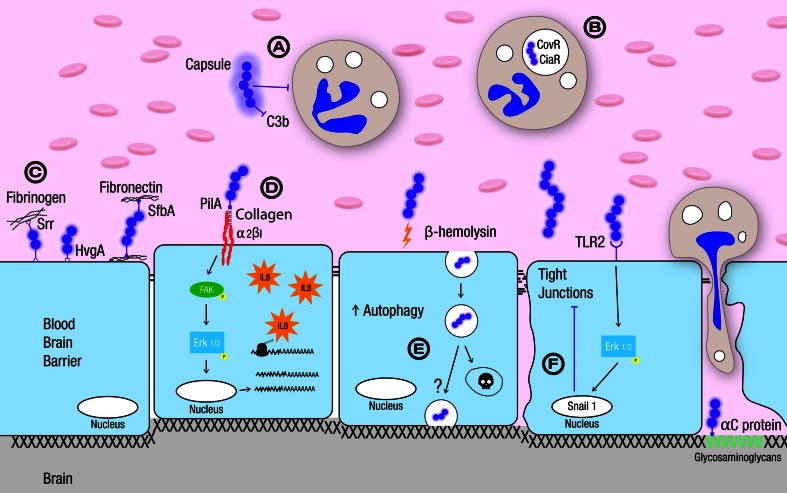
Group B Streptococcus interaction with the blood–brain barrier. a The GBS capsule promotes blood stream survival by preventing deposition of complement and ultimately phagocytosis. b GBS response regulators, CovR and CiaR, have been shown to further promote survival within phagocytic cells which will aid in GBS bloodstream survival. c GBS adhesins Srr, HvgA and SfbA promote GBS interaction with brain microvascular endothelial cells some by associating with extracellular matrix (ECM) components. d Another key GBS adhesin, the pilus tip protein PilA, binds collagen to bridge an interaction with α2β1 integrins on the endothelial cell surface. This initiates bacterial uptake and immune activation. e The GBS β-hemolysin activates brain microvascular endothelial cells including autophagy that may contribute to clearance of GBS by shuttling intracellular bacteria to the lysosome, although the exact mechanism of GBS transcytosis is unknown. f The host transcription factor, Snail1, which is a repressor of tight junctional components, is induced during GBS infection and results in the loss of tight junctions. This contributes to GBS penetration and BBB permeability during disease progression
Fig. 4
Fig. 4
Pathogenesis of Streptococcus suis meningitis. 1 ApuA degrades glycogen and mediates adhesion to mucus. 2 S. suis harbors the cholesterol-dependent cytolysin SLY, which induces pore-formation in eukaryotic cells. 3 For a more effective adhesion and invasion, S. suis actively downregulates its polysaccharide capsule (CPS). 4 S. suis co-opts host proteins, such as serum and/or extracellular matrix (ECM) proteins and specifically interacts with epithelial cells by molecular bridges (e.g., with integrins). 5 S. suis evolves the proteases IGA1 and IdeSuis, which inactivate IgA and IgM, respectively, and thus prevents opsonization. 6 The Arginine Deiminase System (ADS) facilitates bacterial survival under acidic (intra-phagolysosomal) conditions in myeloid and non-myeloid cells. 7 CPS expression depends on nutrient availability and is high in blood but low in CSF. 8 Neutrophil Extracellular Trap (NET) formation is an ancient mechanism to combat bacterial infection. S. suis harbors to DNAses to circumvent NETosis. 9 S. suis uses monocytes to for dissemination. 10 S. suis-activated monocytes upregulate cellular adhesion molecules to interact with BMECs. 11 During infection, granulocytes overcome the B-CSFB by transmigration, thus serving as a vehicle for S. suis to disseminate into the CSF. 12 Upon S. suis infection, microglia upregulate innate immune pattern recognition receptors, such as TLR2, TLR3, CD14 and NOD2
Fig. 5
Fig. 5
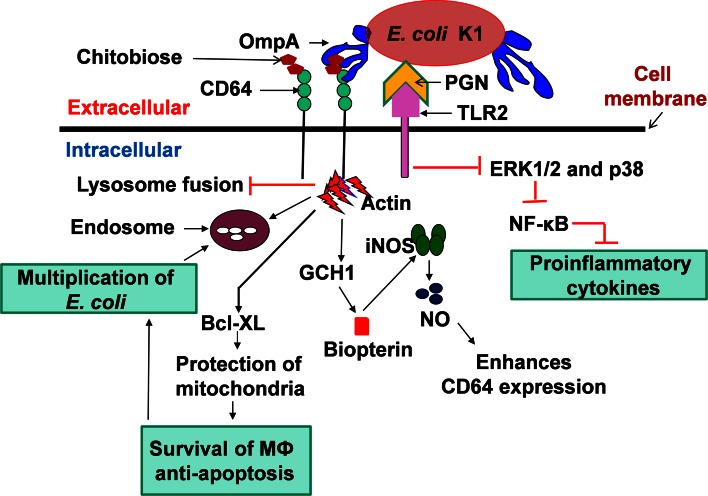
Mechanisms involved in Escherichia coli K1 manipulation of macrophages. The outer membrane protein A (OmpA) of E. coli K1 interacts with chitobiose moieties (GlcNAc1-4GlcNAc) in CD64 for inducing actin rearrangements to the sites of bacterial attachment for internalization of E. coli. During this process, the intracellular domain of CD64 triggers the upregulation of B cell lymphoma-extra large (Bcl-XL), an anti-apoptotic protein by an unknown mechanism to prevent apoptosis of the infected macrophages. In addition, toll-like receptor 2 (TLR2) ligands such as peptidoglycan (PGN) interaction with TLR2 also induces inducible nitric oxide (NO) production by activation of iNOS. Parallel to Bcl-XL upregulation, OmpA interaction with CD64 also enhances guanidine cyclohydrolase I (GCH1), which in turn produces biopterin. The biopterin subsequently acts as a co-factor for more inducible nitric oxide synthase (iNOS) activation and produce greater amounts of NO, which triggers the expression of CD64 to the cells surface. Thus, more E. coli bind to the receptor and enter the macrophages. The OmpA-CD64-mediated entry also avoids the fusion of lysosome with endosome, thereby finding a niche for survival and multiplication. To prevent the hostile conditions for bacterial survival, E. coli also suppresses mitogen-activated protein (MAP) kinases, extracellular signal-regulated kinases (ERK1/2), and p38, thereby the activity of nuclear factor-κB (NF-κB). This arm of signaling prevents the production of pro-inflammatory cytokines in macrophages. Red lines indicate inhibition of specific signaling pathway

References

    1. Al-Numani D, Segura M, Dore M, Gottschalk M. Up-regulation of ICAM-1, CD11a/CD18 and CD11c/CD18 on human THP-1 monocytes stimulated by Streptococcus suis serotype 2. Clin Exp Immunol. 2003;133:67–77. doi: 10.1046/j.1365-2249.2003.02189.x. - DOI - PMC - PubMed
    1. Alkuwaity K, Taylor A, Heckels JE, Doran KS, Christodoulides M. Group B Streptococcus interactions with human meningeal cells and astrocytes in vitro. PLoS One. 2012;7:e42660. doi: 10.1371/journal.pone.0042660. - DOI - PMC - PubMed
    1. Baker CJ, Edwards MS. Group B streptococcal infections. In: Remington JS, Klein JO, editors. Infectious diseases of the fetus and newborn infant. 5. Philadelphia: WB Saunders; 2001. pp. 1091–1156.
    1. Banerjee A, Kim BJ, Carmona EM, Cutting AS, Gurney MA, Carlos C, Feuer R, Prasadarao NV, Doran KS. Bacterial Pili exploit integrin machinery to promote immune activation and efficient blood-brain barrier penetration. Nat Commun. 2011;2:462. doi: 10.1038/ncomms1474. - DOI - PMC - PubMed
    1. Barichello T, Collodel A, Generoso JS, Simoes LR, Moreira AP, Ceretta RA, Petronilho F, Quevedo J. Targets for adjunctive therapy in pneumococcal meningitis. J Neuroimmunol. 2015;278:262–270. doi: 10.1016/j.jneuroim.2014.11.015. - DOI - PubMed

Publication types