


Estimating Children's Soil/Dust Ingestion Rates through Retrospective Analyses of Blood Lead Biomonitoring from the Bunker Hill Superfund Site in Idaho
- PMID: 26745545
- PMCID: PMC5010415
- DOI: 10.1289/ehp.1510144
Estimating Children's Soil/Dust Ingestion Rates through Retrospective Analyses of Blood Lead Biomonitoring from the Bunker Hill Superfund Site in Idaho
Abstract
Background: Soil/dust ingestion rates are important variables in assessing children's health risks in contaminated environments. Current estimates are based largely on soil tracer methodology, which is limited by analytical uncertainty, small sample size, and short study duration.
Objectives: The objective was to estimate site-specific soil/dust ingestion rates through reevaluation of the lead absorption dose-response relationship using new bioavailability data from the Bunker Hill Mining and Metallurgical Complex Superfund Site (BHSS) in Idaho, USA.
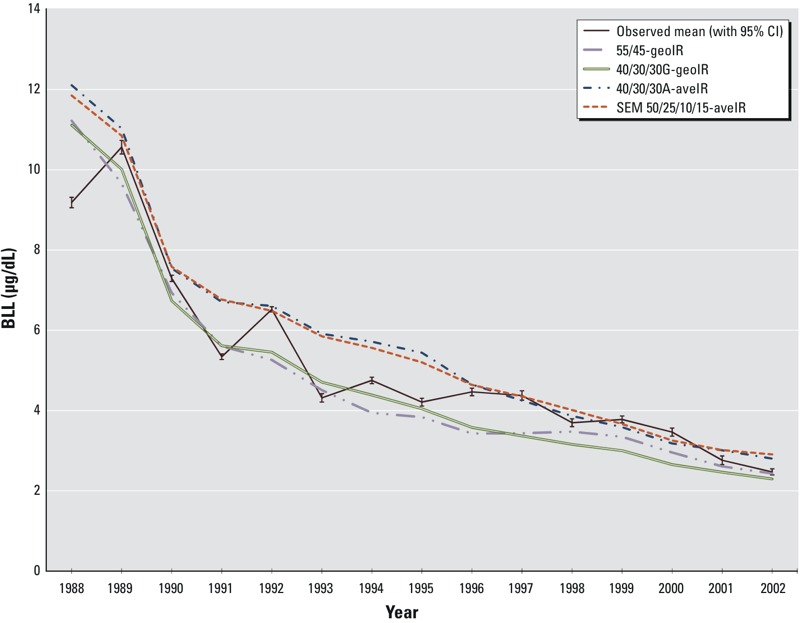
Methods: The U.S. Environmental Protection Agency (EPA) in vitro bioavailability methodology was applied to archived BHSS soil and dust samples. Using age-specific biokinetic slope factors, we related bioavailable lead from these sources to children's blood lead levels (BLLs) monitored during cleanup from 1988 through 2002. Quantitative regression analyses and exposure assessment guidance were used to develop candidate soil/dust source partition scenarios estimating lead intake, allowing estimation of age-specific soil/dust ingestion rates. These ingestion rate and bioavailability estimates were simultaneously applied to the U.S. EPA Integrated Exposure Uptake Biokinetic Model for Lead in Children to determine those combinations best approximating observed BLLs.
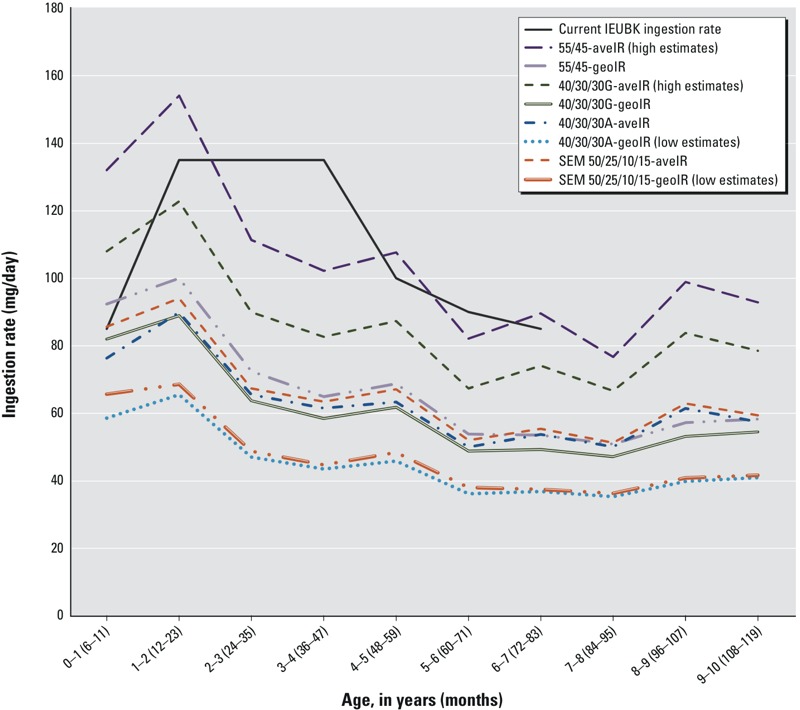
Results: Absolute soil and house dust bioavailability averaged 33% (SD ± 4%) and 28% (SD ± 6%), respectively. Estimated BHSS age-specific soil/dust ingestion rates are 86-94 mg/day for 6-month- to 2-year-old children and 51-67 mg/day for 2- to 9-year-old children.
Conclusions: Soil/dust ingestion rate estimates for 1- to 9-year-old children at the BHSS are lower than those commonly used in human health risk assessment. A substantial component of children's exposure comes from sources beyond the immediate home environment.
Citation: von Lindern I, Spalinger S, Stifelman ML, Stanek LW, Bartrem C. 2016. Estimating children's soil/dust ingestion rates through retrospective analyses of blood lead biomonitoring from the Bunker Hill Superfund Site in Idaho. Environ Health Perspect 124:1462-1470; http://dx.doi.org/10.1289/ehp.1510144.
Conflict of interest statement
This manuscript was reviewed by the U.S. EPA and approved for publication. Views expressed by the authors do not necessarily represent the U.S. EPA or agency policy. I.v.L., S.S., and C.B. are employees of TerraGraphics Environmental Engineering, Inc., which is a consultant to the Idaho Department of Environmental Quality, and held two contracts at the time of this project for scientific and engineering support services for the Bunker Hill Superfund Site. TerraGraphics was also a consultant to U.S. EPA to conduct analyses for this research project. I.v.L. served on the U.S. Clean Air Science Advisory Committee for the Integrated Science Assessment for Lead in the Ambient Air and the Review of the Air Quality Criteria Document for Lead. C.B. and I.v.L. are also employed by TerraGraphics International Foundation, a nonprofit organization. The other authors declare they have no actual or potential competing financial interests.
Figures

References
-
- Batelle. Summary Report of the U.S. EPA Colloquium on Soil/Dust Ingestion Rates and Mouthing Behavior for Children and Adults. 2005 Available: http://cfpub.epa.gov/ncea/cfm/recordisplay.cfm?deid=146585#Download [accessed 13 January 2015]
-
- Bierkens J, Van Holderbeke M, Cornelis C, Torfs R. In: Dealing with Contaminated Sites: from Theory towards Practical Application. (Swartjes FA, ed) Dordrecht, the Netherlands: Springer Science+Business Media B.V.; 2011. Exposure through soil and dust ingestion. pp. 261–286.
-
- Carey G. Path Analysis Using PROC CALIS. 1998 Available: http://psych.colorado.edu/~carey/courses/psyc7291/handouts/pathcalis.pdf [accessed 13 January 2015]
-
- CH2M Hill. Seattle, WA: U.S. EPA Region 10 Office; 1991. Residential Soil Feasibility Study for the Bunker Hill CERCLA Site Populated Areas. Prepared for the Idaho Division of Environmental Quality, Boise, ID. Document Number BHPA-RSFS-F-RO-041991.
Publication types
MeSH terms
Substances
LinkOut - more resources
Full Text Sources
Other Literature Sources
Research Materials