


Catechol-O-Methyltransferase Val158Met Polymorphism and Clinical Response to Antipsychotic Treatment in Schizophrenia and Schizo-Affective Disorder Patients: a Meta-Analysis
- PMID: 26745992
- PMCID: PMC4886669
- DOI: 10.1093/ijnp/pyv132
Catechol-O-Methyltransferase Val158Met Polymorphism and Clinical Response to Antipsychotic Treatment in Schizophrenia and Schizo-Affective Disorder Patients: a Meta-Analysis
Abstract
Background: The catechol-O-methyltransferase (COMT) enzyme plays a crucial role in dopamine degradation, and the COMT Val158Met polymorphism (rs4680) is associated with significant differences in enzymatic activity and consequently dopamine concentrations in the prefrontal cortex. Multiple studies have analyzed the COMT Val158Met variant in relation to antipsychotic response. Here, we conducted a meta-analysis examining the relationship between COMT Val158Met and antipsychotic response.
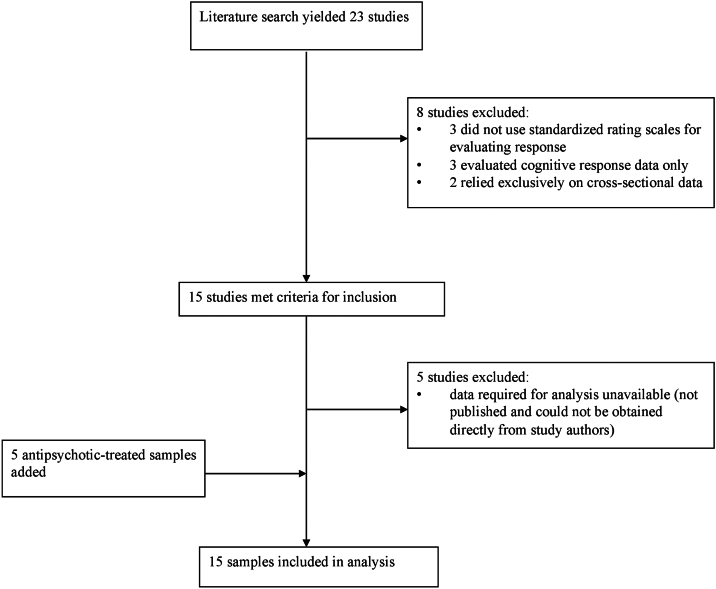
Methods: Searches using PubMed, Web of Science, and PsycInfo databases (03/01/2015) yielded 23 studies investigating COMT Val158Met variation and antipsychotic response in schizophrenia and schizo-affective disorder. Responders/nonresponders were defined using each study's original criteria. If no binary response definition was used, authors were asked to define response according to at least 30% Positive and Negative Syndrome Scale score reduction (or equivalent in other scales). Analysis was conducted under a fixed-effects model.
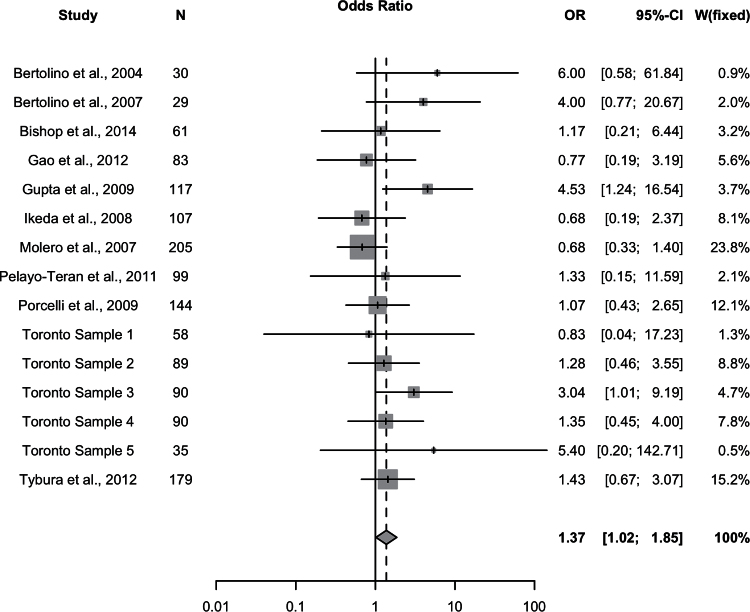
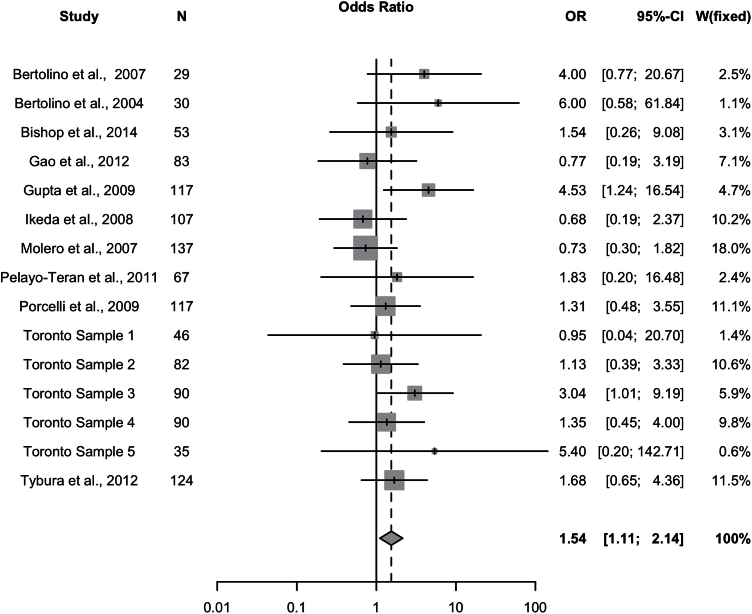
Results: Ten studies met inclusion criteria for the meta-analysis. Five additional antipsychotic-treated samples were analyzed for Val158Met and response and included in the meta-analysis (ntotal=1416). Met/Met individuals were significantly more likely to respond than Val-carriers (P=.039, ORMet/Met=1.37, 95% CI: 1.02-1.85). Met/Met patients also experienced significantly greater improvement in positive symptoms relative to Val-carriers (P=.030, SMD=0.24, 95% CI: 0.024-0.46). Posthoc analyses on patients treated with atypical antipsychotics (n=1207) showed that Met/Met patients were significantly more likely to respond relative to Val-carriers (P=.0098, ORMet/Met=1.54, 95% CI: 1.11-2.14), while no difference was observed for typical-antipsychotic-treated patients (n=155) (P=.65).
Conclusions: Our findings suggest that the COMT Val158Met polymorphism is associated with response to antipsychotics in schizophrenia and schizo-affective disorder patients. This effect may be more pronounced for atypical antipsychotics.
Keywords: COMT; Val158Met; antipsychotics; clinical response; schizophrenia.
© The Author 2016. Published by Oxford University Press on behalf of CINP.
Figures
References
-
- Anttila S, Illi A, Kampman O, Mattila KM, Lehtimäki T, Leinonen E. (2004) Interaction between NOTCH4 and catechol-O-methyltransferase genotypes in schizophrenia patients with poor response to typical neuroleptics. Pharmacogenet Genomics 14:303–307. - PubMed
-
- Badner J, Gershon E. (2002) Meta-analysis of whole-genome linkage scans of bipolar disorder and schizophrenia. Mol Psychiatry 7:405–411. - PubMed
-
- Bakker P, Van Harten P, Van Os J. (2008) Antipsychotic-induced tardive dyskinesia and polymorphic variations in COMT, DRD2, CYP1A2 and MnSOD genes: a meta-analysis of pharmacogenetic interactions. Mol Psychiatry 13:544–556. - PubMed
-
- Bakker PR, van Harten PN, van Os J. (2006) Antipsychotic-induced tardive dyskinesia and the Ser9Gly polymorphism in the DRD3 gene: a meta analysis. Schizophr Res 83:185–192. - PubMed
-
- Bertolino A, Caforio G, Blasi G, De Candia M, Latorre V, Petruzzella V, Altamura M, Nappi G, Papa S, Callicott JH. (2004) Interaction of COMT Val108/158 Met genotype and olanzapine treatment on prefrontal cortical function in patients with schizophrenia. Am J Psychiatry 161:1798–1805. - PubMed
Publication types
MeSH terms
Substances
Grants and funding
LinkOut - more resources
Full Text Sources
Other Literature Sources
Medical
Miscellaneous
