


Complex Homology and the Evolution of Nervous Systems
- PMID: 26746806
- PMCID: PMC4765321
- DOI: 10.1016/j.tree.2015.12.005
Complex Homology and the Evolution of Nervous Systems
Abstract
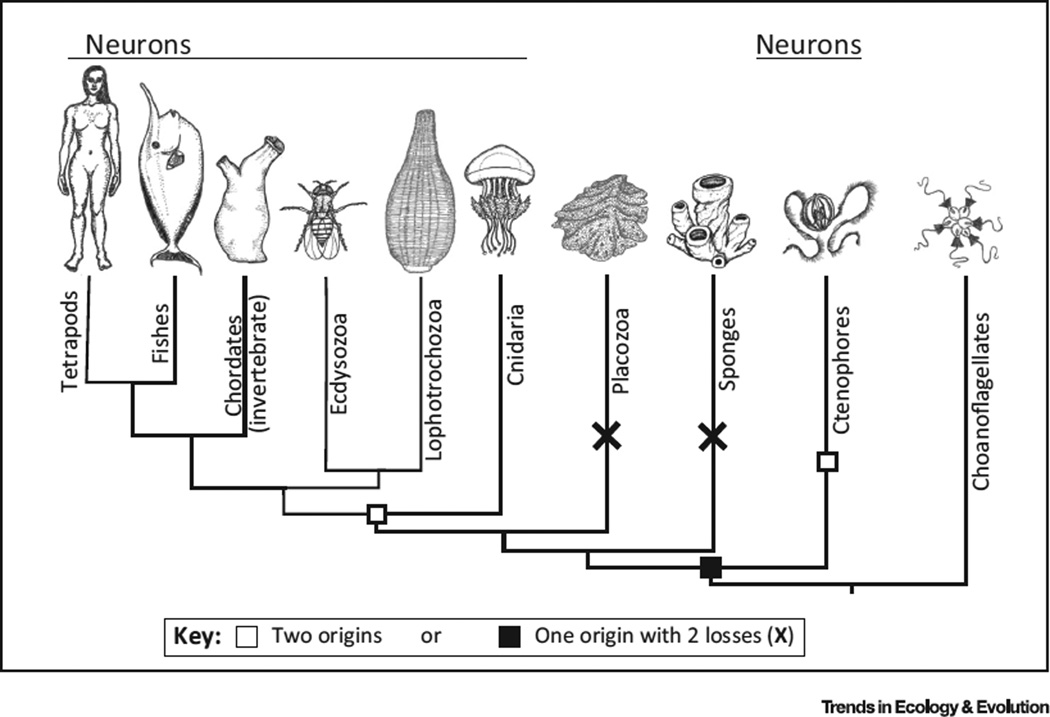
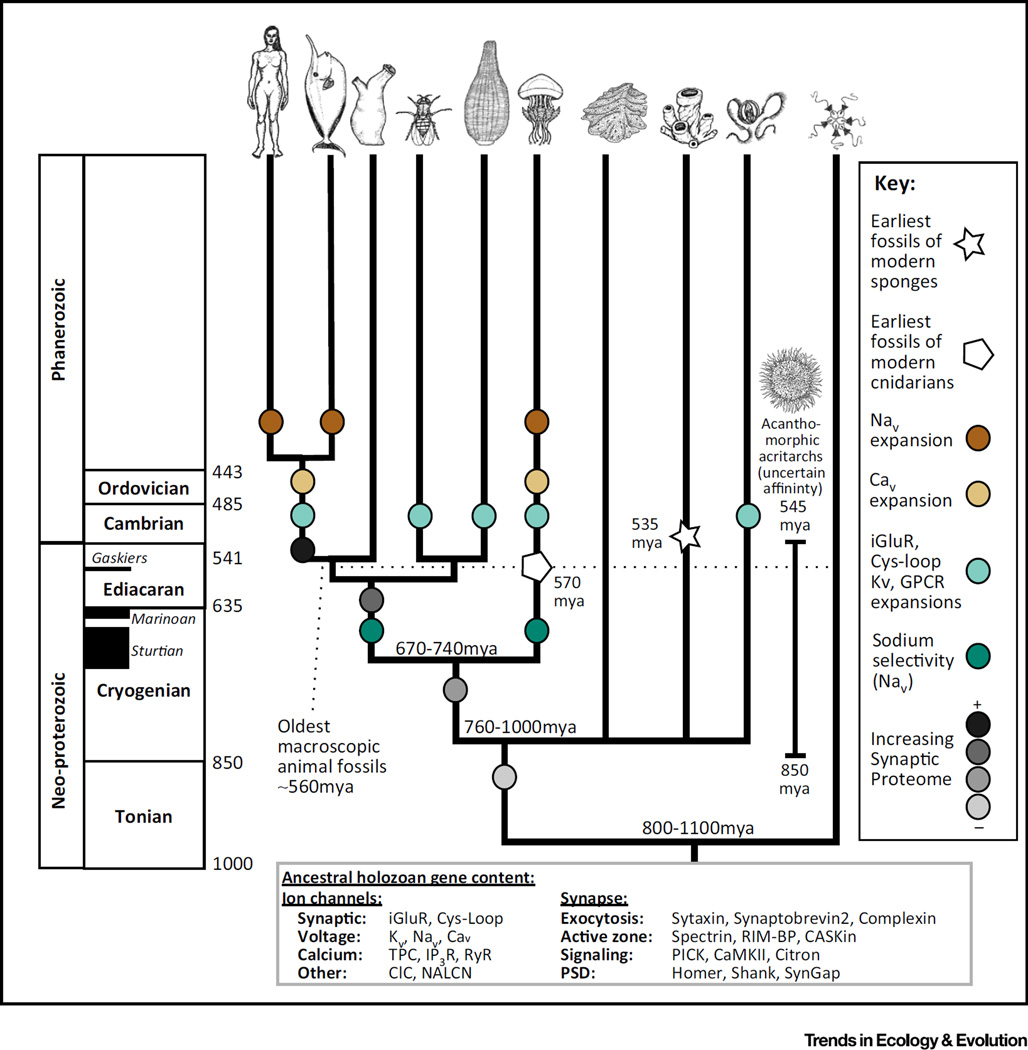
We examine the complex evolution of animal nervous systems and discuss the ramifications of this complexity for inferring the nature of early animals. Although reconstructing the origins of nervous systems remains a central challenge in biology, and the phenotypic complexity of early animals remains controversial, a compelling picture is emerging. We now know that the nervous system and other key animal innovations contain a large degree of homoplasy, at least on the molecular level. Conflicting hypotheses about early nervous system evolution are due primarily to differences in the interpretation of this homoplasy. We highlight the need for explicit discussion of assumptions and discuss the limitations of current approaches for inferring ancient phenotypic states.
Copyright © 2015. Published by Elsevier Ltd.
Figures
References
-
- Bock WJ. Philosophical foundations of classical evolutionary classification. Syst. Zool. 1973;22:375–392.
-
- Szucsich NU, Wirkner CS. Homology: a synthetic concept of evolutionary robustness of patterns. Zool. Scr. 2007;36:281–289.
-
- Wagner GP. The biological homology concept. Annu. Rev. Ecol. Syst. 1989;20:51–69.
-
- Hall BK. Homology: The Hierarchial Basis of Comparative Biology. Academic Press; 1994.
Publication types
MeSH terms
Grants and funding
LinkOut - more resources
Full Text Sources
Other Literature Sources
