Comparative Study
. 2016 Mar;162(3):466-475.
doi: 10.1099/mic.0.000238. Epub 2016 Jan 8.

Comparison of Lactobacillus crispatus isolates from Lactobacillus-dominated vaginal microbiomes with isolates from microbiomes containing bacterial vaginosis-associated bacteria

Affiliations
Comparative Study

Comparison of Lactobacillus crispatus isolates from Lactobacillus-dominated vaginal microbiomes with isolates from microbiomes containing bacterial vaginosis-associated bacteria

Abdallah A Abdelmaksoud et al. Microbiology (Reading). 2016 Mar.

Abstract

Vaginal lactobacilli can inhibit colonization by and growth of other bacteria, thereby preventing development of bacterial vaginosis (BV). Amongst the lactobacilli, Lactobacillus crispatus appears to be particularly effective at inhibiting growth of BV-associated bacteria. Nonetheless, some women who are colonized with this species can still develop clinical BV. Therefore, we sought to determine whether strains of L. crispatus that colonize women with lactobacilli-dominated vaginal microbiomes are distinct from strains that colonize women who develop BV. The genomes of L. crispatus isolates from four women with lactobacilli-dominated vaginal microbiomes ( <1% 16S rRNA reads above threshold from genera other than Lactobacillus) and four women with microbiomes containing BV-associated bacteria (>12% 16S rRNA reads from bacterial taxa associated with BV) were sequenced and compared. Lactic acid production by the different strains was quantified. Phage induction in the strains was also analysed. There was considerable genetic diversity between strains, and several genes were exclusive to either the strains from Lactobacillus-dominated microbiomes or those containing BV-associated bacteria. Overall, strains from microbiomes dominated by lactobacilli did not differ from strains from microbiomes containing BV-associated bacteria with respect to lactic acid production. All of the strains contained multiple phage, but there was no clear distinction between the presence or absence of BV-associated bacteria with respect to phage-induced lysis. Genes found to be exclusive to the Lactobacillus-dominated versus BV-associated bacteria-containing microbiomes could play a role in the maintenance of vaginal health and the development of BV, respectively.


Figures
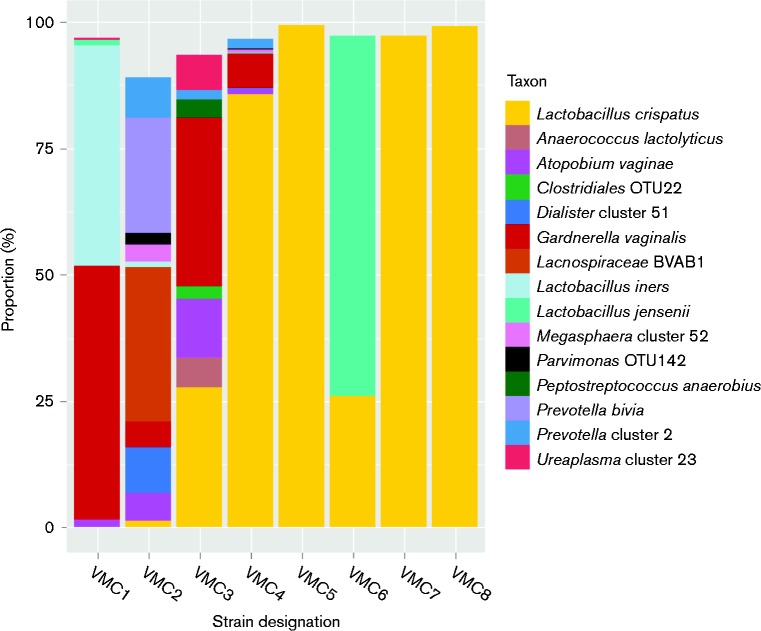
Fig. 1.
Fig. 1.
Microbiome of samples used for isolation of L. crispatus. Microbial profiles for each of the eight subjects chosen for isolation of L. crispatus are shown. The y-axis represents the prevalence of different bacterial taxa as a function of percentage of total reads of the 16S rRNA gene. Only bacterial taxa representing ≥ 2 % of the reads from 16S rRNA gene surveys are shown. The x-axis labels are the strain designations given to the L. crispatus isolates chosen from each vaginal swab sample for study.
Fig. 2.
Fig. 2.
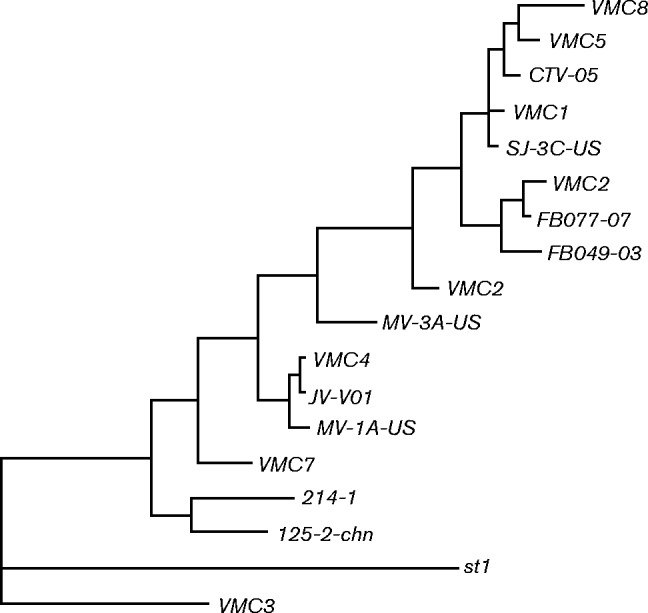
Phylogenetic analysis of L. crispatus isolates. The entire genomes of the 10 L. crispatus strains analysed by Ojala et al. (2014) and the eight strains isolated in this study were compared using realphy (Bertels et al., 2014).
Fig. 3.
Fig. 3.
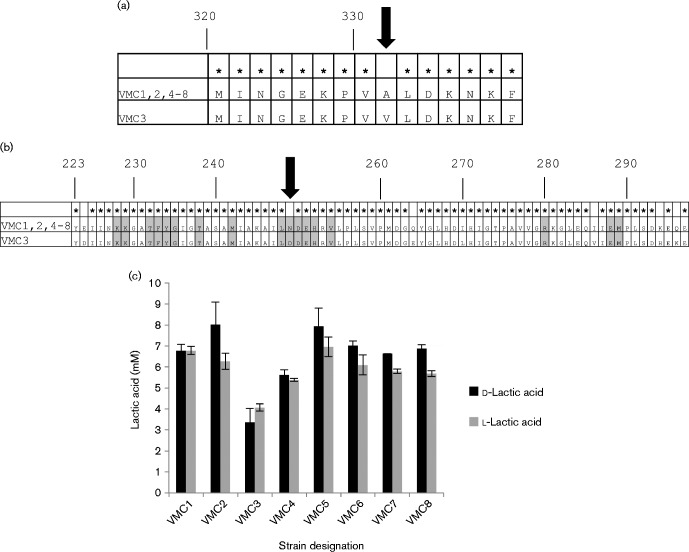
Lactic acid production. (a) The amino acid sequences of the d-lactate dehydrogenase genes of strains VMC1, 2 and 4–8 were identical. There was a single amino acid substitution in strain VMC3, at position 331. (b) The amino acid sequences of the l-lactate dehydrogenase genes of strains VMC1, 2 and 4–8 were identical. Amino acids conserved amongst members of the LDH Conserved Protein Domain Family (NCBI) are shaded in grey. There were six amino acid substitutions in strain VMC3, at positions 224, 249, 264, 286, 294 and 296. (c) Lactic acid produced during culture in CDM resembling vaginal secretions.
Fig. 4.
Fig. 4.
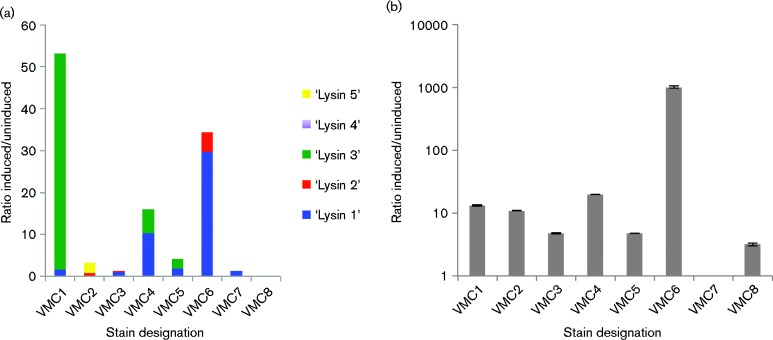
Phage induction. Mitomycin C was used to induce the strains and DNA was extracted from spent medium. Relative levels of DNA encoding the phage lysin genes were quantified by qPCR as a measure of phage replication. Relative levels of DNA encoding the 16S rRNA gene were quantified as a measure of bacterial lysis. The ratio of bacterial or phage DNA in the spent medium from cultures induced with mitomycin C to uninduced was calculated as (2Ctinduced)/(2Ctuninduced) and is shown on the y-axis.

References

    1. Adzhubei I. A., Schmidt S., Peshkin L., Ramensky V. E., Gerasimova A., Bork P., Kondrashov A. S., Sunyaev S. R. (2010). A method and server for predicting damaging missense mutations Nat Methods 7 248–249 10.1038/nmeth0410-248 . - DOI - PMC - PubMed
    1. Allen-Daniels M. J., Serrano M. G., Pflugner L. P., Fettweis J. M., Prestosa M. A., Koparde V. N., Brooks J. P., Strauss J. F., III, Romero R., other authors (2015). Identification of a gene in Mycoplasma hominis associated with preterm birth and microbial burden in intraamniotic infection Am J Obstet Gynecol 212 779.1–779.e13 10.1016/j.ajog.2015.01.032 . - DOI - PMC - PubMed
    1. Amsel R., Totten P. A., Spiegel C. A., Chen K. C., Eschenbach D., Holmes K. K. (1983). Nonspecific vaginitis. Diagnostic criteria and microbial and epidemiologic associations Am J Med 74 14–22 10.1016/0002-9343(83)91112-9 . - DOI - PubMed
    1. Antonio M. A., Hawes S. E., Hillier S. L. (1999). The identification of vaginal Lactobacillus species and the demographic and microbiologic characteristics of women colonized by these species J Infect Dis 180 1950–1956 10.1086/315109 . - DOI - PubMed
    1. Baugher J. L., Durmaz E., Klaenhammer T. R. (2014). Spontaneously induced prophages in Lactobacillus gasseri contribute to horizontal gene transfer Appl Environ Microbiol 80 3508–3517 10.1128/AEM.04092-13 . - DOI - PMC - PubMed

Publication types

LinkOut - more resources