. 2016 Feb;70(2):502-11.
doi: 10.1111/evo.12848. Epub 2016 Feb 5.

The evolution of sperm competition genes: The effect of mating system on levels of genetic variation within and between species

Affiliations

The evolution of sperm competition genes: The effect of mating system on levels of genetic variation within and between species

Amy L Dapper et al. Evolution. 2016 Feb.

Abstract

It is widely established that proteins involved in reproduction diverge between species more quickly than other proteins. For male sperm proteins, rapid divergence is believed to be caused by postcopulatory sexual selection and/or sexual conflict. Here, we derive the expected levels of gene diversity within populations and divergence between them for male sperm protein genes evolving by postcopulatory, prezygotic fertility competition, i.e. the function imputed for some sperm and seminal fluid genes. We find that, at the mutation-selection equilibrium, both gene diversity within species and divergence between them are elevated relative to genes with similar selection coefficients expressed by both sexes. We show that their expected level of diversity is a function of the harmonic mean number of mates per female, which affects the strength of fertility selection stemming from male-male sperm competition. Our predictions provide a null hypothesis for distinguishing between other selective hypotheses accounting for the rapid evolution of male reproductive genes.

Keywords: Rapid evolution; relaxed selection; reproductive genes; sexual selection; sperm proteins.


Figures

Figure 1
Figure 1
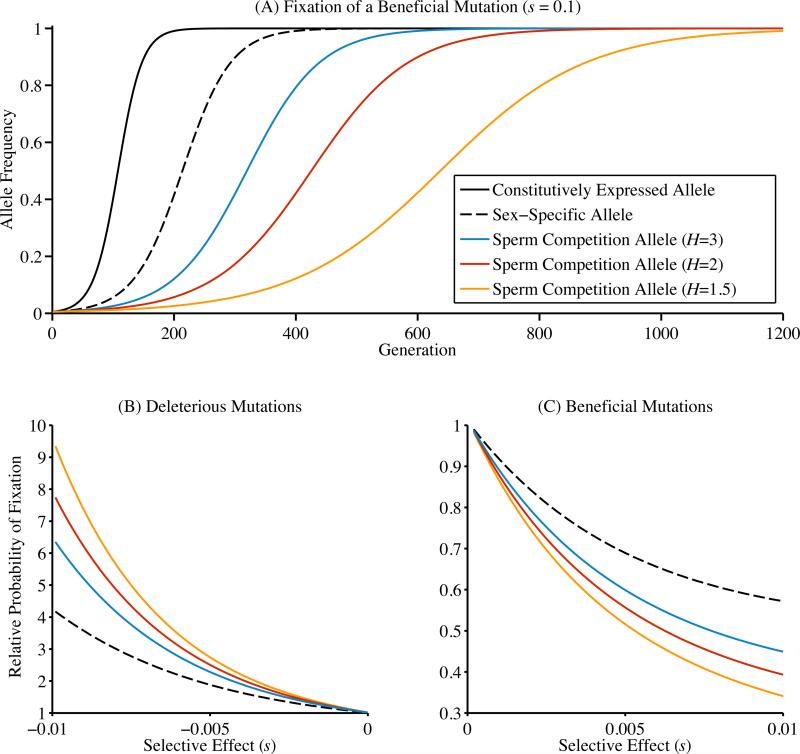
(A) Beneficial alleles (s = 0.1, h = 0.5) take longer to near fixation when they occur in sex-specific genes (dashed, black) in comparison to constitutively expressed genes (solid, black). If they occur in sex-specific genes that function primarily in sperm competition, the expected time near fixation increases as the harmonic mean number of mates per female (H) decreases (H=3, blue; H=2, red; H=1.5, yellow). (B) New deleterious mutations (s < 0, h = 0.5) have a higher probability of fixing in sex-specific gene relative to standard constitutively expressed genes (black, dashed). (C) Conversely, new beneficial mutations (s > 0, h = 0.5) have a lower probability of fixing in sex-specific gene relative to standard constitutively expressed genes. These effects are exaggerated in sex-specific genes that function primarily in sperm competition. Among sperm competition genes, the relative probability of fixation is a function of the harmonic mean number of mates per female (H). This figure illustrates the most common case (diploid adults with diploid expression of sperm and seminal fluid proteins). For the other cases, please see the supplementary material.
Figure 2
Figure 2
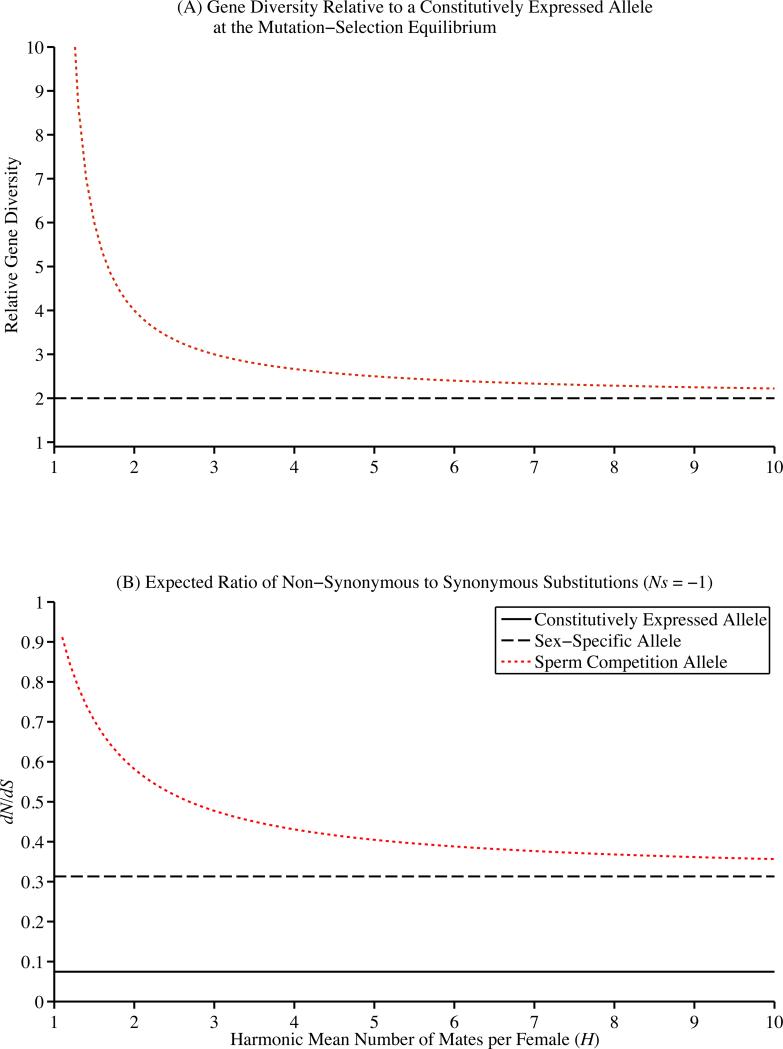
(A) Sex-specific genes are expected to exhibit twice as much gene diversity at the mutation-selection balance relative to standard constitutively expressed genes (black, dashed line). Sperm competition genes are expected to exhibit even higher levels of gene diversity relative to constitutively expressed genes (red, dotted line). The relative increase in gene diversity is a function of the harmonic mean number of mates per female (H) decreases. (B) Sperm competition (red, dotted line) and sex-specific genes (black, dashed line) are expected to exhibit elevated ratios of non-synonymous to synonymous substitutions (dN/dS) in comparison with standard, constitutively expressed genes (black, solid), given the same average selective effect of new mutations (Ns = −1). Among sperm competition genes, the expected dN/dS ratio increases with decreasing harmonic mean number of mates per female (H). This figure illustrates the most common case (diploid adults with diploid expression of sperm and seminal fluid proteins). For the other cases, please see the supplementary material.

References

    1. Andres JA, Maroja LS, Bogdanowicz SM, Swanson WJ, Harrison RG. Molecular evolution of seminal proteins in field crickets. Mol. Biol. Evol. 2006;23:1574–1584. - PubMed
    1. Barker MS, Demuth JP, Wade MJ. Maternal expression relaxes constraint on innovation of the anterior determinant, bicoid. PLoS Genet. 2005;1:527–530. - PMC - PubMed
    1. Begun DJ, Whitley P, Todd BL, Waldrip-Dail HM, Clark AG. Molecular population genetics of male accessory gland proteins in drosophila. Genetics. 2000;156:1879–1888. - PMC - PubMed
    1. Birkhead TR, Pizzari T. Postcopulatory sexual selection. Nat. Rev. Genet. 2002;3:262–273. - PubMed
    1. Braun RE, Behringer RR, Peschon JJ, Brinster RL, Palmiter RD. Genetically haploid spermatids are phenotypically diploid. Nature. 1989;337:373–376. - PubMed

Publication types