. 2016 Jan 11:7:10214.
doi: 10.1038/ncomms10214.

High-efficiency robust perovskite solar cells on ultrathin flexible substrates

Affiliations

High-efficiency robust perovskite solar cells on ultrathin flexible substrates

Yaowen Li et al. Nat Commun. .

Abstract

Wide applications of personal consumer electronics have triggered tremendous need for portable power sources featuring light-weight and mechanical flexibility. Perovskite solar cells offer a compelling combination of low-cost and high device performance. Here we demonstrate high-performance planar heterojunction perovskite solar cells constructed on highly flexible and ultrathin silver-mesh/conducting polymer substrates. The device performance is comparable to that of their counterparts on rigid glass/indium tin oxide substrates, reaching a power conversion efficiency of 14.0%, while the specific power (the ratio of power to device weight) reaches 1.96 kW kg(-1), given the fact that the device is constructed on a 57-μm-thick polyethylene terephthalate based substrate. The flexible device also demonstrates excellent robustness against mechanical deformation, retaining >95% of its original efficiency after 5,000 times fully bending. Our results confirmed that perovskite thin films are fully compatible with our flexible substrates, and are thus promising for future applications in flexible and bendable solar cells.


Figures
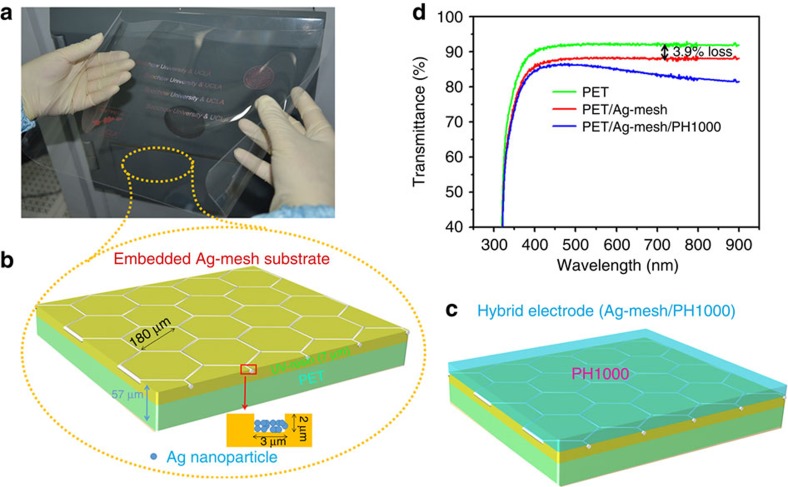
Figure 1
Figure 1. Schematic illustration of the FEAMs substrate and hybrid electrode.
(a) An image of the large-area FEAMs substrate. (b) The structure of the FEAMs substrate with detail parameters. (c) The diagram for the hybrid electrode (PET/Ag-mesh/PH1000). (d) Transmission spectra of bare PET, PET/Ag-mesh, PET/Ag-mesh/PH1000-based substrates.
Figure 2
Figure 2. Flexible pero-SCs architecture and morphology.
(a) Device architecture of the hybrid electrode/PEDOT:PSS (35 nm)/MAPbI3 (∼280 nm)/PCBM (∼60 nm)/Al (100 nm) cells tested in this study. (b) Cross-section SEM images of complete perovskite devices showed both Ag-mesh area (scale bar, 1 μm) and Flat PET area (scale bar, 500 nm). SEM top-view images of perovskite films; (d) : low-resolution image of perovskite film coated on both flat PET and Ag-mesh (scale bar, 2 μm); (c): film surface on bare PET (scale bar, 500 nm); (e): film surface on Ag-mesh (scale bar, 500 nm). (f) The corresponding energy-level diagram of each layer.
Figure 3
Figure 3. Photovoltaic performance characteristics.
(a) JV curves in reverse and forward scan measured under 100 mW cm−2 AM 1.5G illumination and dark for the champion flexible PET/Ag-mesh/PH1000/PEDOT:PSS/MAPbI3/PCBM/Al solar cell: Inset shows photograph of corresponding ultra-thin flexible pero-SCs. (b) Steady-state photocurrent output at the maximum power point (0.8 V). (c) External quantum efficiency (EQE) spectrum of champion flexible pero-SC. (d) Histograms of device PCE measured for 50 devices of PET/Ag-mesh/PH1000/PEDOT:PSS/MAPbI3/PCBM/Al.
Figure 4
Figure 4. Characterization of flexible pero-SCs.
(a) JSC as a function of light intensity in a double log plot. (b) VOC as a function of light intensity in a semi-log scale. (c) The steady-state PL spectra of perovskite film on various substrates, and (d) TRPL decay transient spectra of PET/Ag-mesh/PH1000/PEDOT:PSS/MAPbI3 and glass/ITO/PEDOT:PSS/MAPbI3. Charge transient time and traces for optimized devices based on glass/ITO and PET/Ag-mesh/PH1000 electrodes by (e) transient photovoltage measurement under 0.5 sun bias light and (f) transient photocurrent measurement.
Figure 5
Figure 5. Annealing-time evolution of the perovskite films.
Annealing MAPbI3 grown on PET/Ag-mesh/PH1000/PEDOT:PSS substrate at 130 °C for 10 s, 30 s, 1 min, 2 min, 4 min and 8 min, respectively: (a) JV curves of the corresponding solar cells. (b) X-ray diffraction patterns of the perovskite films. (ch) Top-view SEM images of the perovskite films coated on both flat PET and Ag-mesh area (scale bar, 2 μm): (c) 10 s; (d) 30 s; (e) 1 min; (f) 2 min; (g) 4 min; (h) 8 min. Ag-mesh area row: the SEM images of corresponding perovskite films coated on Ag-mesh (scale bar, 500 nm); Flat PET area row: SEM images of corresponding perovskite films coated on flat PET (scale bar, 500 nm).
Figure 6
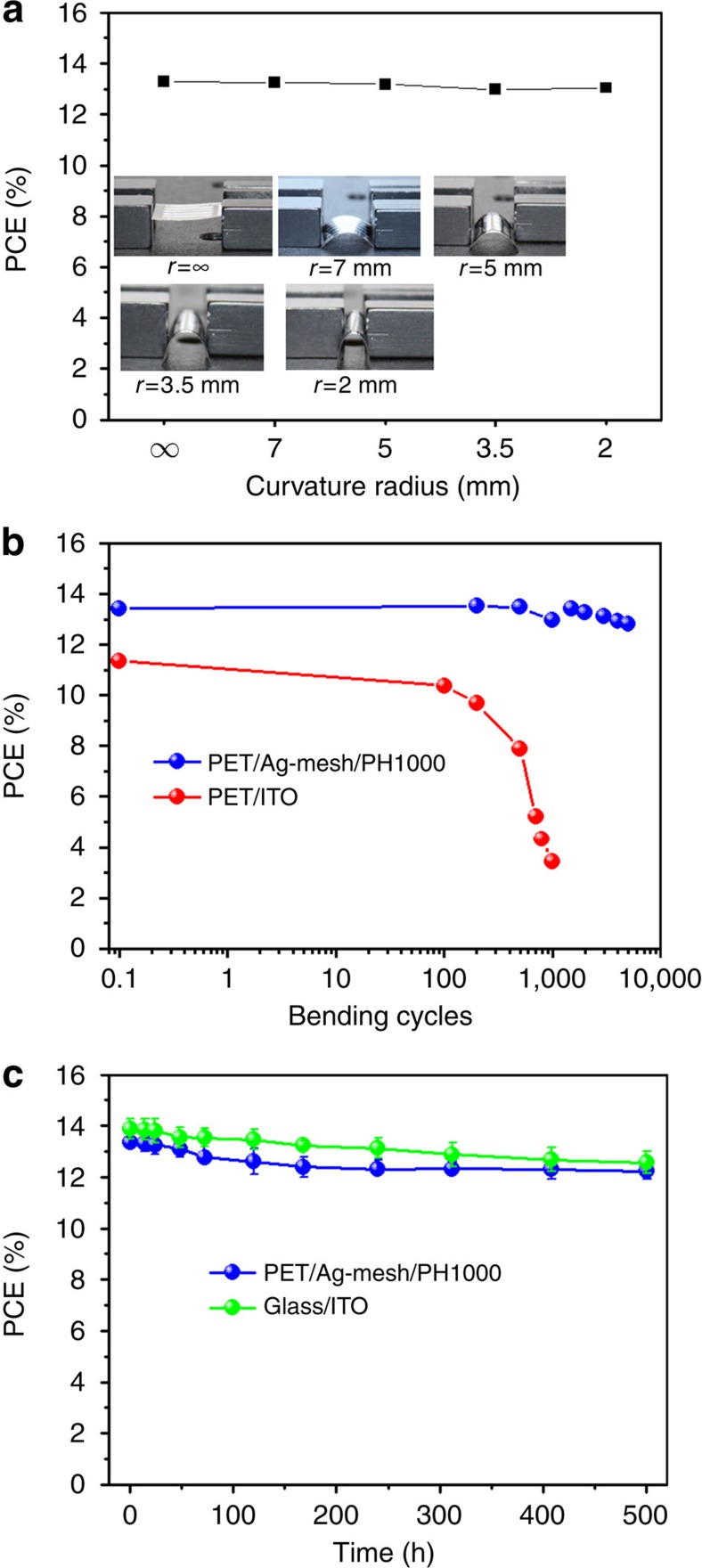
Figure 6. Bending and stability test of flexible pero-SCs.
(a) PCEs measured after bending PET/Ag-mesh/PH1000 electrode-based flexible pero-SCs within a specified radius of ∞, 7, 5, 3.5 and 2 mm. The inset shows the real images of the corresponding bending radii, respectively. (b) PCEs of flexible pero-SCs based on both PET/Ag-mesh/PH1000 and PET/ITO electrodes as a function of bending cycles at a radius of 5 mm. (c) Stability of pero-SCs based on both PET/Ag-mesh/PH1000 and glass/ITO substrates under room temperature in N2-filled glove box in a timescale of a few hundred hours. PCE values are obtained from statistical distribution of six devices for each condition. The ball symbols represent the mean, while the line across the ball represents the distribution.

References

    1. Yang W. S. et al.. High-performance photovoltaic perovskite layers fabricated through intramolecular exchange. Science 347, 522–525 (2015). - PubMed
    1. Kojima A. et al.. Organometal halide perovskites as visible-light sensitizers for photovoltaic cells. J. Am. Chem. Soc. 131, 6050–6051 (2009). - PubMed
    1. Im J. H. et al.. 6.5% efficient perovskite quantum-dot-sensitized solar cell. Nanoscale 3, 4088–4093 (2011). - PubMed
    1. Kim H. S. et al.. Lead iodide perovskite sensitized all-solid-state submicron thin film mesoscopic solar cell with efficiency exceeding 9%. Sci. Rep. 2, 591 (2012). - PMC - PubMed
    1. Liu M. et al.. Efficient planar heterojunction perovskite solar cells by vapour deposition. Nature 501, 395–398 (2013). - PubMed

Publication types