


Mandarin Tone and Vowel Recognition in Cochlear Implant Users: Effects of Talker Variability and Bimodal Hearing
- PMID: 26752089
- PMCID: PMC4844803
- DOI: 10.1097/AUD.0000000000000265
Mandarin Tone and Vowel Recognition in Cochlear Implant Users: Effects of Talker Variability and Bimodal Hearing
Abstract
Objectives: For cochlear implant (CI) users with residual low-frequency acoustic hearing in the nonimplanted ear, bimodal hearing combining the use of a CI and a contralateral hearing aid (HA) may provide more salient talker voice cues than CI alone to handle the variability of talker identity across trials. This study tested the effects of talker variability, bimodal hearing, and their interaction on response accuracy and time of CI users' Mandarin tone, vowel, and syllable recognition (i.e., combined Mandarin tone and vowel recognition in this study).
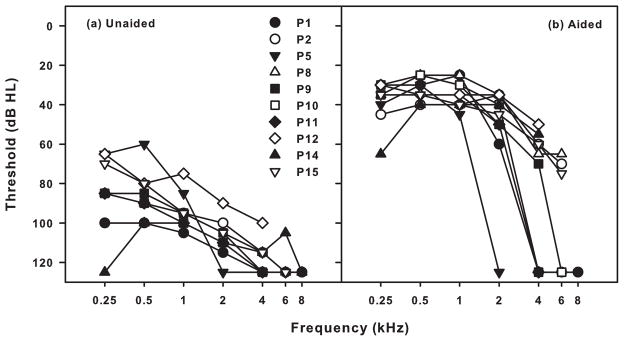
Design: Fifteen prelingually deafened native Mandarin-speaking CI users (at age 20 or lower) participated in this study. Four talkers each produced six Mandarin single-vowel syllables in four lexical tones. The stimuli were presented in quiet via a single loudspeaker. To study the effects of talker variability, Mandarin tone, vowel, and syllable recognition was tested in two presentation conditions: with stimuli blocked according to talker (blocked-talker condition) or mixed across talkers from trial to trial (mixed-talker condition). To explore the effects of bimodal hearing, two processor conditions were tested: CI alone or CI + HA. The cumulative response time was recorded as an indirect indicator of the cognitive load or listening effort in each condition. The correlations were computed between demographic/hearing factors (e.g., hearing thresholds in the nonimplanted ear) and bimodal performance/benefits (where bimodal benefits refer to the performance differences between CI alone and CI + HA).
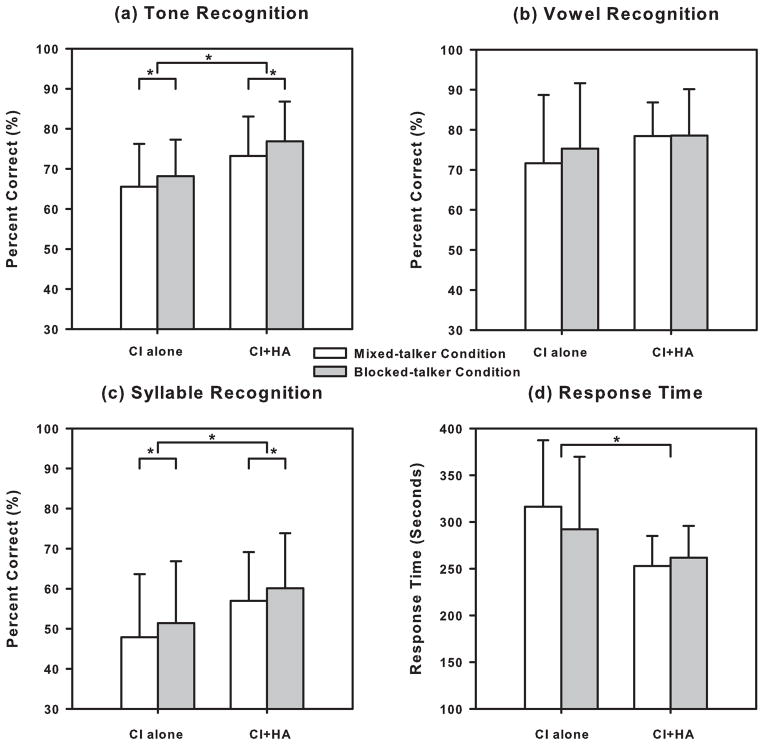
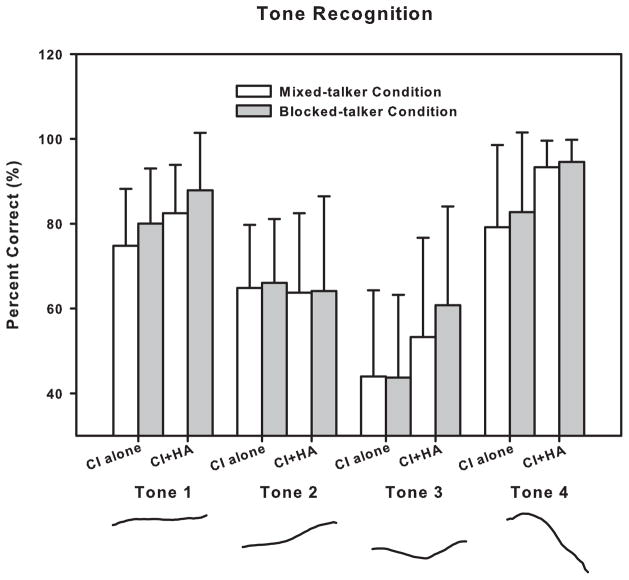
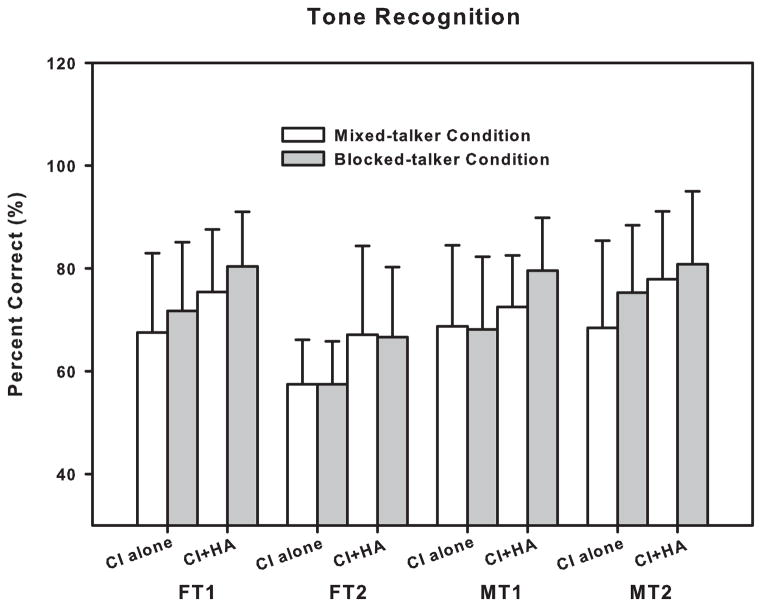
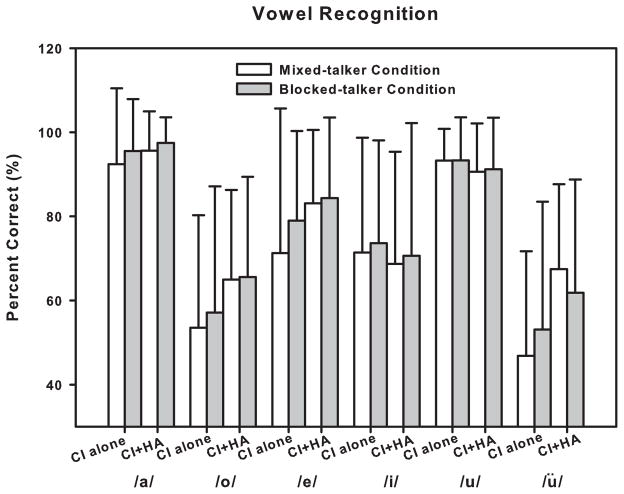
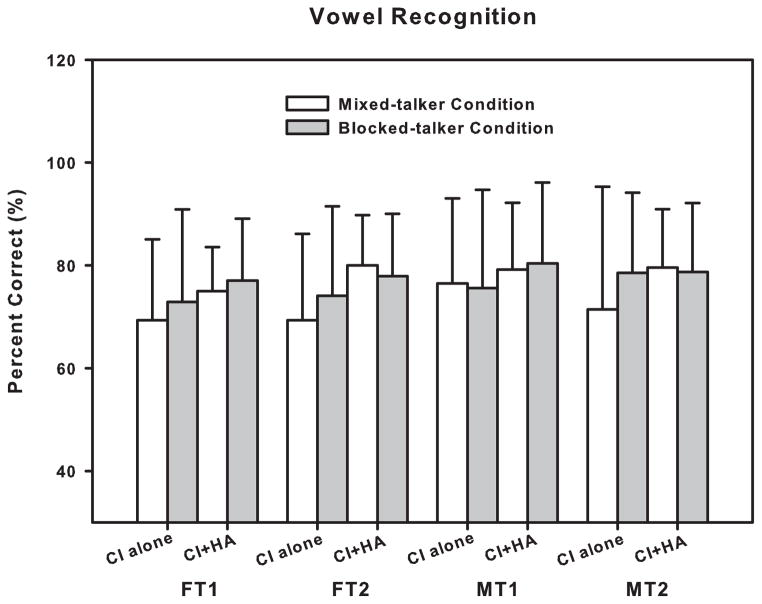
Results: Mandarin tone recognition with both CI alone and CI + HA was significantly poorer in the mixed-talker condition than in the blocked-talker condition, while vowel recognition was comparable in the two presentation conditions. Bimodal hearing significantly improved Mandarin tone recognition but not vowel recognition. Mandarin syllable recognition was significantly affected by both talker variability and bimodal hearing. The cumulative response time significantly reduced with CI + HA compared with CI alone, but remained invariant with respect to talker variability. There was no interaction between talker variability and bimodal hearing for any performance measure adopted in this study. Correlation analyses revealed that the bimodal performance and benefits in Mandarin tone, vowel, and syllable recognition could not be predicted by the hearing thresholds in the nonimplanted ear or by the demographic factors of the participants.
Conclusions: Talker variability from trial to trial significantly degraded Mandarin tone and syllable recognition performance in both the CI alone and CI + HA conditions. While bimodal hearing did not reduce the talker variability effects on Mandarin tone and syllable recognition, generally better Mandarin tone and syllable recognition performance with shorter response time (an indicator of less listening effort) was observed when a contralateral HA was used in conjunction with the CI. On the other hand, vowel recognition was not significantly affected by either talker variability or bimodal hearing, because ceiling effects could not be counted out of the vowel recognition results.
Figures
References
-
- Baer T, Moore BCJ, Gatehouse S. Spectral contrast enhancement of speech in noise for listeners with sensorineural hearing impairment: Effects on intelligibility, quality, and response times. J Rehabil Res Dev. 1993;30:49–72. - PubMed
-
- Chang Y, Fu QJ. Effects of talker variability on vowel recognition in cochlear implants. J Speech Lang Hear Res. 2006;49:1331–1341. - PubMed
-
- Chao YR. Mandarin primer. Cambridge, MA: Harvard University Press; 1948.
-
- Ching TYC, Incerti P, Hill M. Binaural benefits for adults who use hearing aids and cochlear implants in opposite ears. Ear Hear. 2004;25:9–21. - PubMed
MeSH terms
Grants and funding
LinkOut - more resources
Full Text Sources
Other Literature Sources
Medical
