. 2016 Jan 11;11(1):e0146638.
doi: 10.1371/journal.pone.0146638. eCollection 2016.

Benefits and Challenges with Applying Unique Molecular Identifiers in Next Generation Sequencing to Detect Low Frequency Mutations

Affiliations

Benefits and Challenges with Applying Unique Molecular Identifiers in Next Generation Sequencing to Detect Low Frequency Mutations

Ruqin Kou et al. PLoS One. .

Abstract

Indexing individual template molecules with a unique identifier (UID) before PCR and deep sequencing is promising for detecting low frequency mutations, as true mutations could be distinguished from PCR errors or sequencing errors based on consensus among reads sharing same index. In an effort to develop a robust assay to detect from urine low-abundant bladder cancer cells carrying well-documented mutations, we have tested the idea first on a set of mock templates, with wild type and known mutants mixed at defined ratios. We have measured the combined error rate for PCR and Illumina sequencing at each nucleotide position of three exons, and demonstrated the power of a UID in distinguishing and correcting errors. In addition, we have demonstrated that PCR sampling bias, rather than PCR errors, challenges the UID-deep sequencing method in faithfully detecting low frequency mutation.


Conflict of interest statement

Competing Interests: The authors are all employed by a commercial company, GENEWIZ LLC, and this does not alter the authors’ adherence to PLOS ONE policies on sharing data and materials.

Figures

Fig 1
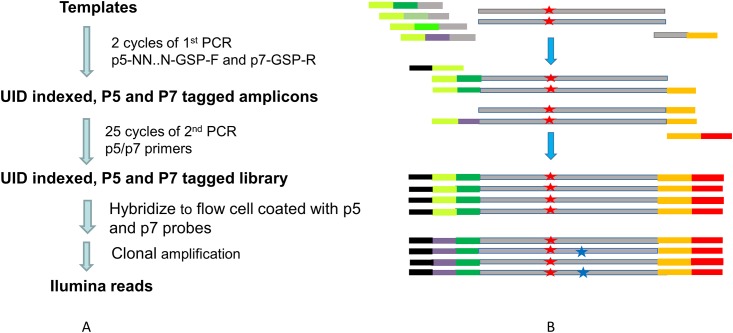
Fig 1. UID-targeted DNA sequencing workflow and the principle in distinguishing errors from true mutation.
(A) Illustration of UID-targeted DNA sequencing workflow. (B) True mutation from errors introduced during PCR and sequencing. A true mutation (illustrated as red star) is expected to be present in all the reads carrying the same UID (or derived from the same template molecule), while an error (illustrated as blue star) is expected in some but not all the reads carrying the same UID.
Fig 2
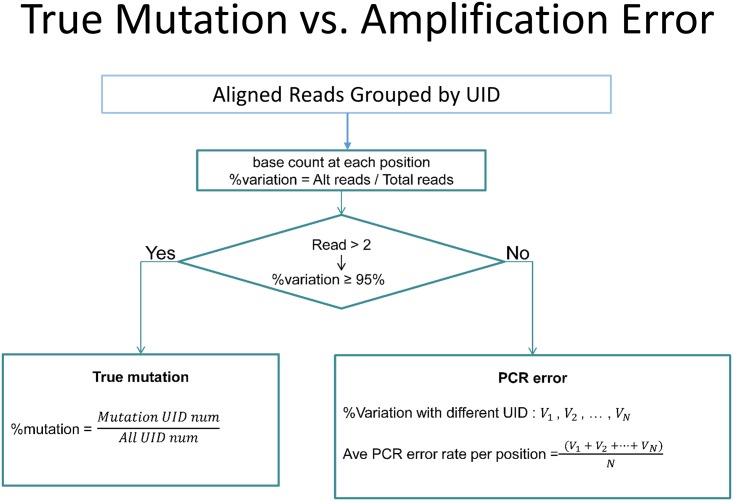
Fig 2. Flowchart for error vs mutation data analysis.
Reads were grouped by UID. When an UID has 3 or more reads, the ratio of altered reads/total reads was calculated. If the ratio was more than 95%, the altered nucleotides were counted as pre-existed in the template tagged with the UID; if the ratio was less than 95%, the altered nucleotides were counted as error occurred during the amplification of the tagged template or the sequencing step.
Fig 3
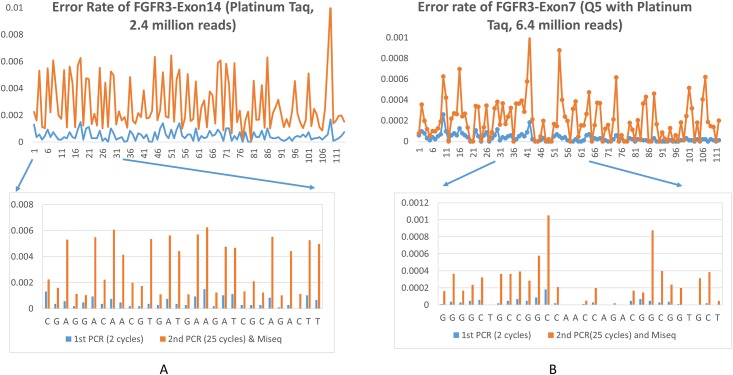
Fig 3. Error rate at each nucleotide position of FGFR3-Exon14 and Exon 7.
(A) Error plotted for all 114 nucleotides of Exon14 (amplified with Platinum Taq), with 30 nucleotides magnified. (B) Error plotted for all 112 nucleotides of Exon7 (amplified with Q5 enzyme), with 30 nucleotides magnified.
Fig 4
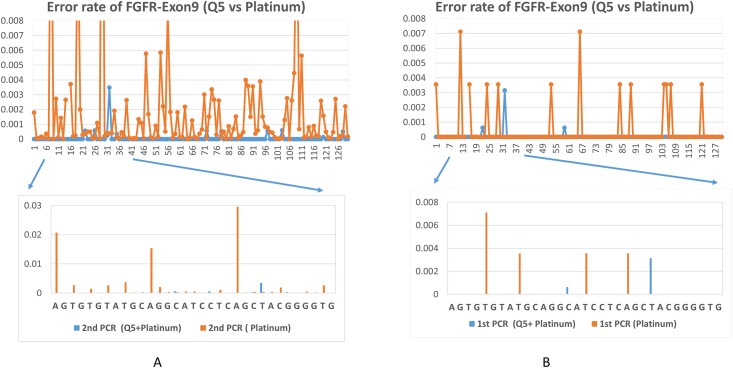
Fig 4. Q5 DNA polymerase improved the fidelity of UID deep sequencing.
(A) Comparison of error rate at each position of FGFR3-Exon 9 in Stage 2 PCR and Illumina sequencing when Q5 (with Taq spike in) vs Platinum DNA Polymerase was used. (B) Comparison of error rate at each position of FGFR3-Exon 9 in Stage 1 PCR when Q5 (with Taq spike in) vs Platinum DNA Polymerase was used.
Fig 5
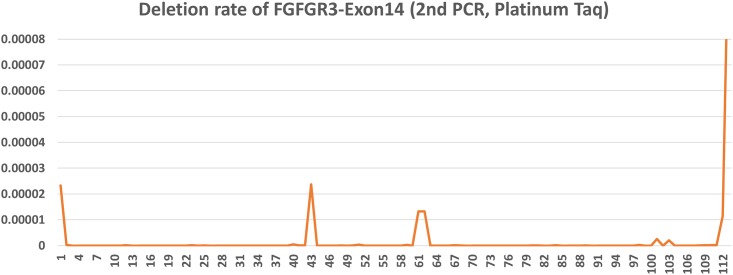
Fig 5. Error rates of deletion types in FGFR3 Exon14.
Platinum DNA polymerase was used. Notice the scale is 100 fold lower than that of Fig 3 or Fig 4.
Fig 6
Fig 6. PCR Bias for wild type over mutant FGFR3-Exon7.
FGFR3-Exon7 was amplified from the wild type template, mutant template (Chr4:1803564 G>A), or 1:1 mixture of the wild type and mutant templates, and the PCR products were sequenced by Sanger method.

References

    1. Bejar R, Stevenson KE, Caughey B, Lindsley RC, Brenton GM, Stojanov P, et al. Somatic Mutations Predict Poor Outcome in Patients With Myelodysplastic Syndrome After Hematopoietic Stem-Cell Transplantation. JCO, 2014; 32(25), 2691–2698 - PMC - PubMed
    1. Bronte G, Rizzo S, La Paglia L, Adamo V, Siragusa S, Ficorella C, et al. Driver mutations and differential sensitivity to targeted therapies: a new approach to the treatment of lung adenocarcinoma. Cancer Treat Rev. 2010; 36Suppl 3: S21–29 10.1016/S0305-7372(10)70016-5 - DOI - PubMed
    1. Kompier LC, Lurkin I, van der Aa MN, van Rhijn BW, van der Kwast TH, Zwarthoff EC. FGFR3, HRAS, KRAS, NRAS and PIK3CA mutations in bladder cancer and their potential as biomarkers for surveillance and therapy. PLoS ONE 2010, 5, e13821 10.1371/journal.pone.0013821 - DOI - PMC - PubMed
    1. Menzo S, Vincenti D, Solmone M, Prosperi M, Bruselles A, Abbate I, et al. Low-Abundance Drug Resistance Mutations: Extending the HIV Paradigm to Hepatitis B Virus. J Infect Dis. 2009, 200 (11):1798–1799 10.1086/647991 - DOI - PubMed
    1. Simen BB, Simons JF, Hullsiek KH, Novak RM, Macarthur RD, Baxter JD, et al. Low-abundance drug-resistant viral variants in chronically HIV-infected, antiretroviral treatment-naive patients significantly impact treatment outcomes. J Infect Dis 2009, 199:693–701 10.1086/596736 - DOI - PubMed

Substances