


Multiband RF pulses with improved performance via convex optimization
- PMID: 26754063
- PMCID: PMC4716678
- DOI: 10.1016/j.jmr.2015.11.010
Multiband RF pulses with improved performance via convex optimization
Abstract
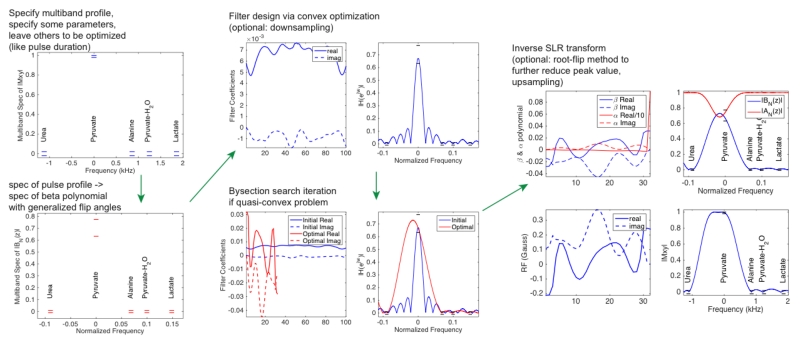
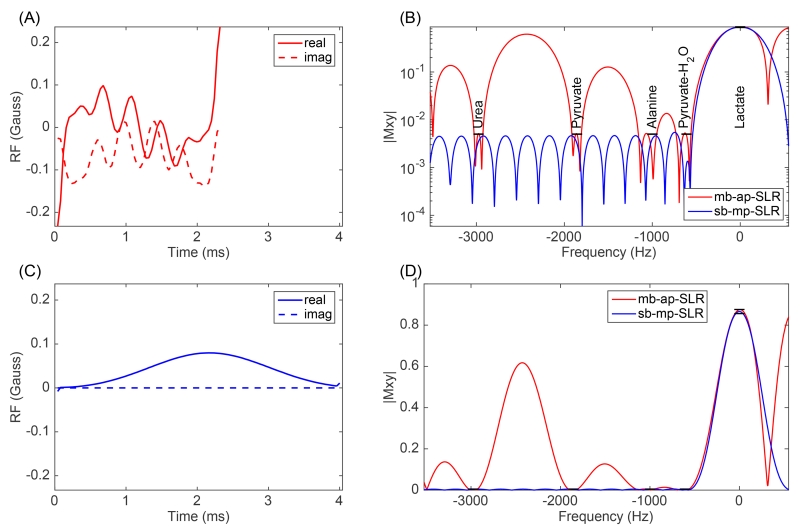
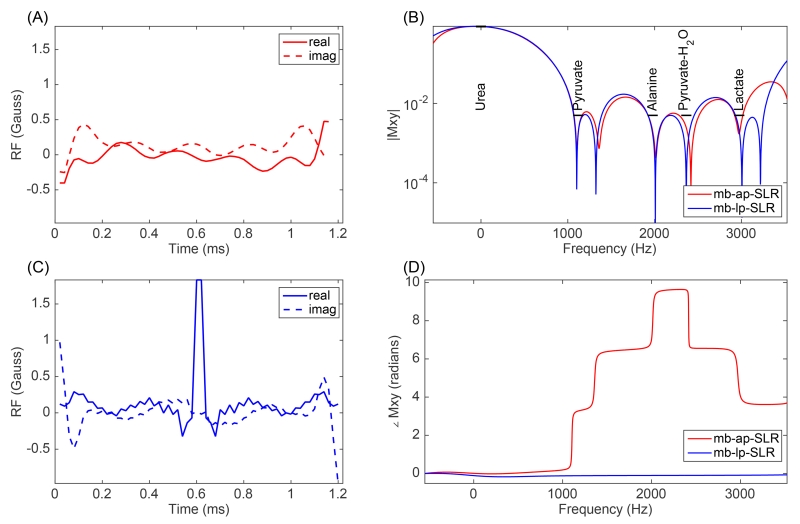
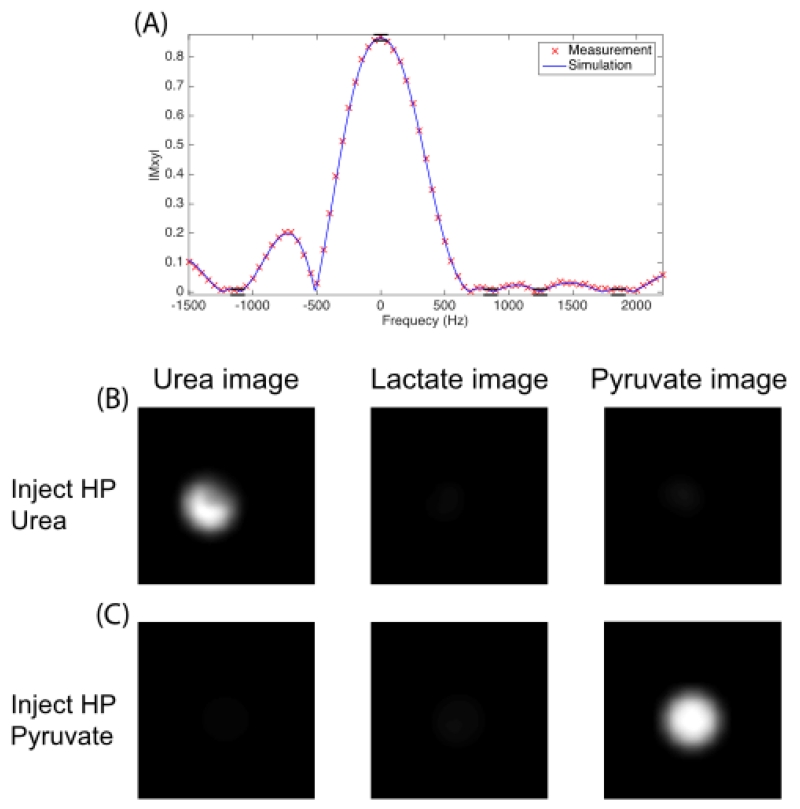
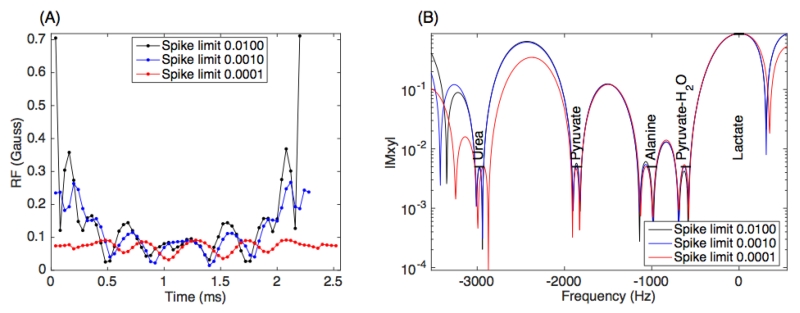
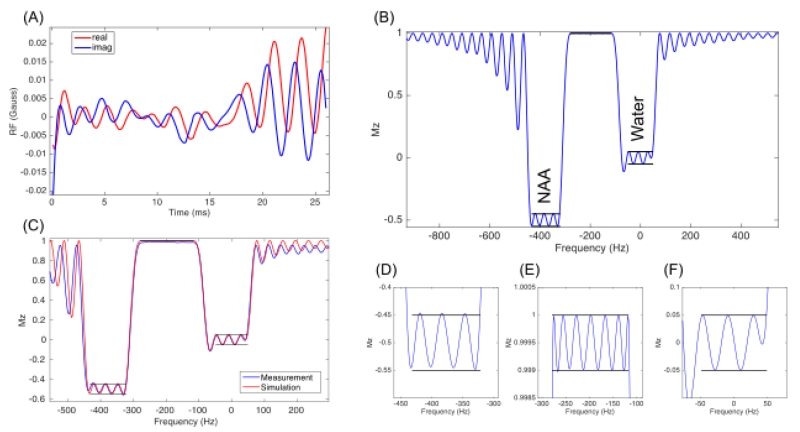
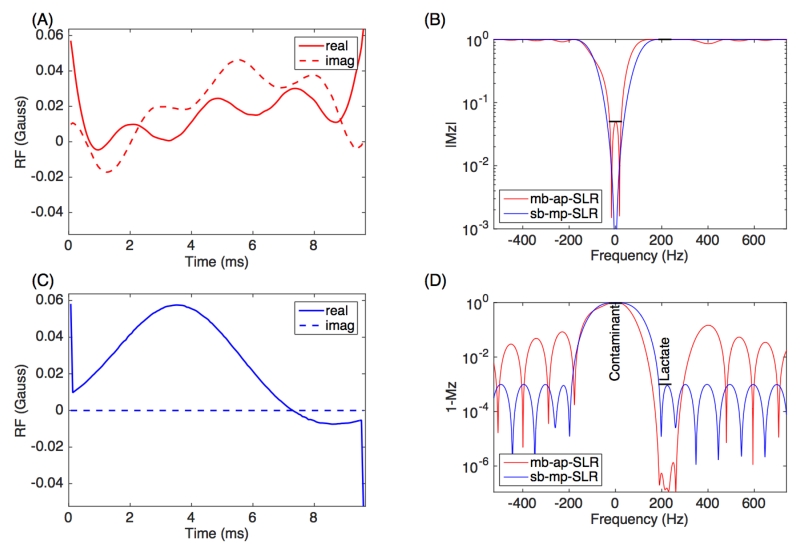
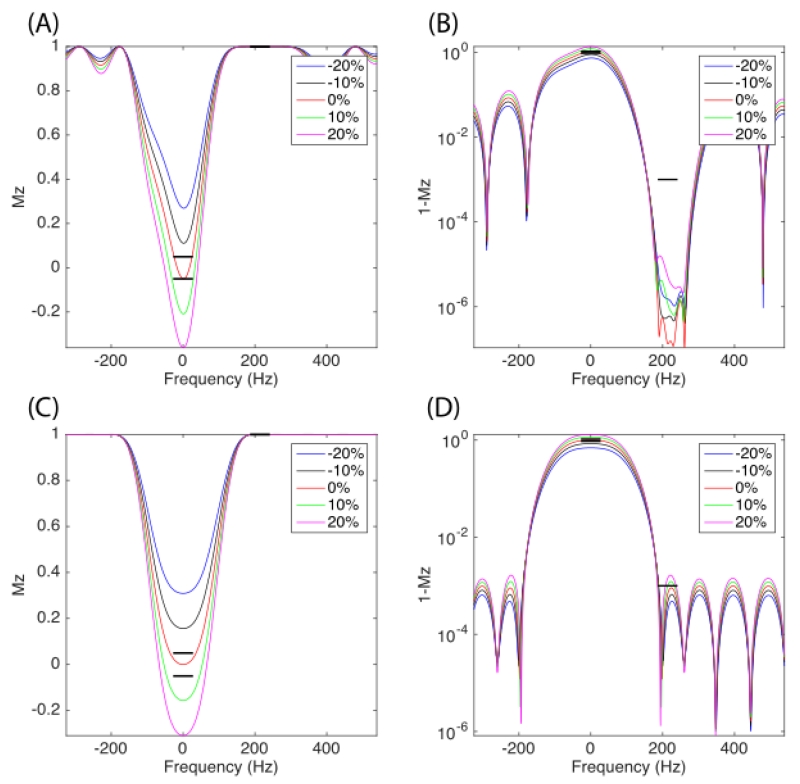
Selective RF pulses are commonly designed with the desired profile as a low pass filter frequency response. However, for many MRI and NMR applications, the spectrum is sparse with signals existing at a few discrete resonant frequencies. By specifying a multiband profile and releasing the constraint on "don't-care" regions, the RF pulse performance can be improved to enable a shorter duration, sharper transition, or lower peak B1 amplitude. In this project, a framework for designing multiband RF pulses with improved performance was developed based on the Shinnar-Le Roux (SLR) algorithm and convex optimization. It can create several types of RF pulses with multiband magnitude profiles, arbitrary phase profiles and generalized flip angles. The advantage of this framework with a convex optimization approach is the flexible trade-off of different pulse characteristics. Designs for specialized selective RF pulses for balanced SSFP hyperpolarized (HP) (13)C MRI, a dualband saturation RF pulse for (1)H MR spectroscopy, and a pre-saturation pulse for HP (13)C study were developed and tested.
Keywords: Convex optimization; Generalized flip angle; Improved pulse performance; Multiband; RF pulse design; Shinnar–Le Roux algorithm.
Copyright © 2015 Elsevier Inc. All rights reserved.
Figures
References
-
- Schricker Amir A., Pauly John M., John Kurhanewicz, Swanson Mark G., Vigneron Daniel B. Dualband spectral-spatial RF pulses for prostate MR spectroscopic imaging. Magnetic resonance in medicine. 2001;46(6):1079–1087. - PubMed
-
- Kerr AB, Larson PE, Lustig M, Cunningham CH, Chen AP, Vigneron DB, Pauly JM. Multiband spectral-spatial design for high-field and hyperpolarized C-13 applications; Proceedings of the 16th Annual Meeting of ISMRM; 2008.p. 226.
-
- Larson Peder EZ, Kerr Adam B., Chen Albert P., Lustig Michael S., Zierhut Matthew L., Simon Hu, Cunningham Charles H., Pauly John M., John Kurhanewicz, Vigneron Daniel B. Multiband excitation pulses for hyperpolarized 13C dynamic chemical-shift imaging. Journal of magnetic resonance. 2008;194(1):121–127. - PMC - PubMed
-
- Pauly John, Patrick Le Roux, Dwight Nishimura, Albert Macovski. Parameter relations for the Shinnar-Le Roux selective excitation pulse design algorithm [NMR imaging] Medical Imaging, IEEE Transactions on. 1991;10(1):53–65. - PubMed
-
- Cunningham Charles H., Wood Michael L. Method for improved multiband excitation profiles using the Shinnar-Le Roux transform. Magnetic resonance in medicine. 1999;42(3):577–584. - PubMed
Publication types
MeSH terms
Substances
Grants and funding
- P41 EB013598/EB/NIBIB NIH HHS/United States
- R01 EB013427/EB/NIBIB NIH HHS/United States
- P30 DK026743/DK/NIDDK NIH HHS/United States
- P41EB013598/EB/NIBIB NIH HHS/United States
- R01 CA183071/CA/NCI NIH HHS/United States
- R01 EB017449/EB/NIBIB NIH HHS/United States
- R01EB016741/EB/NIBIB NIH HHS/United States
- R01EB013427/EB/NIBIB NIH HHS/United States
- R01EB017449/EB/NIBIB NIH HHS/United States
- R00 EB012064/EB/NIBIB NIH HHS/United States
- R01 EB016741/EB/NIBIB NIH HHS/United States
- R00EB012064/EB/NIBIB NIH HHS/United States
LinkOut - more resources
Full Text Sources
Other Literature Sources
Medical
Research Materials
Miscellaneous
