


Estimating mother-to-child HIV transmission rates in Cameroon in 2011: a computer simulation approach
- PMID: 26754155
- PMCID: PMC4709976
- DOI: 10.1186/s12879-016-1336-2
Estimating mother-to-child HIV transmission rates in Cameroon in 2011: a computer simulation approach
Abstract
Background: Despite the progress in the Prevention of the Mother-to-Child Transmission of HIV (PMTCT), the paediatric HIV epidemic remains worrying in Cameroon. HIV prevalence rate for the population of pregnant women was 7.6% in 2010 in Cameroon. The extent of the paediatric HIV epidemic is needed to inform policymakers. We developed a stochastic simulation model to estimate the number of new paediatric HIV infections through MTCT based on the observed uptake of services during the different steps of the PMTCT cascade in Cameroon in 2011. Different levels of PMTCT uptake was also assessed.
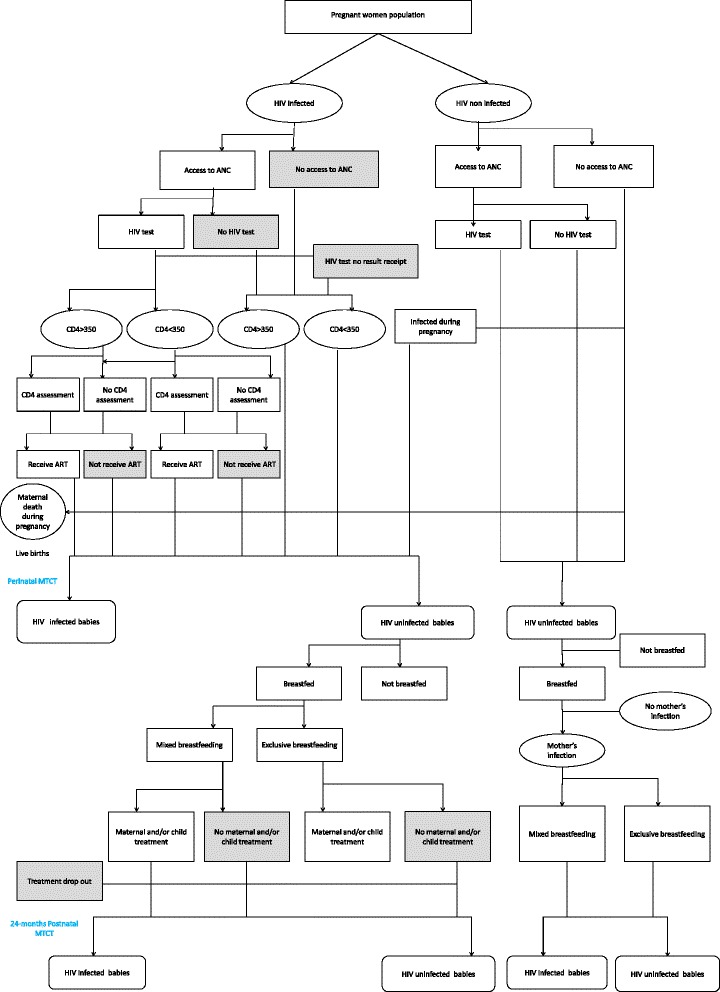
Methods: A discrete events computer simulation-based approach with stochastic structure was proposed to generate a cohort of pregnant women followed-up until 6 weeks post-partum, and optionally until complete breastfeeding cessation in both prevalent and incident lactating HIV-infected women. The different parameters of the simulation model were fixed using data sources available from the 2011 national registry surveys, and from external cohorts in Cameroon. Different PMTCT coverages were simulated to assess their impact on MTCT. Available data show a low coverage of PMTCT services in Cameroon in 2011.
Results: Based on a simulation approach on a population of 995, 533 pregnant women, the overall residual MTCT rate in 2011 was estimated to be 22.1% (95 % CI: 18.6%-25.2%), the 6-week perinatal MTCT rate among prevalent HIV-infected mothers at delivery is estimated at 12.1% (95% CI: 8.1%-15.1%), with an additional postnatal MTCT rate estimated at 13.3% (95% CI: 9.3%-17.8%). The MTCT rate among children whose mothers seroconverted during breastfeeding was estimated at 20.8% (95% CI: 14.1%-26.9%). Overall, we estimated the number of new HIV infections in children in Cameroon to be 10, 403 (95% CI: 9, 054-13, 345) in 2011. When PMTCT uptake have been fixed at 100%, 90% and 80%, global MTCT rate failed to 0.9% (9% CI: 0.5%-1.7%), 2.0% (95% CI: 0.9%-3.2%) and 4.3% (95% CI: 2.4%-6.7%) respectively.
Conclusions: This model is helpful to provide MTCT estimates to guide the national HIV policy in Cameroon. Increasing supply and uptake of PMTCT services among prevalent HIV infected pregnant women, as well as HIV-prevention interventions including the offer and acceptance of HIV testing and counselling in lactating women could reduce significantly the residual HIV MTCT in Cameroon. A public health effort should be made to encourage health care workers and pregnant women to use PMTCT services until complete breastfeeding cessation.
Figures
References
-
- World Health Organisation, UNAIDS report on the global AIDS epidemic 2013. 2013. Available from: http://www.unaids.org/en/media/unaids/contentassets/documents/epidemiolo.... Accessed 19 Sept 2014.
-
- World Health Organisation, UNAIDS Report on the global AIDS epidemic 2012. 2012 Available from: http://www.unaids.org/sites/default/files/media_asset/20121120_UNAIDS_Gl.... Accessed 28 Nov 2015.
-
- Leroy V, Ekouevi D, Becquet R, Viho I, Dequae-Merchadou L, Tonwe-Gold B. 18-month effectiveness of short-course antiretroviral regimens combined with alternatives to breastfeeding to prevent HIV mother-to-child transmission. PLoS ONE. 2008;3(2):e1645–e. doi: 10.1371/journal.pone.0001645. - DOI - PMC - PubMed
Publication types
MeSH terms
LinkOut - more resources
Full Text Sources
Other Literature Sources
Medical
