


Pre-employment examinations for preventing injury, disease and sick leave in workers
- PMID: 26755127
- PMCID: PMC7163410
- DOI: 10.1002/14651858.CD008881.pub2
Pre-employment examinations for preventing injury, disease and sick leave in workers
Abstract
Background: Many employers and other stakeholders believe that health examinations of job applicants prevent occupational diseases and sickness absence. This is an update of the original Cochrane review (Mahmud 2010).
Objectives: To evaluate the effectiveness of pre-employment examinations of job applicants in preventing occupational injury, disease and sick leave compared to no intervention or alternative interventions.
Search methods: We searched CENTRAL (the Cochrane Library), MEDLINE, EMBASE, CINAHL, PsycINFO and PEDro (up to 31 March 2015). We did not impose any restrictions on date, language or publication type.
Selection criteria: We included randomised controlled trials (RCTs), controlled before-after (CBA) studies, and interrupted time-series (ITS) studies of health examinations to prevent occupational diseases and injuries in job applicants in comparison to no intervention or alternative interventions.
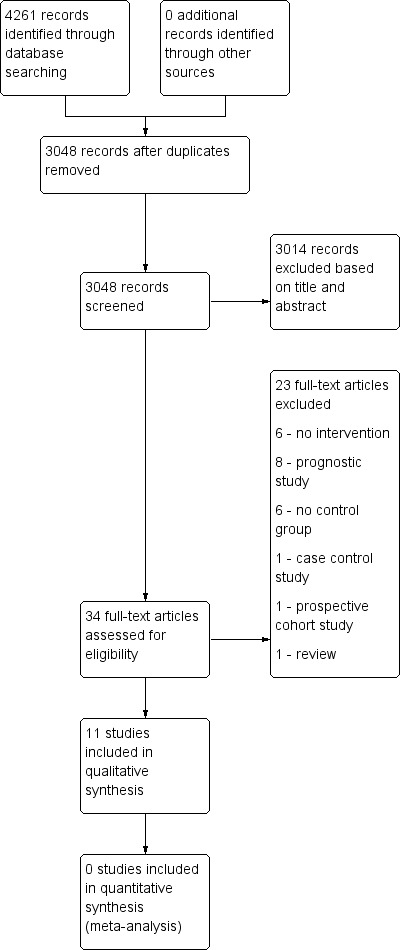
Data collection and analysis: All five review authors independently selected studies from the updated search for inclusion. We retrieved two new studies with the updated search from 1 April 2008 to 31 March 2015, resulting in a total of eleven studies.
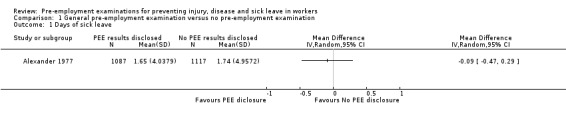
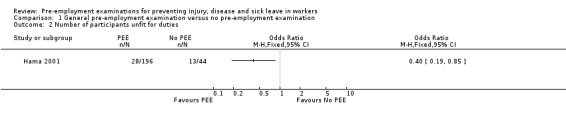
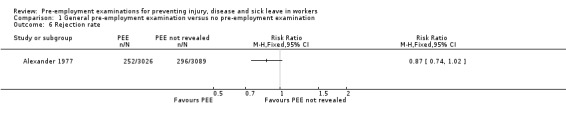
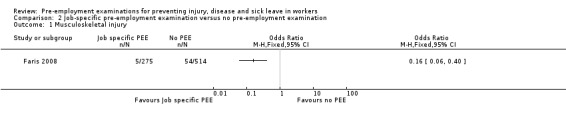
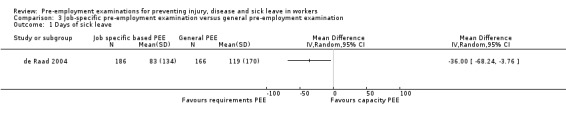
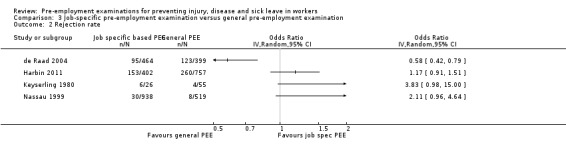
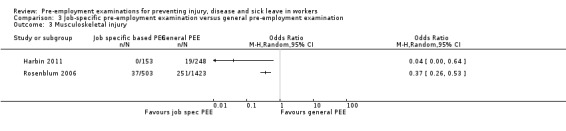
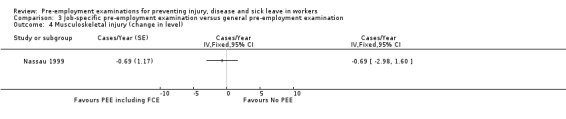
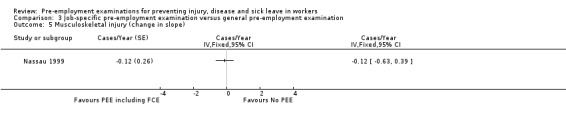
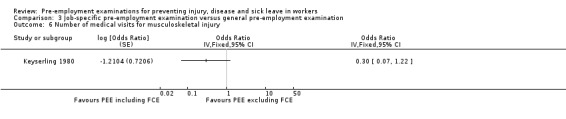
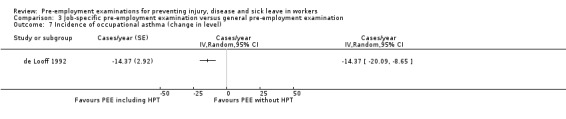
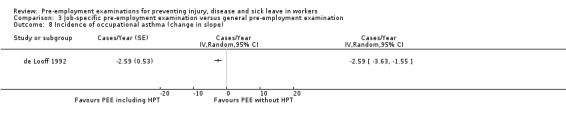
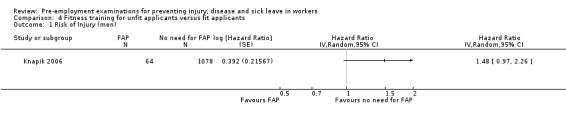
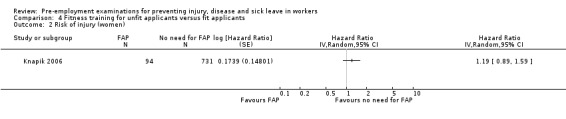
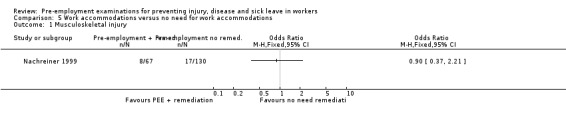
Main results: We included two RCTs, seven CBA studies and two ITS studies. Nine studies with 7820 participants evaluated the screening process of pre-employment examinations as a whole, and two studies with 2164 participants evaluated the measures to mitigate the risks found following the screening process. The studies were too heterogeneous for statistical pooling of results. We rated the quality of the evidence for all outcomes as very low quality. The two new CBA studies both used historical controls and both had a high risk of bias.Of those studies that evaluated the screening process, there is very low quality evidence based on one RCT that a general examination for light duty work may not reduce the risk for sick leave (mean difference (MD) -0.09, 95% confidence interval (CI) -0.47 to 0.29). For army recruits, there is very low quality evidence based on one CBA study that there is a positive effect on fitness for duty after 12 months follow-up (odds ratio (OR) 0.40, 95% CI 0.19 to 0.85).We found inconsistent evidence of an effect of job-focused pre-employment examinations on the risk of musculoskeletal injuries in comparison with general or no pre-employment examination based on one RCT with high risk of bias, and four CBA studies. There is very low quality evidence based on one ITS study that incorporation of a bronchial challenge test may decrease occupational asthma (trend change -2.6, 95% CI -3.6 to -1.5) compared to a general pre-employment examination with lung function tests.Pre-employment examinations may also result in a rejection of the applicant for the new job. In six studies, the rates of rejecting job applicants increased because of the studied examinations , on average, from 2% to 35%, but not in one study.There is very low quality evidence based on two CBA studies that risk mitigation among applicants considered not fit for work at the pre-employment examination may result in a similar risk of work-related musculoskeletal injury during follow-up compared to workers considered fit for work at the health examination.
Authors' conclusions: There is very low quality evidence that a general examination for light duty work may not reduce the risk for sick leave, but may have a positive effect on fitness for duty for army recruits after 12 months follow-up.There is inconsistent evidence of an effect of job-focused pre-employment examinations on the risk of musculoskeletal injuries in comparison with general or no pre-employment examination. There is very low quality evidence that incorporation of a bronchial challenge test may decrease occupational asthma compared to a general pre-employment examination with lung function tests. Pre-employment examinations may result in an increase of rejecting job applicants in six out of seven studies. Risk mitigation based on the result of pre-employment examinations may be effective in reducing an increased risk for occupational injuries based on very low quality evidence. This evidence supports the current policy to restrict pre-employment examinations to only job-specific examinations. Better quality evaluation studies on pre-employment examinations are necessary, including the evaluation of the benefits of risk mitigation, given the effect on health and on the financial situation for those employees who do not pass the pre-employment examination.
Conflict of interest statement
Frederieke Schaafsma: None known.
Norashikin Mahmud: None known.
Michiel Reneman: None known.
Jean‐Baptiste Fassier: None known.
Franciscus Jungbauer: None known.
Figures
Update of
-
Pre-employment examinations for preventing occupational injury and disease in workers.Cochrane Database Syst Rev. 2010 Dec 8;(12):CD008881. doi: 10.1002/14651858.CD008881. Cochrane Database Syst Rev. 2010. Update in: Cochrane Database Syst Rev. 2016 Jan 12;(1):CD008881. doi: 10.1002/14651858.CD008881.pub2. PMID: 21154401 Updated.
References
References to studies included in this review
Alexander 1977 {published data only}
-
- Alexander RW, Brennan JC, Maida AS, Walker RJ. The value of pre‐placement medical examinations for non‐hazardous light duty work. Journal of Occupational Medicine 1977;19(2):107‐12. - PubMed
-
- Alexander RW, Maida AS, Walker RJ. The validity of pre‐employment medical evaluations. Journal of Occupational Medicine 1975;17(11):687‐92. - PubMed
de Looff 1992 {published data only}
-
- Looff AJ, Dijkmans AP, Sorgdrager B. Histamine provocation test: an effective pre‐employment selection method for aluminium workers. Medicina del Lavoro 1992;83(5):422‐7. - PubMed
de Raad 2004 {published data only}
-
- Raad J, Redekop WK. A comparison between two systems for pre‐employment medical assessment in the Royal Netherlands Army by a randomised controlled study. Military Medicine 2004;169(6):437‐43. - PubMed
Faris 2008 {published data only}
-
- Faris J. Lowering nursing injuries using post offer pre‐employment testing. Work 2008;31:39‐45. - PubMed
Hama 2001 {published data only}
-
- Hama Y, Masumori K, Tagami H, Fujiwara K, Kusano S. Preassignment examination for personnel on Iwo Jima. Military Medicine 2001;166(8):721‐4. - PubMed
Harbin 2011 {published data only}
-
- Harbin GL, Shenoy C, Garcia A, Olson JC. Shoulder injury reduction with post‐offer testing. Work 2011;39:113‐23. - PubMed
Keyserling 1980 {published data only}
-
- Keyserling WM, Herrin GD, Chaffin DB. Isometric strength testing as a means of controlling medical incidents on strenuous jobs. Journal of Occupational Medicine 1980;22(5):332‐6. - PubMed
Knapik 2006 {published data only}
-
- Knapik JJ, Darakjy S, Hauret KG, Canada S, Scott S, Rieger W, et al. Increasing the physical fitness of low‐fit recruits before basic combat training: an evaluation of fitness, injuries, and training outcomes. Military Medicine 2006;171(1):45‐54. - PubMed
Nachreiner 1999 {published data only}
-
- Nachreiner N, McGovern P, Kochevar LK, Lohman WH, Cato C, Ayers E. Preplacement assessments:Impact on injury outcomes. American Association of Occupational Health Nurses 1999;47(6):245‐53. - PubMed
Nassau 1999 {published data only}
-
- Nassau DW. The effects of pre work functional screening on lowering an employer's injury rate, medical costs, and lost work days. Spine 1999;24(3):269‐74. - PubMed
Rosenblum 2006 {published data only}
-
- Rosenblum KE, Shankar A. A study of the effects of isokinetic pre‐employment physical capability screening in the reduction of musculoskeletal disorders in a labor intensive work environment. Work 2006;26(2):215‐28. - PubMed
References to studies excluded from this review
Adeyekun 2010 {published data only}
-
- Adeyekun AA, Egbagbe EE, Oni OA. Contact tracing/pre‐employment screening for pulmonary tuberculosis: should positive Mantoux test necessitates routine chest X‐ray?. Annals of African Medicine 2010;9(3):159‐63. - PubMed
Ali 2002 {published data only}
-
- Ali NS, Hussain SF, Azam SI. Is there a value of Mantoux test and erythrocyte sedimentation rate in pre‐employment screening of health care workers for tuberculosis in a high prevalence country?. International Journal of Tuberculosis and Lung Disease 2002;6(11):1012‐6. - PubMed
Anderson 2008 {published data only}
-
- Anderson C, Briggs J. A study of the effectiveness of ergonomically‐based functional screening tests and their relationship to reducing worker compensation injuries. Work 2008;31(1):27‐37. - PubMed
Arndt 2002 {published data only}
-
- Arndt KH, Roth M. Fitness for public service ‐ Results of standardised acceptance examinations. Gesundheitswesen 2002;64(8‐9):499‐502. - PubMed
Barnard 2004 {published data only}
Bigos 1987 {published data only}
-
- Bigos SJ, Battie MC. Preplacement worker testing and selection considerations. Ergonomics 1987;30(2):249‐51. - PubMed
Bigos 1992a {published data only}
-
- Bigos SJ, Battie MC, Fisher LD, Hansson TH, Spengler DM, Nachemson AL. A prospective evaluation of pre employment screening methods for acute industrial back pain. Spine 1992;17(8):922‐6. - PubMed
Bigos 1992b {published data only}
-
- Bigos SJ, Hansson T, Castillo RN, Beecher PJ, Wortley MD. The value of pre employment roentgenographs for predicting acute back injury claims and chronic back pain disability. Clinical Orthopaedics and Related Research 1992;283:124‐9. - PubMed
Bingham 1996 {published data only}
-
- Bingham RC, Rosecrance JC, Cook TM. Prevalence of abnormal median nerve conduction in applicants for industrial jobs. American Journal of Industrial Medicine 1996;30(3):355‐61. - PubMed
Chaffin 1978 {published data only}
-
- Chaffin DB, Herrin GD, Keyserling WM. Preemployment strength testing. An updated position. Journal of Occupational Medicine 1978;20(6):403‐8. - PubMed
Dale 2014 {published data only}
de Raad 2005 {published data only}
-
- Raad J, Redekop WK. Analysis of health factors as predictors for the functioning of military personnel: Study of the factors that predict fitness for duty and medical costs of soldiers of the Royal Netherlands Army. Military Medicine 2005;170(1):14‐20. - PubMed
Evans 2005 {published data only}
-
- Evans R, Reynolds K, Creedon J, Murphy M. Incidence of acute injury related to fitness testing of U.S. Army personnel. Military Medicine 2005;170(2):1005‐11. - PubMed
Franzblau 2004 {published data only}
-
- Franzblau A, Werner RA, Yihan J. Preplacement nerve testing for carpal tunnel syndrome: Is it cost effective?. Journal of Occupational and Environmental Medicine 2004;46(7):714‐9. - PubMed
Gassoway 2000 {published data only}
-
- Gassoway J, Flory V. Prework screen: Is it helpful in reducing injuries and costs?. Work 2000;15(2):101‐6. - PubMed
Harbin 2005 {published data only}
-
- Harbin G, Olson J. Post‐offer, pre‐placement testing in industry. American Journal of Industrial Medicine 2005;47(4):296‐307. - PubMed
La Rocca 1969 {published data only}
Legge 2013 {published data only}
Lowenthal 1986 {published data only}
-
- Lowenthal G. Medical centre worker pre‐placement screening: A follow‐up study. Journal of Occupational Medicine 1986;28(6):451‐2. - PubMed
Lucey 2008 {published data only}
-
- Lucey SP. Can pre‐placement health assessments predict subsequent sickness absence?. Occupational Medicine 2008;58:355‐60. - PubMed
Madan 2012 {published data only}
-
- Madan I, Williams S. Is pre‐employment health screening by questionnaire effective?. Occupational Medicine 2012;62(2):112‐16. - PubMed
Normand 1989 {published data only}
-
- Normand J, Salyards S. An empirical evaluation of pre‐employment drug testing in the United States postal service: Interim report of findings. NIDA Research Monograph Series 91 1989:111‐38. - PubMed
Ryan 2010 {published data only}
-
- Ryan S. The predictive capacity of declared musculoskeletal disorder at pre‐employment screening. Occupational Medicine 2010;60:354‐357. - PubMed
Additional references
ADA 2009
-
- Americans with Disability Act. www.ada.gov/employmt.htm (accessed 10 November 2009).
Barrat 2002
-
- Barrat A, Irwig L, Glasziou P, Cumming R, Raffle A, Hicks N, et al. Recommendations about screening. In: Guyatt G, Rennie D editor(s). Users' Guide to the Medical Literature: a Manual for Evidence‐Based Clinical Practice. 2nd Edition. Chicago (IL): American Medical Association, 2002:583‐97.
Braddick 1992
-
- Braddick MR, Atwell CP, Aw T‐C. Audit of pre‐employment health assessment in the National Health Service. Occupational Medicine 1992;42:36‐8. - PubMed
Cox 2000
-
- Cox R, Edwards F, Palmer KT. Fitness for Work, the Medical Aspects. 3rd Edition. Oxford: Oxford Medical Publications, 2000.
de Kort 1991
-
- Kort WL, Fransman LG, Dijk FJ. Pre‐employment medical examination in a large occupational health service. Scandinavian Journal of Work, Environment and Health 1991;17(6):392‐7. - PubMed
de Kort 1997
Downs 1998
EPOC 2006
-
- The Cochrane Effective Practice and Organisation of Care Group (EPOC). Including Interrupted Time Series (ITS). Design in an EPOC Review. EPOC methods paper. http://www.epociuottawa.ca/inttime.pdf (accessed 25 April 2007).
GRADE working group 2004
Hulshof 1999
MacLean 2006
-
- MacLean CH, Newberry SJ, Mojica WA, Khanna P, Issa AM, Suttorp MJ, et al. Effects of omega‐3 fatty acids on cancer risk: a systematic review. JAMA 2006;295(4):403‐15. - PubMed
Mahmud 2010a
Moher 2009
Oliver 2007
Pachman 2009
Ramsay 2003
-
- Ramsay CR, Matowe L, Grilli R, Grimshaw JM, Thomas RE. Interrupted time series designs in health technology assessment: Lessons from two systematic reviews of behavior change strategies. International Journal of Technology Assessment in Health Care 2003;19(4):613‐23. - PubMed
Schonstein 2006
-
- Schonstein E, Verbeek JH. Occupational health systematic reviews: An overview. Work 2006;26(3):255‐8. - PubMed
Serra 2007
Soer 2008
-
- Soer R, Schans CP, Groothoff JW, Geertsen JH, Reneman MF. Towards consensus in operational definitions in functional capacity evaluation: a Delphi Study. Journal of Occupational Rehabilitation 2008;18(4):389‐400. - PubMed
Sorgdrager 2004
-
- Sorgdrager B, Hulshof CT, Dijk FJ. Evaluation of the effectiveness of pre‐employment screening. International Archives of Occupational and Environmental Health 2004;77(4):271‐6. - PubMed
Straus 2006
-
- Straus E, Richardson W, Glasziou P, Haynes RB. Evidence‐based Medicine. Edinburgh: Churchill Livingstone, 2006.
Whitaker 1995
-
- Whitaker S, Aw T‐C. Audit of pre‐employment assessments by occupational health departments in the National Health Service. Occupational Medicine 1995;45:75‐80. - PubMed
References to other published versions of this review
Mahmud 2008
Publication types
MeSH terms
LinkOut - more resources
Full Text Sources
Other Literature Sources
Medical
Miscellaneous
