Review
. 2016 Apr 30;22(2):181-92.
doi: 10.5056/jnm15137.

Mast Cells and Irritable Bowel Syndrome: From the Bench to the Bedside

Affiliations
Review

Mast Cells and Irritable Bowel Syndrome: From the Bench to the Bedside

Lei Zhang et al. J Neurogastroenterol Motil. .

Abstract

Irritable bowel syndrome (IBS) is traditionally defined as a functional disorder since it lacks demonstrable pathological abnormalities. However, in recent years, low grade inflammatory infiltration, often rich in mast cells, in both the small and large bowel, has been observed in some patients with IBS. The close association of mast cells with major intestinal functions, such as epithelial secretion and permeability, neuroimmune interactions, visceral sensation, and peristalsis, makes researchers and gastroenterologists to focus attention on the key roles of mast cells in the pathogenesis of IBS. Numerous studies have been carried out to identify the mechanisms in the development, infiltration, activation, and degranulation of intestinal mast cells, as well as the actions of mast cells in the processes of mucosal barrier disruption, mucosal immune dysregulation, visceral hypersensitivity, dysmotility, and local and central stress in IBS. Moreover, therapies targeting mast cells, such as mast cell stabilizers (cromoglycate and ketotifen) and antagonists of histamine and serotonin receptors, have been tried in IBS patients, and have partially exhibited considerable efficacy. This review focuses on recent advances in the role of mast cells in IBS, with particular emphasis on bridging experimental data with clinical therapeutics for IBS patients.

Keywords: Innate immunity; Irritable bowel syndrome; Mast cells; Mucosal barrier; Visceral pain.


Figures
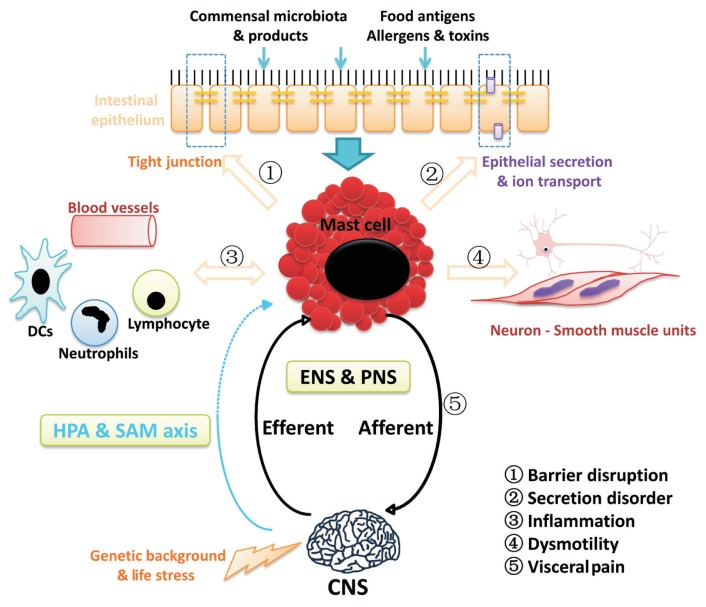
Figure 1
Figure 1
Mechanisms of mast cells involved in the process of irritable bowel syndrome (IBS). On one hand, local microenvironment in the gut lumen including commensal bacteria and products, food antigens, allergens and toxin play key roles in regulating mast cell activation and secretion. Central stress such as psychological distress and negative life events may also contribute to the activation and degranulation of mast cells via the direct pathway (peripheral nervous innervations) and the indirect pathways (the hypothalamic-pituitary-adrenal [HPA] axis and the sympathetic-adrenal-medullary [SAM] axis). On the other hand, activation of mast cell participates in multiple pathophysiological processes in the gut of IBS: ➀ regulating epithelial permeability via acting on tight junction; ➁ regulating epithelial water and ion transport; ➂ regulating blood flow and endothelial functions, as well as immunomodulation, inflammation, and defense against microbes; ➃ regulating intestinal peristalsis; and ➅ regulating function of visceral afferent and sensation via neuroimmune mechanisms. DCs, dendritic cells; ENS, enteric nervous system; PNS, peripheral nervous system; CNS, central nervous system.
Figure 2
Figure 2
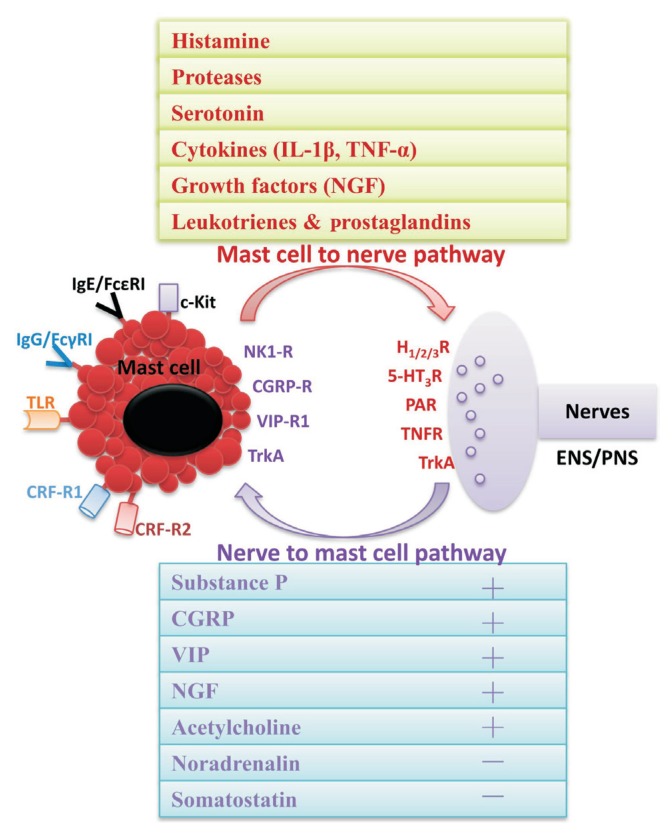
The functionally mast cell (MC)–neuronal units consist of 2 pathways: the nerve to MC signaling and the MC to nerve signaling. In the MC to nerve signaling, MC activate and release bioactive substances preformed in granules (histamine, serotonin, and enzymes) and newly synthesized (cytokines, growth factors, and lipid metabolites), which act on the relevant receptors expressed on the nerve endings, and result in a series of neuronal effects, especially visceral pain. In the nerve to MC signaling, both intrinsic and extrinsic nerves may respond to a variety of mechanical, biological, or chemical stimuli and release a high number of neuropeptides, such as substance P (SP), vasoactive intestinal polypeptide (VIP), calcitonin gene-related peptide (CGRP), nerve growth factor (NGF), and somatostatin, which in turn regulate the activation of MCs. IL-1β, interleukin-1β; TNF-α, tumor necrosis factor-α; FcɛRI, Fc epsilon receptor I; FcγRI, Fc gamma receptor I; TLR, Toll-like receptor; CRF-R1, corticotropin releasing factor receptor 1; CRF-R2, corticotropin releasing factor receptor 2; NK1-R, neurokinin receptor 1; TrkA, tropomyosin receptor kinase A; HR, histamine receptor; 5-HT3, 5-hydroxytryptamine receptor 3; PAR, protease-activated receptor; TNFR, TNF receptor; ENS, enteric nervous system; PNS, peripheral nervous system.

References

    1. Oshima T, Miwa H. Epidemiology of functional gastrointestinal disorders in Japan and in the world. J Neurogastroenterol Motil. 2015;21:320–329. doi: 10.5056/jnm14165. - DOI - PMC - PubMed
    1. Whorwell PJ. IBS in 2014: developments in pathophysiology, diagnosis and management. Nat Rev Gastroenterol Hepatol. 2015;12:72–74. doi: 10.1038/nrgastro.2014.225. - DOI - PubMed
    1. Ohman L, Simrén M. Pathogenesis of IBS: role of inflammation, immunity and neuroimmune interactions. Nat Rev Gastroenterol Hepatol. 2010;7:163–173. doi: 10.1038/nrgastro.2010.4. - DOI - PubMed
    1. Bischoff SC, Krämer S. Human mast cells, bacteria, and intestinal immunity. Immunol Rev. 2007;217:329–337. doi: 10.1111/j.1600-065X.2007.00523.x. - DOI - PubMed
    1. O’Sullivan M, Clayton N, Breslin NP, et al. Increased mast cells in the irritable bowel syndrome. Neurogastroenterol Motil. 2000;12:449–457. doi: 10.1046/j.1365-2982.2000.00221.x. - DOI - PubMed