Review
. 2015:2015:368761.
doi: 10.1155/2015/368761. Epub 2015 Nov 22.

Controversies in Pediatric Perioperative Airways

Affiliations
Review

Controversies in Pediatric Perioperative Airways

Jozef Klučka et al. Biomed Res Int. 2015.

Abstract

Pediatric airway management is a challenge in routine anesthesia practice. Any airway-related complication due to improper procedure can have catastrophic consequences in pediatric patients. The authors reviewed the current relevant literature using the following data bases: Google Scholar, PubMed, Medline (OVID SP), and Dynamed, and the following keywords: Airway/s, Children, Pediatric, Difficult Airways, and Controversies. From a summary of the data, we identified several controversies: difficult airway prediction, difficult airway management, cuffed versus uncuffed endotracheal tubes for securing pediatric airways, rapid sequence induction (RSI), laryngeal mask versus endotracheal tube, and extubation timing. The data show that pediatric anesthesia practice in perioperative airway management is currently lacking the strong evidence-based medicine (EBM) data that is available for adult subpopulations. A number of procedural steps in airway management are derived only from adult populations. However, the objective is the same irrespective of patient age: proper securing of the airway and oxygenation of the patient.


Figures
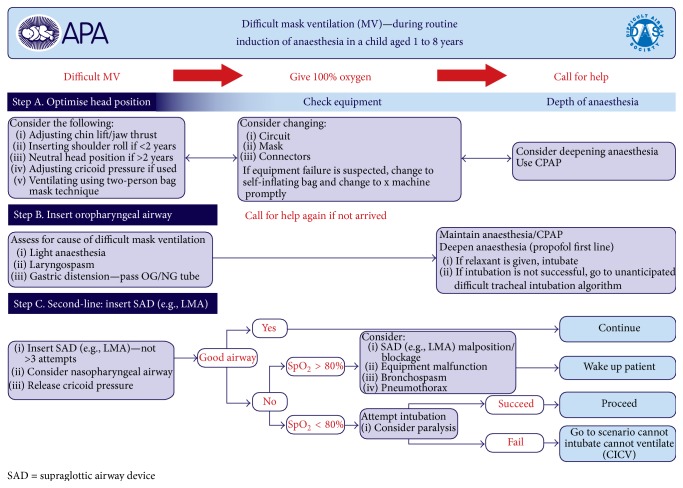
Figure 1
Figure 1
Guidelines for the management of difficult mask ventilation in children aged 1–8 years, published by DAS (Difficult Airway Society) at http://www.das.uk.com/guidelines/paediatric-difficult-airway-guidelines.
Figure 2
Figure 2
Guidelines for the management of unexpected difficult tracheal intubation in children aged 1–8 years, published by DAS (Difficult Airway Society) at http://www.das.uk.com/guidelines/paediatric-difficult-airway-guidelines.
Figure 3
Figure 3
Guidelines for the management of CICV scenario in children aged 1–8 years, published by DAS (Difficult Airway Society) at http://www.das.uk.com/guidelines/paediatric-difficult-airway-guidelines.
Figure 4
Figure 4
Guidelines for the management of tracheal extubation, basic algorithm, published by DAS (Difficult Airway Society) at http://www.das.uk.com/guidelines/paediatric-difficult-airway-guidelines.
Figure 5
Figure 5
Guidelines for the management of tracheal extubation, low risk algorithm, published by DAS (Difficult Airway Society) at http://www.das.uk.com/guidelines/paediatric-difficult-airway-guidelines.
Figure 6
Figure 6
Guidelines for the management of tracheal extubation, high risk algorithm, published by DAS (Difficult Airway Society) at http://www.das.uk.com/guidelines/paediatric-difficult-airway-guidelines.

References

    1. Litman R. S., Weissend E. E., Shibata D., Westesson P.-L. Developmental changes of laryngeal dimensions in unparalyzed, sedated children. Anesthesiology. 2003;98(1):41–45. doi: 10.1097/00000542-200301000-00010. - DOI - PubMed
    1. Karkouti K., Rose D. K., Wigglesworth D., Cohen M. M. Predicting difficult intubation: a multivariable analysis. Canadian Journal of Anesthesia. 2000;47(8):730–739. doi: 10.1007/bf03019474. - DOI - PubMed
    1. Frei F. J., Ummenhofer W. Difficult intubation in paediatrics. Paediatric Anaesthesia. 1996;6(4):251–263. doi: 10.1111/j.1460-9592.1996.tb00447.x. - DOI - PubMed
    1. Heinrich S., Birkholz T., Ihmsen H., Irouschek A., Ackermann A., Schmidt J. Incidence and predictors of difficult laryngoscopy in 11.219 pediatric anesthesia procedures. Paediatric Anaesthesia. 2012;22(8):729–736. doi: 10.1111/j.1460-9592.2012.03813.x. - DOI - PubMed
    1. Heinrich S., Birkholz T., Irouschek A., Ackermann A., Schmidt J. Incidences and predictors of difficult laryngoscopy in adult patients undergoing general anesthesia: a single-center analysis of 102,305 cases. Journal of Anesthesia. 2013;27(6):815–821. doi: 10.1007/s00540-013-1650-4. - DOI - PubMed

Publication types
