Survey on RGB, 3D, Thermal, and Multimodal Approaches for Facial Expression Recognition: History, Trends, and Affect-Related Applications
- PMID: 26761193
- PMCID: PMC7426891
- DOI: 10.1109/TPAMI.2016.2515606
Survey on RGB, 3D, Thermal, and Multimodal Approaches for Facial Expression Recognition: History, Trends, and Affect-Related Applications
Abstract
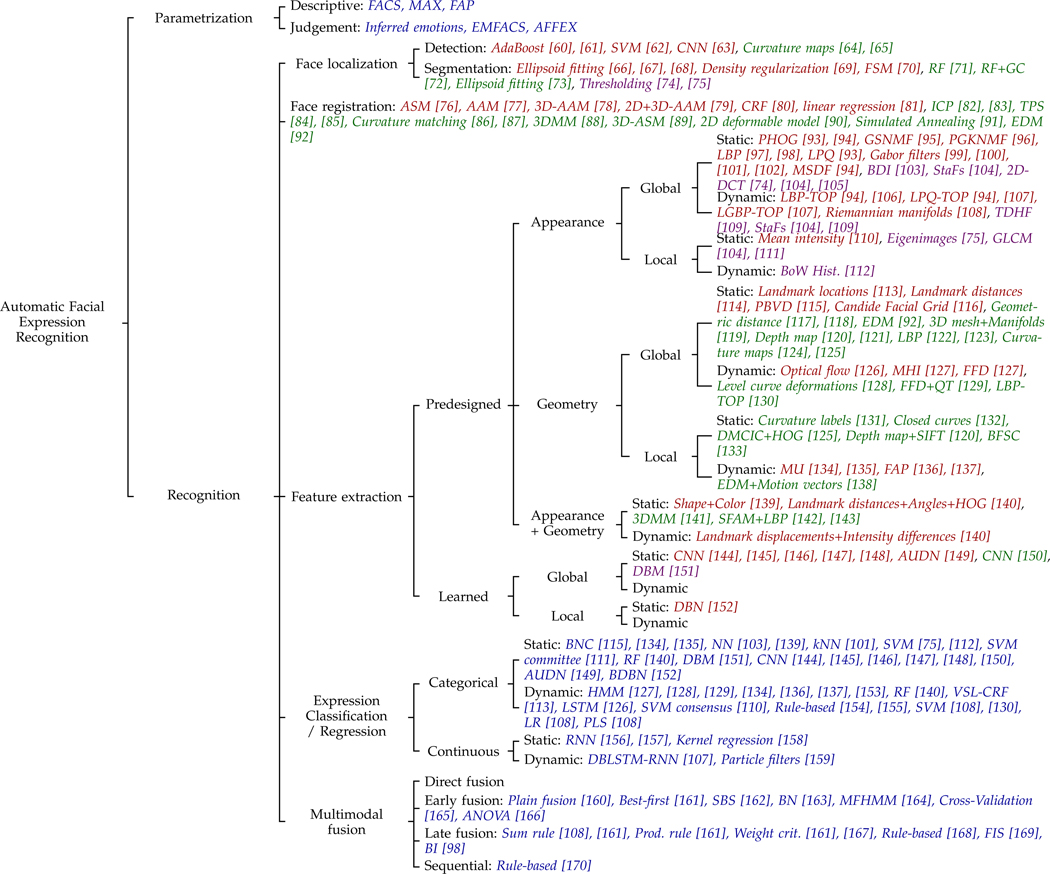
Facial expressions are an important way through which humans interact socially. Building a system capable of automatically recognizing facial expressions from images and video has been an intense field of study in recent years. Interpreting such expressions remains challenging and much research is needed about the way they relate to human affect. This paper presents a general overview of automatic RGB, 3D, thermal and multimodal facial expression analysis. We define a new taxonomy for the field, encompassing all steps from face detection to facial expression recognition, and describe and classify the state of the art methods accordingly. We also present the important datasets and the bench-marking of most influential methods. We conclude with a general discussion about trends, important questions and future lines of research.
Figures




References
-
- Roger Highfield RW and Jenkins R, “How your looks betray your personality,” New Scientist, 2009.
-
- Chastel A, Leonardo on Art and the Artist. Courier Corporation, 2002.
-
- Greenblatt S et al., “Toward a universal language of motion: reflections on a seventeenth century muscle man,” 1994.
-
- de Boulogne G-BD and Cuthbertson RA, The Mechanism of Human Facial Expression. Cambridge University Press, 1990.
-
- Darwin C, The expression of emotion in man and animals. Oxford University Press, 1872.
Publication types
MeSH terms
Grants and funding
LinkOut - more resources
Full Text Sources
Other Literature Sources