


Toward Bioremediation of Methylmercury Using Silica Encapsulated Escherichia coli Harboring the mer Operon
- PMID: 26761437
- PMCID: PMC4712050
- DOI: 10.1371/journal.pone.0147036
Toward Bioremediation of Methylmercury Using Silica Encapsulated Escherichia coli Harboring the mer Operon
Abstract
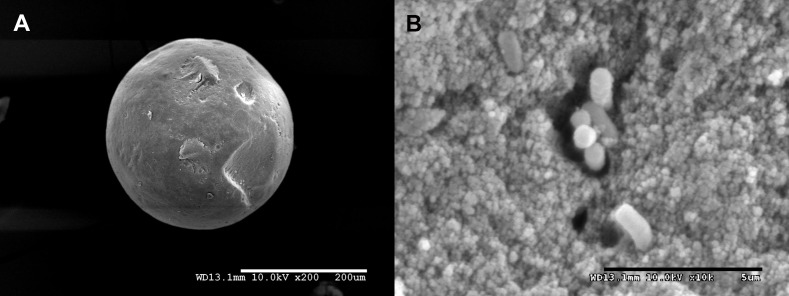
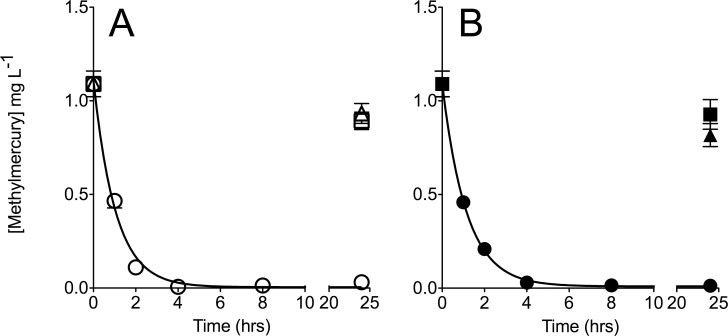
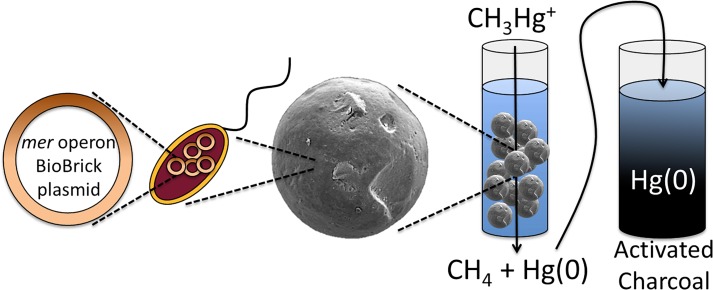
Mercury is a highly toxic heavy metal and the ability of the neurotoxin methylmercury to biomagnify in the food chain is a serious concern for both public and environmental health globally. Because thousands of tons of mercury are released into the environment each year, remediation strategies are urgently needed and prompted this study. To facilitate remediation of both organic and inorganic forms of mercury, Escherichia coli was engineered to harbor a subset of genes (merRTPAB) from the mercury resistance operon. Protein products of the mer operon enable transport of mercury into the cell, cleavage of organic C-Hg bonds, and subsequent reduction of ionic mercury to the less toxic elemental form, Hg(0). E. coli containing merRTPAB was then encapsulated in silica beads resulting in a biological-based filtration material. Performing encapsulation in aerated mineral oil yielded silica beads that were smooth, spherical, and similar in diameter. Following encapsulation, E. coli containing merRTPAB retained the ability to degrade methylmercury and performed similarly to non-encapsulated cells. Due to the versatility of both the engineered mercury resistant strain and silica bead technology, this study provides a strong foundation for use of the resulting biological-based filtration material for methylmercury remediation.
Conflict of interest statement
Figures
References
-
- Lin CC, Yee N, Barkay T. Microbial transformation in the mercury cycle In: Liu G, Yong C, O’Driscoll N, editors. Environmental chemistry and toxicology of mercury. Hoboken: John Wiley and Sons; 2012. pp. 155–191.
-
- Barkay T, Miller SM, Summers AO. Bacterial mercury resistance from atoms to ecosystems. FEMS Microbiol Rev. 2003;27: 355–384. - PubMed
-
- Tchounwou PB, Ayensu WK, Ninashvili N, Sutton D. Environmental exposure to mercury and its toxicopathologic implications for public health. Environ Toxicol. 2003;18: 149–175. - PubMed
-
- United Nations Environment Programme. Global mercury assessment 2013: Sources, emissions, releases and environmental transport Geneva: UNEP Chemicals Branch; 2013. pp. 1–32.
-
- Wagner-Döbler I. Current research for bioremediation of mercury In: Wagner-Dobler I, editor. Bioremediation of mercury: Current research and industrial applications. Norfolk: Caister Academic Press; 2013. pp. 1–13.
Publication types
MeSH terms
Substances
LinkOut - more resources
Full Text Sources
Other Literature Sources
Miscellaneous
