


Changes in plasma biomarkers following treatment with cabozantinib in metastatic castration-resistant prostate cancer: a post hoc analysis of an extension cohort of a phase II trial
- PMID: 26762579
- PMCID: PMC4712499
- DOI: 10.1186/s12967-015-0747-y
Changes in plasma biomarkers following treatment with cabozantinib in metastatic castration-resistant prostate cancer: a post hoc analysis of an extension cohort of a phase II trial
Abstract
Background: Cabozantinib is an orally available inhibitor of tyrosine kinases including VEGFR2 and c-MET. We performed a post hoc analysis to find associations between select plasma biomarkers and treatment response in patients (pts) with metastatic castration resistant prostate cancer (mCRPC) who received cabozantinib 100 mg daily as part of a phase 2 non-randomized expansion cohort (NCT00940225).
Methods: Plasma samples were collected at baseline, 6 weeks and at time of maximal response from 81 mCRPC pts with bone metastases, of which 33 also had measurable soft-tissue disease. Levels of 27 biomarkers were measured in duplicate using enzyme-linked immunosorbent assay. Spearman correlation coefficients were calculated for the association between biomarker levels or their change on treatment and either bone scan response (BSR) or soft tissue response according to RECIST.
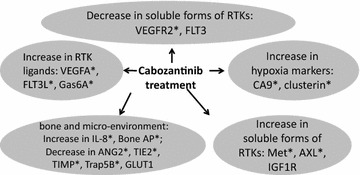
Results: A BSR and RECIST response were seen in 66/81 pts (81 %) and 6/33 pts (18 %) respectively. No significant associations were found between any biomarker at any time point and either type of response. Plasma concentrations of VEGFA, FLT3L, c-MET, AXL, Gas6A, bone-specific alkaline phosphatase, interleukin-8 and the hypoxia markers CA9 and clusterin significantly increased during treatment with cabozantinib irrespective of response. The plasma concentrations of VEGFR2, Trap5b, Angiopoietin-2, TIMP-2 and TIE-2 significantly decreased during treatment with caboznatinib.
Conclusions: Our data did not reveal plasma biomarkers associated with response to cabozantinib. The observed alterations in several biomarkers during treatment with cabozantinib may provide insights on the effects of cabozantinib on tumor cells and on tumor micro-environment and may help point to potential co-targeting approaches.
Figures

References
-
- Lalonde E, Ishkanian AS, Sykes J, Fraser M, Ross-Adams H, Erho N, et al. Tumour genomic and microenvironmental heterogeneity for integrated prediction of 5-year biochemical recurrence of prostate cancer: a retrospective cohort study. Lancet Oncol. 2014;15(13):1521–1532. doi: 10.1016/S1470-2045(14)71021-6. - DOI - PubMed
Publication types
MeSH terms
Substances
Associated data
LinkOut - more resources
Full Text Sources
Other Literature Sources
Medical
Research Materials
Miscellaneous
