


MTBDRplus and MTBDRsl Assays: Absence of Wild-Type Probe Hybridization and Implications for Detection of Drug-Resistant Tuberculosis
- PMID: 26763971
- PMCID: PMC4809938
- DOI: 10.1128/JCM.02505-15
MTBDRplus and MTBDRsl Assays: Absence of Wild-Type Probe Hybridization and Implications for Detection of Drug-Resistant Tuberculosis
Abstract
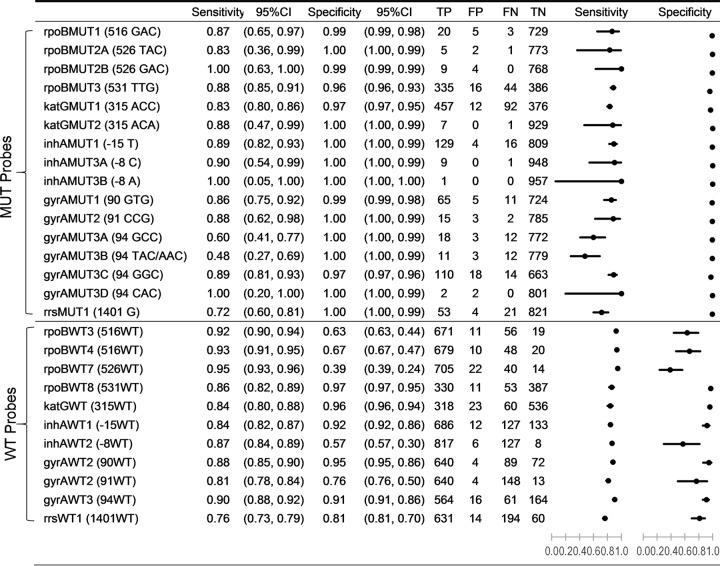
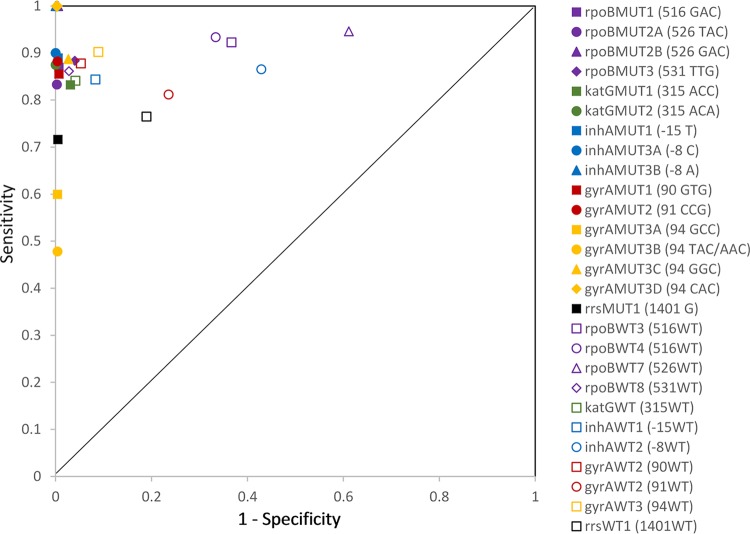
Accurate identification of drug-resistantMycobacterium tuberculosisis imperative for effective treatment and subsequent reduction in disease transmission. Line probe assays rapidly detect mutations associated with resistance and wild-type sequences associated with susceptibility. Examination of molecular-level performance is necessary for improved assay result interpretation and for continued diagnostic development. Using data collected from a large, multisite diagnostic study, probe hybridization results from line probe assays, MTBDRplusand MTBDRsl, were compared to those of sequencing, and the diagnostic performance of each individual mutation and wild-type probe was assessed. Line probe assay results classified as resistant due to the absence of wild-type probe hybridization were compared to those of sequencing to determine if novel mutations were inhibiting wild-type probe hybridization. The contribution of absent wild-type probe hybridization to the detection of drug resistance was assessed via comparison to a phenotypic reference standard. In our study, mutation probes demonstrated significantly higher specificities than wild-type probes and wild-type probes demonstrated marginally higher sensitivities than mutation probes, an ideal combination for detecting the presence of resistance conferring mutations while yielding the fewest number of false-positive results. The absence of wild-type probe hybridization without mutation probe hybridization was determined to be primarily the result of failure of mutation probe hybridization and not the result of novel or rare mutations. Compared to phenotypic culture-based drug susceptibility testing, the absence of wild-type probe hybridization without mutation probe hybridization significantly contributed to the detection of phenotypic rifampin and fluoroquinolone resistance with negligible increases in false-positive results.
Copyright © 2016, American Society for Microbiology. All Rights Reserved.
Figures
References
-
- World Health Organization. 2014. Global tuberculosis report 2014. World Health Organization, Geneva, Switzerland.
-
- World Health Organization. 2014. Drug-resistant TB surveillance and response. World Health Organization, Geneva, Switzerland.
-
- World Health Organization. 2015. Global tuberculosis report 2015. World Health Organization, Geneva, Switzerland.
Publication types
MeSH terms
Substances
Grants and funding
LinkOut - more resources
Full Text Sources
Other Literature Sources
