


Characterization of methacrylate-based composites containing thio-urethane oligomers
- PMID: 26764173
- PMCID: PMC5014358
- DOI: 10.1016/j.dental.2015.11.022
Characterization of methacrylate-based composites containing thio-urethane oligomers
Abstract
Objective: To evaluate the ability of thio-urethane oligomers to improve the properties of restorative composite resins.
Methods: Oligomers were synthesized by combining 1,6-hexanediol-diissocyante (aliphatic) with pentaerythritol tetra-3-mercaptopropionate (PETMP) or 1,3-bis(1-isocyanato-1-methylethyl)benzene (aromatic) with trimethylol-tris-3-mercaptopropionate (TMP), at 1:2 isocyanate:thiol, leaving pendant thiols. Oligomers were added at 0-20 wt% to BisGMA-TEGDMA (70-30 wt%). Silanated inorganic fillers were added (70 wt%). Materials were photoactivated at 800 mW/cm(2) filtered to 320-500 nm. Near-IR was used to follow degree of methacrylate conversion (DC). Mechanical properties were evaluated in three-point bending with 2 mm × 2 mm × 25 mm bars for flexural strength/modulus and toughness (FS/E, and T) according to ISO 4049, and 2 mm × 5 mm × 25 mm notched specimens for fracture toughness (KIC). Polymerization stress (PS) was measured on the Bioman. Results were analyzed with ANOVA/Tukey's test (α=5%).
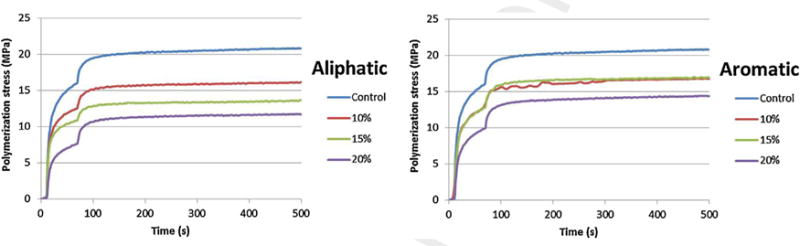
Results: Significant increase in DC was observed in thio-urethane-containing materials especially for the group with 20 wt% of aliphatic version. Materials composed by oligomers also promoted higher FS, E, and KIC in comparison to controls irrespective of thio-urethane type. A significant increase in toughness was detected by ANOVA, but not distinguished in the groups. The PS was significantly reduced by the presence of thio-urethane for almost all groups.
Conclusions: The use of thio-urethane oligomer to compose methacrylate-based restorative composite promote increase in DC, FS, E and KIC while significant reduces PS.
Significance: A simple additive was shown to reduce stress while increasing convrersion and mechanical properties, mainly fracture toughness. This has he potential of increasing the service life of dental composites, without changing current operatory procedures.
Keywords: Composite resin; Mechanical properties; Polymerization stress; Thio-urethane oligomers.
Copyright © 2015 Academy of Dental Materials. Published by Elsevier Ltd. All rights reserved.
Figures
References
-
- Lohbauer U, Belli R, Ferracane JL. Factors involved in mechanical fatigue degradation of dental composites. J Dent Res. 2013;92:584–91. - PubMed
-
- Ferracane JL. Developing a more complete understanding of stress produced in dental composites during polymerization. Dent Mater. 2005;21:36–42. - PubMed
-
- Pfeifer CS, Ferracane JL, Sakaguchi RL, Braga RR. Factors affecting photopolymerization stress in dental composites. J Dent Res. 2008;87:1043–7. - PubMed
-
- Peutzfeld A. Resin composite in dentistry: the monomer system. Eur J Oral Sci. 1997;105:97–116. - PubMed
MeSH terms
Substances
Grants and funding
LinkOut - more resources
Full Text Sources
Other Literature Sources
Miscellaneous
