


Establishing and Governing e-Mental Health Care in Australia: A Systematic Review of Challenges and A Call For Policy-Focussed Research
- PMID: 26764181
- PMCID: PMC4730106
- DOI: 10.2196/jmir.4827
Establishing and Governing e-Mental Health Care in Australia: A Systematic Review of Challenges and A Call For Policy-Focussed Research
Abstract
Background: Growing evidence attests to the efficacy of e-mental health services. There is less evidence on how to facilitate the safe, effective, and sustainable implementation of these services.
Objective: We conducted a systematic review on e-mental health service use for depressive and anxiety disorders to inform policy development and identify policy-relevant gaps in the evidence base.
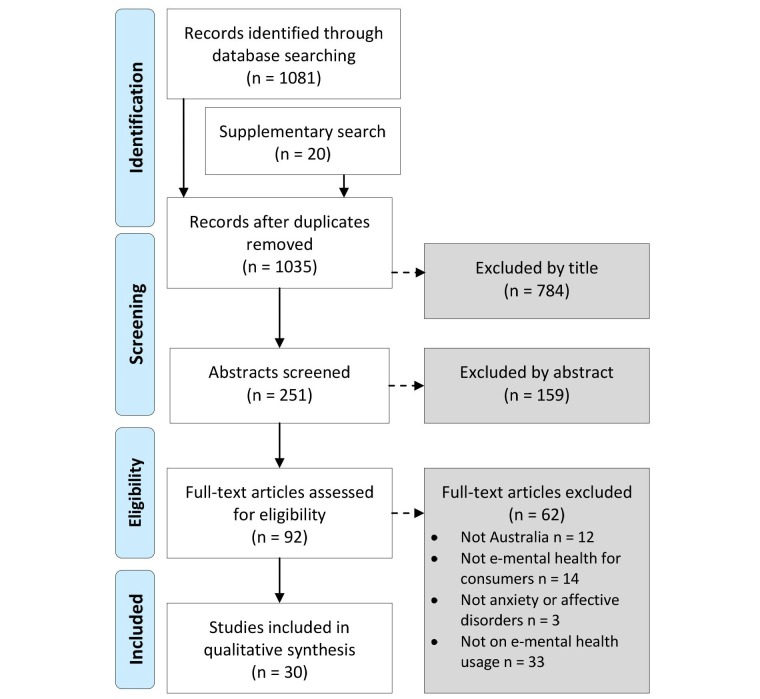
Methods: Following the PRISMA protocol, we identified research (1) conducted in Australia, (2) on e-mental health services, (3) for depressive or anxiety disorders, and (4) on e-mental health usage, such as barriers and facilitators to use. Databases searched included Cochrane, PubMed, PsycINFO, CINAHL, Embase, ProQuest Social Science, and Google Scholar. Sources were assessed according to area and level of policy relevance.
Results: The search yielded 1081 studies; 30 studies were included for analysis. Most reported on self-selected samples and samples of online help-seekers. Studies indicate that e-mental health services are predominantly used by females, and those who are more educated and socioeconomically advantaged. Ethnicity was infrequently reported on. Studies examining consumer preferences found a preference for face-to-face therapy over e-therapies, but not an aversion to e-therapy. Content relevant to governance was predominantly related to the organizational dimensions of e-mental health services, followed by implications for community education. Financing and payment for e-services and governance of the information communication technology were least commonly discussed.
Conclusions: Little research focuses explicitly on policy development and implementation planning; most research provides an e-services perspective. Research is needed to provide community and policy-maker perspectives. General population studies of prospective treatment seekers that include ethnicity and socioeconomic status and quantify relative preferences for all treatment modalities are necessary.
Keywords: Australia; Internet; anxiety; anxiety disorders; cognitive behavioural therapy; depression; depressive disorder; e-health; e-mental health; e-therapy; evidence-informed policy; implementation; online; research translation; telemedicine.
Conflict of interest statement
Conflicts of Interest: None declared.
Figures
References
-
- Andersson G, Cuijpers P, Carlbring P, Riper H, Hedman E. Guided Internet-based vs. face-to-face cognitive behavior therapy for psychiatric and somatic disorders: a systematic review and meta-analysis. World Psychiatry. 2014 Oct;13(3):288–295. doi: 10.1002/wps.20151. http://dx.doi.org/10.1002/wps.20151 - DOI - PMC - PubMed
-
- Andrews G, Titov N. Is internet treatment for depressive and anxiety disorders ready for prime time? Med J Aust. 2010 Jun 7;192(11 Suppl):S45–S47. - PubMed
-
- Christensen H, Hickie IB. Using e-health applications to deliver new mental health services. Med J Aust. 2010 Jun 7;192(11 Suppl):S53–S56. - PubMed
Publication types
MeSH terms
LinkOut - more resources
Full Text Sources
Other Literature Sources
Medical
Miscellaneous
