


Long-Term Trajectories of PTSD in Vietnam-Era Veterans: The Course and Consequences of PTSD in Twins
- PMID: 26764215
- PMCID: PMC5884065
- DOI: 10.1002/jts.22075
Long-Term Trajectories of PTSD in Vietnam-Era Veterans: The Course and Consequences of PTSD in Twins
Abstract
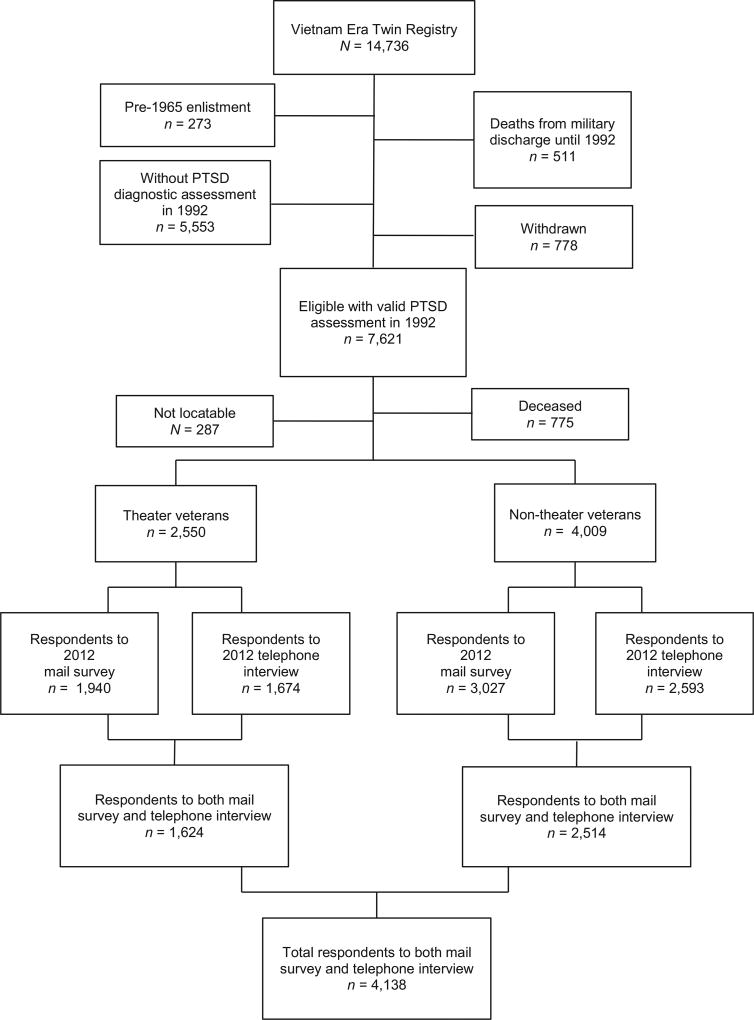
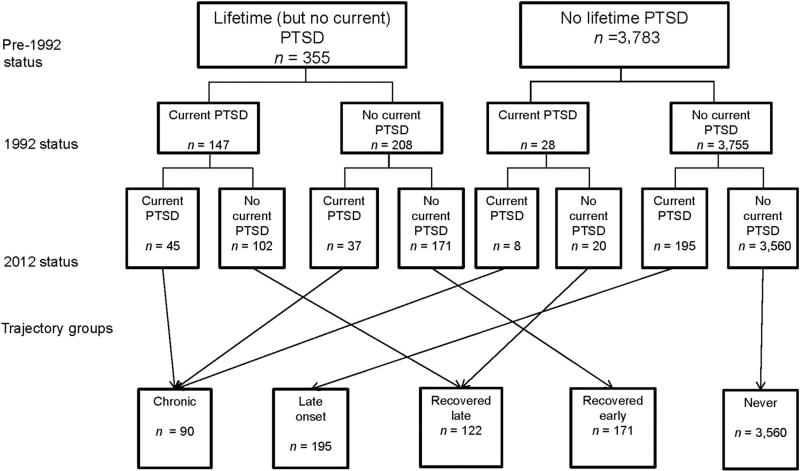
We estimated the temporal course of posttraumatic stress disorder (PTSD) in Vietnam-era veterans using a national sample of male twins with a 20-year follow-up. The complete sample included those twins with a PTSD diagnostic assessment in 1992 and who completed a DSM-IV PTSD diagnostic assessment and a self-report PTSD checklist in 2012 (n = 4,138). Using PTSD diagnostic data, we classified veterans into 5 mutually exclusive groups, including those who never had PTSD, and 4 PTSD trajectory groups: (a) early recovery, (b) late recovery, (c) late onset, and (d) chronic. The majority of veterans remained unaffected by PTSD throughout their lives (79.05% of those with theater service, 90.85% of those with nontheater service); however, an important minority (10.50% of theater veterans, 4.45% of nontheater veterans) in 2012 had current PTSD that was either late onset (6.55% theater, 3.29% nontheater) or chronic (3.95% theater, 1.16% nontheater). The distribution of trajectories was significantly different by theater service (p < .001). PTSD remains a prominent issue for many Vietnam-era veterans, especially for those who served in Vietnam.
Copyright © 2016 International Society for Traumatic Stress Studies.
Figures
References
-
- American Psychiatric Association. Diagnostic and statistical manual of mental disorders. 3. Washington, DC: Author; 1987.
-
- American Psychiatric Association. Diagnostic and statistical manual of mental disorders. 4. Washington, DC: Author; 1994.
-
- Blanchard EB, Hickling EJ, Taylor AE, Forneris CA, Loos W, Jaccard J. Effects of varying scoring rules of the Clinician-Administered PTSD Scale (CAPS) for the diagnosis of post-traumatic stress disorder in motor vehicle accident victims. Behaviour Research and Therapy. 1995;33:471–475. doi: 10.1016/0005-7967(94)00064-Q. - DOI - PubMed
Publication types
MeSH terms
Grants and funding
LinkOut - more resources
Full Text Sources
Other Literature Sources
Medical
