. 2016 Jan 13;19(1):102-13.
doi: 10.1016/j.chom.2015.12.011.

Homeostatic Control of Innate Lung Inflammation by Vici Syndrome Gene Epg5 and Additional Autophagy Genes Promotes Influenza Pathogenesis

Affiliations

Homeostatic Control of Innate Lung Inflammation by Vici Syndrome Gene Epg5 and Additional Autophagy Genes Promotes Influenza Pathogenesis

Qun Lu et al. Cell Host Microbe. .

Abstract

Mutations in the autophagy gene EPG5 are linked to the multisystem human disease Vici syndrome, which is characterized in part by pulmonary abnormalities, including recurrent infections. We found that Epg5-deficient mice exhibited elevated baseline innate immune cellular and cytokine-based lung inflammation and were resistant to lethal influenza virus infection. Lung transcriptomics, bone marrow transplantation experiments, and analysis of cellular cytokine expression indicated that Epg5 plays a role in lung physiology through its function in macrophages. Deletion of other autophagy genes including Atg14, Fip200, Atg5, and Atg7 in myeloid cells also led to elevated basal lung inflammation and influenza resistance. This suggests that Epg5 and other Atg genes function in macrophages to limit innate immune inflammation in the lung. Disruption of this normal homeostatic dampening of lung inflammation results in increased resistance to influenza, suggesting that normal homeostatic mechanisms that limit basal tissue inflammation support some infectious diseases.


Figures

Figure 1
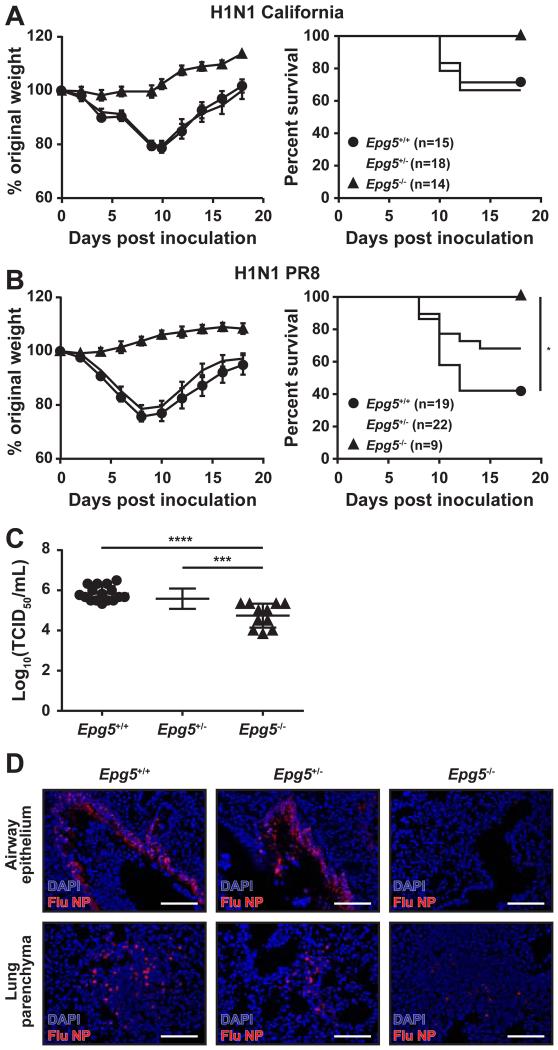
Figure 1. Epg5 Deficiency Protects Mice from Influenza
Epg5mice were infected with 104 EID50 California (A) or 50 TCID50 PR8 (B) and monitored for weight loss and mortality. (C) Mice were infected with 50 TCID50 PR8. At 2 days post infection (dpi), viral titers were determined by TCID50. Each symbol represents an individual mouse and the mean Log10TCID50/ml ± SEM is indicated. (D) Mice were infected with 50 TCID50 PR8. At 2 dpi, lungs were harvested, sectioned, and stained for flu-NP with DAPI counterstaining. Representative photomicrographs are shown (n= 4~8). Scale bars 100μm. See also Figure S1.
Figure 2
Figure 2. Cellular Lung Inflammation in Epg5 Deficiency Micew
(A) Lung sections from 8 week-old naive mice H&E stained. BAL cells were adhered to slides and subjected to Wright-Giemsa staining. (B) Single cell suspensions were prepared from naïve adult Epg5 mouse lungs and evaluated by flow cytometry, with pre-gating on CD45+ cells. (C) Flow cytometry plots, representative of 9-13 mice per genotype across 3 independent experiments. SiglecF+CD11c+ AM populations were further analyzed for CD64 and CD11b expression. Data represent the mean ± SEM. Scale bars 100μm. See also Figure S2.
Figure 3
Figure 3. Epg5 Deficiency Enhances Innate Immunity to Influenza
(A) Lung sections and BAL from 8 week-old naïve Rag1−/−Epg5 mice. Scale bars 100μm. (B) Single cell suspensions were prepared from naïve adult Rag1−/−Epg5 mouse lungs and analyzed by flow cytometry. Representative plots are shown. (C) Flow cytometry analysis of total cell number and cell populations in the lungs of Rag1−/−Epg5 mice. (B-C) Data represent the mean ± SEM of 8-11 mice per genotype across at least three independent experiments. (D) Rag1−/−Epg5 mice were infected with 50 TCID50 PR8 and monitored for weight loss and mortality.
Figure 4
Figure 4. Epg5 Regulates Basal Expression of Cytokines Important for Control of Influenza in the Lung
RNA was prepared from the (A) lungs or (B) indicated organs of Epg5 mice and the indicated transcripts were determined by qPCR. (C) RNA was prepared from the lungs of Rag1−/−Epg5 mice and the indicated transcripts were evaluated by qPCR. Each symbol represents an individual mouse. Data represent the mean ± SEM. (D-F) Lung sections from Epg5 mice were stained for p62 in combination with F4/80 (D), IL-1β (E) or IL-13 (F). Scale bars 50μm. See also Figure S3.
Figure 5
Figure 5. Deletion of Autophagy Genes in Myeloid Cells Causes Resistance to Influenza and Basal Hyper-inflammation in the Lung
(A-E) Survival and weight loss of Atg14f/f-LysMcre (A), FIP200f/f-LysMcre (B), Atg7f/f-LysMcre (C), Atg5f/f-LysMcre (D) and Atg16L1f/f-LysMcre (E) mice following inoculation with 50 TCID50 PR8. (F) GM-CSF, TNFα, IL-1β and MCP-1 transcript levels were measured by qPCR in the lungs of the indicated mouse genotypes. Each symbol represents an individual mouse. Data represent the mean ± SEM. See also Figure S4.
Figure 6
Figure 6. Cellular Lung Inflammation in Atg14f/f-LysMcre Mice
(A) 8-10 week-old naïve Atg14f/f-LysMcre mice were analyzed for lung histology and BAL content. Scale bars 100μm. (B) Quantitation of cell number and populations in Atg14f/f-LysMcre mice. (C) Flow cytometry analysis of AMs in Atg14f/f-LysMcre mice. Data are representative of three independent experiments with 9-10 mice in each genotype.

Comment in

References

    1. Abdel FE, Bhattacharya A, Herron A, Safdar Z, Eissa NT. Critical role for IL-18 in spontaneous lung inflammation caused by autophagy deficiency. Journal of immunology. 2015;194:5407–5416. - PMC - PubMed
    1. Beale R, Wise H, Stuart A, Ravenhill BJ, Digard P, Randow F. A LC3-interacting motif in the influenza A virus M2 protein is required to subvert autophagy and maintain virion stability. Cell host & microbe. 2014;15:239–247. - PMC - PubMed
    1. Byers DE, Alexander-Brett J, Patel AC, Agapov E, Dang-Vu G, Jin X, Wu K, You Y, Alevy Y, Girard JP, et al. Long-term IL-33-producing epithelial progenitor cells in chronic obstructive lung disease. The Journal of clinical investigation. 2013;123:3967–3982. - PMC - PubMed
    1. Cadwell K, Liu JY, Brown SL, Miyoshi H, Loh J, Lennerz JK, Kishi C, Kc W, Carrero JA, Hunt S, et al. A key role for autophagy and the autophagy gene Atg16l1 in mouse and human intestinal Paneth cells. Nature. 2008;456:259–263. - PMC - PubMed
    1. Chen M, Hong MJ, Sun H, Wang L, Shi X, Gilbert BE, Corry DB, Kheradmand F, Wang J. Essential role for autophagy in the maintenance of immunological memory against influenza infection. Nature medicine. 2014;20:503–510. - PMC - PubMed

Publication types

MeSH terms