


Association of Injury History and Incident Injury in Cadet Basic Military Training
- PMID: 26765627
- PMCID: PMC4868773
- DOI: 10.1249/MSS.0000000000000872
Association of Injury History and Incident Injury in Cadet Basic Military Training
Abstract
Purpose: This study aimed to determine the association between injury history at enrollment and incident lower extremity (LE) injury during cadet basic training among first-year military cadets.
Methods: Medically treated LE injuries during cadet basic training documented in the Defense Medical Surveillance System were ascertained in a prospective cohort study of three large US military academies from 2005 to 2008. Both acute injuries (International Classification of Disease, Ninth Revision, codes in the 800-900s, including fracture, dislocations, and sprains/strains) and injury-related musculoskeletal injuries (International Classification of Disease, Ninth Revision, codes in the 700s, including inflammation and pain, joint derangement, stress fracture, sprain/strain/rupture, and dislocation) were included. Risk ratio (RR) and 95% confidence interval (CI) were computed using multivariate log-binomial models stratified by gender.
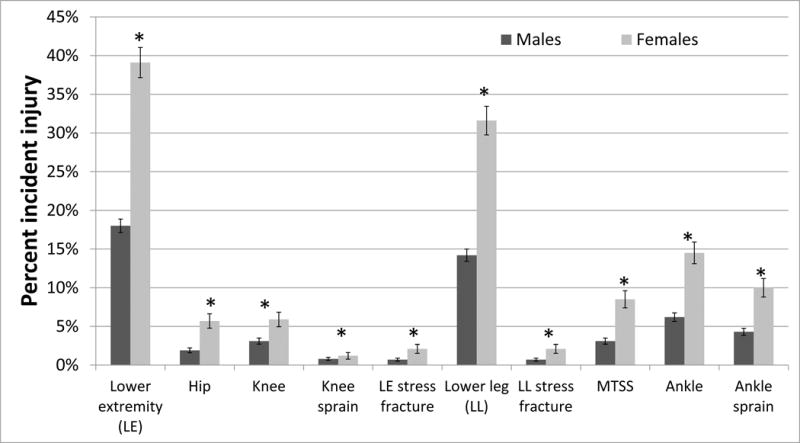
Results: During basic training, there were 1438 medically treated acute and 1719 musculoskeletal-related LE injuries in the 9811 cadets. The most frequent LE injuries were sprains/strains (73.6% of acute injuries) and inflammation and pain (89.6% of musculoskeletal-related injuries). The overall risk of incident LE injury was 23.2% (95% CI = 22.3%-24.0%). Cadets with a history of LE injury were at increased risk for incident LE injury. This association was identical in males (RR = 1.74, 95% CI = 1.55-1.94) and females (RR = 1.74, 95% CI = 1.52-1.99). In site-specific analyses, strong associations between injury history and incident injury were observed for hip, knee ligament, stress fracture, and ankle sprain. Injury risk was greater (P < 0.01) for females (39.1%) compared with males (18.0%). The elevated injury risk in females (RR = 2.19, 95% CI = 2.04-2.36) was independent of injury history (adjusted RR = 2.09, 95% CI = 1.95-2.24).
Conclusion: Injury history upon entry to the military is associated with the incidence of LE injuries sustained during cadet basic training. Prevention programs targeted at modifiable factors in cadets with a history of LE injury should be considered.
Conflict of interest statement
CONFLICT OF INTEREST:
The authors have no conflicts of interest to disclose. The results of the present study do not constitute endorsement by ACSM.
Figures
References
-
- Almeida S, Trone D, Leone D, Shaffer R, Patheal S, Long K. Gender differences in musculoskeletal injury rates: a function of symptom reporting? Medicine & Science in Sports & Exercise. 1999;31(12):1807–12. - PubMed
-
- Bell NS, Mangione TW, Hemenway D, Amoroso PJ, Jones BH. High injury rates among female Army trainees: A function of gender? Am J Prev Med. 2000;18(3, Supplement 1):141–6. - PubMed
-
- Bijur PE, Horodyski M, Egerton W, Kurzon M, Lifrak S, Friedman S. Comparison of Injury During Cadet Basic Training by Gender. Arch Pediatr Adolesc Med. 1997;151(5):456–61. - PubMed
-
- Billings CE. Epidemiology of Injuries and Illness during the United States Air Force Academy 2002 Basic Cadet Training Program: Documenting the Need for Prevention. Mil Med. 2004;169(8):664–70. - PubMed
Publication types
MeSH terms
Grants and funding
LinkOut - more resources
Full Text Sources
Other Literature Sources
Medical
