


Risk Factors for Pertussis Among Hispanic Infants: Metropolitan Portland, Oregon, 2010-2012
- PMID: 26766145
- PMCID: PMC6941792
- DOI: 10.1097/INF.0000000000001061
Risk Factors for Pertussis Among Hispanic Infants: Metropolitan Portland, Oregon, 2010-2012
Abstract
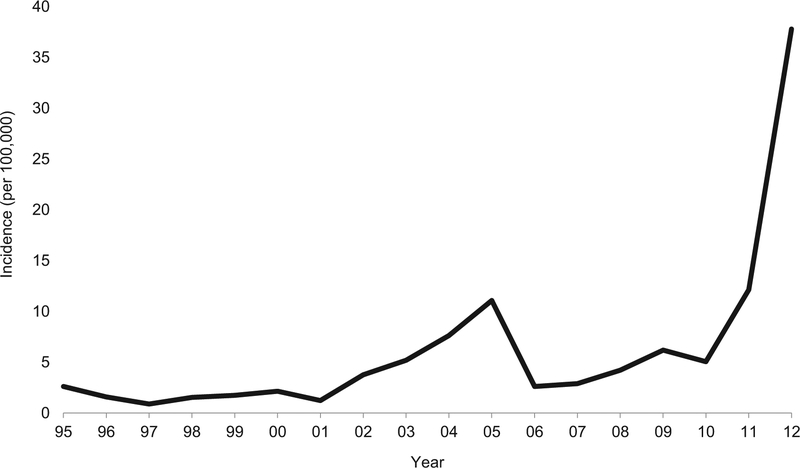
Background: In 2012, Oregon observed its highest numbers of reported pertussis cases since 1953. The greatest morbidity occurred among infants <6 months of age, with higher rates among Hispanics than non-Hispanics. To explain this disparity, we analyzed pertussis surveillance data.
Methods: An analysis was conducted among infants <6 months of age in the Portland metropolitan area during 2010-2012. Characteristics examined were ethnicity (Hispanic or non-Hispanic), household size (>4 or ≤4 persons), pertussis vaccination status (upto-date or not up-to-date for age), child care center attendance (yes or no), infant birth weight (<2500 or ≥2500 g) and maternal age (<20 or ≥20 years).
Results: Eighty-two infants <6 months of age with pertussis were identified. Twenty-eight case-infants (34%) were Hispanic, and 54 (66%) were non-Hispanic. By ethnicity, infants with pertussis were similar in illness confirmation method, sex, age, hospitalization status, vaccination status, child care center attendance, infant birth weight and maternal age. Hispanic infants were more likely than non-Hispanic infants to live in households with >4 persons. Univariate analysis showed Hispanic infants had approximately 2.3 times the risk for pertussis, compared with non-Hispanic infants, and infants living in households >4 persons had approximately 2.4 times the risk for illness, compared with those in households with <4 persons; stratified risk ratios did not differ between Hispanic (2.4; confidence interval: 1.0-5.7]) and non-Hispanic infants (2.0; confidence interval: 1.2-3.5).
Conclusions: A household size of >4 persons is a potential risk factor for pertussis; the magnitude of this risk is similar for Hispanic and non-Hispanic infants.
Conflict of interest statement
The authors have no conflicts of interest or funding to disclose.
Figures
References
-
- Wendelboe AM, Njamkepo E, Bourillon A, et al.; Infant Pertussis Study Group. Transmission of Bordetella pertussis to young infants. Pediatr Infect Dis J. 2007;26:293–299. - PubMed
-
- Bisgard KM, Pascual FB, Ehresmann KR, et al. Infant pertussis: who was the source? Pediatr Infect Dis J. 2004;23:985–989. - PubMed
-
- Tanaka M, Vitek CR, Pascual FB, et al. Trends in pertussis among infants in the United States, 1980–1999. JAMA. 2003;290:2968–2975. - PubMed
-
- Centers for Disease Control and Prevention. 2012 Final Pertussis Surveillance Report. MMWR 2013;62
MeSH terms
Grants and funding
LinkOut - more resources
Full Text Sources
Other Literature Sources
Medical
