


The lack of clinical value of peritoneal washing cytology in high risk patients undergoing risk-reducing salpingo-oophorectomy: a retrospective study and review
- PMID: 26768420
- PMCID: PMC4712515
- DOI: 10.1186/s12885-015-2011-5
The lack of clinical value of peritoneal washing cytology in high risk patients undergoing risk-reducing salpingo-oophorectomy: a retrospective study and review
Abstract
Background: To assess the clinical value of peritoneal washing cytology (PWC) in women with BRCA1 or BRCA2 mutations and women from a family with hereditary breast and/or ovarian cancer (HBOC) undergoing risk-reducing salpingo-oophorectomy (RRSO) in detecting primary peritoneal cancer (PPC) or occult ovarian/fallopian tube cancer.
Methods: A retrospective study of patients with known BRCA1 or BRCA2 mutation or HBOC who underwent RRSO at the Erasmus Medical Centre, Rotterdam, The Netherlands between January 2000-2014. Patients with an elevated risk of malignancy prior to the procedure were excluded from primary analysis (elevated CA-125, an ovarian mass, abdominal pain or another gynecological malignancy). A review of the literature was conducted.
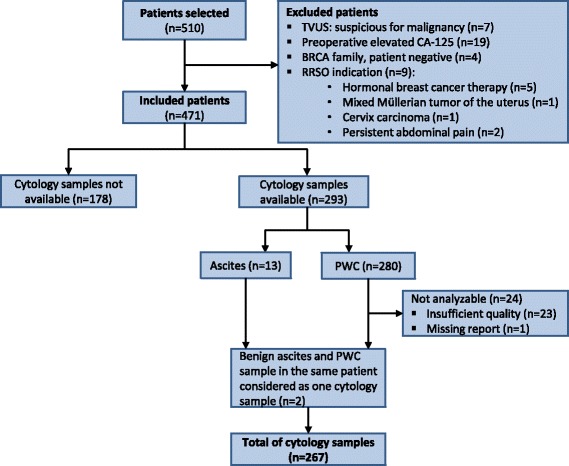
Results: Of the 471 patients who underwent RRSO, a total of 267 cytology samples were available for analysis. Four samples showed malignant cells, all four patients were diagnosed with ovarian and/or fallopian tube cancer at histologic examination. A fifth patient, of whom no cytology sample was obtained during RRSO, developed primary peritoneal cancer 80 months post RRSO.
Conclusions: This study failed to show that cytology is of value during RRSO in detecting primary peritoneal cancer, however 36% of patients with concomitant ovarian or fallopian tube cancer had positive cytology. Therefore, the routine sampling of peritoneal washings during RRSO is not found to be useful to detect subsequent PPC.
Figures
References
-
- Mathew S, Erozan YS. Significance of peritoneal washings in gynecologic oncology. The experience with 901 intraoperative washings at an academic medical center. Arch Pathol Lab Med. 1997;121(6):604–6. - PubMed
Publication types
MeSH terms
Substances
LinkOut - more resources
Full Text Sources
Other Literature Sources
Medical
Research Materials
Miscellaneous
