Emergency Department-Initiated Palliative Care in Advanced Cancer: A Randomized Clinical Trial
- PMID: 26768772
- PMCID: PMC9252442
- DOI: 10.1001/jamaoncol.2015.5252
Emergency Department-Initiated Palliative Care in Advanced Cancer: A Randomized Clinical Trial
Abstract
Importance: The delivery of palliative care is not standard of care within most emergency departments (EDs).
Objective: To compare quality of life, depression, health care utilization, and survival in ED patients with advanced cancer randomized to ED-initiated palliative care consultation vs care as usual.
Design, setting, and participants: A single-blind, randomized clinical trial of ED-initiated palliative care consultation for patients with advanced cancer vs usual care took place from June 2011 to April 2014 at an urban, academic ED at a quaternary care referral center. Adult patients with advanced cancer who were able to pass a cognitive screen, had never been seen by palliative care, spoke English or Spanish, and presented to the ED met eligibility criteria; 136 of 298 eligible patients were approached and enrolled in the ED and randomized via balanced block randomization.
Interventions: Intervention participants received a comprehensive palliative care consultation by the inpatient team, including an assessment of symptoms, spiritual and/or social needs, and goals of care.
Main outcomes and measures: The primary outcome was quality of life as measured by the change in Functional Assessment of Cancer Therapy-General Measure (FACT-G) score at 12 weeks. Secondary outcomes included major depressive disorder as measured by the Patient Health Questionnaire-9, health care utilization at 180 days, and survival at 1 year.
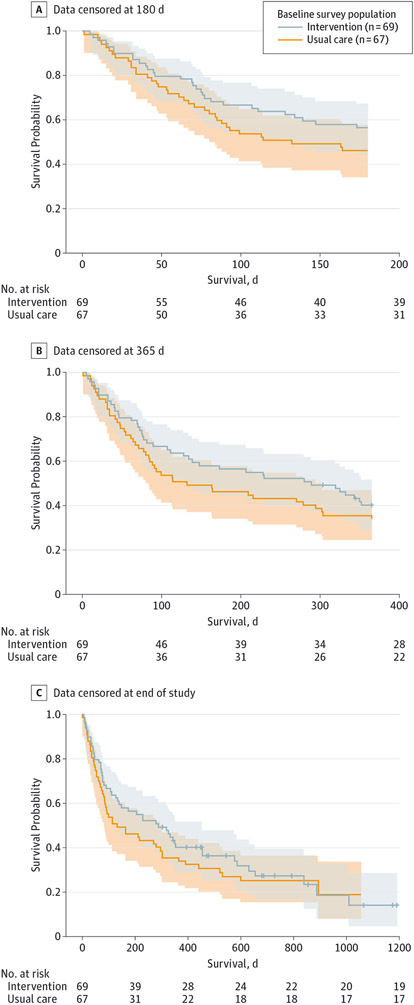
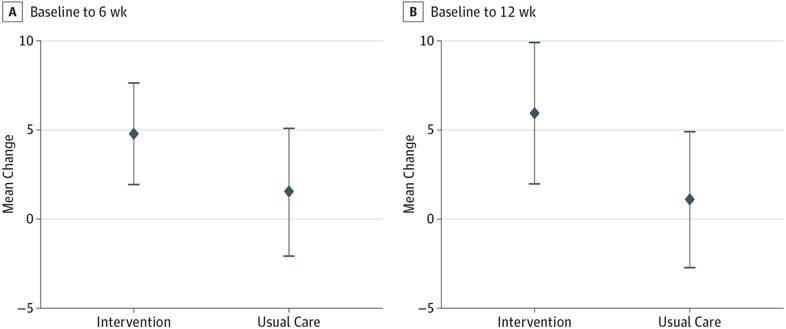
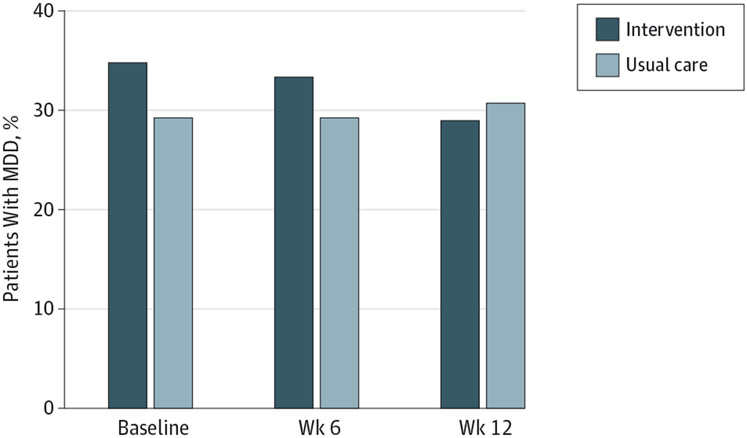
Results: A total of 136 participants were enrolled, and 69 allocated to palliative care (mean [SD], 55.1 [13.1] years) and 67 were randomized to usual care (mean [SD], 57.8 [14.7] years). Quality of life, as measured by a change in FACT-G score from enrollment to 12 weeks, was significantly higher in patients randomized to the intervention group, who demonstrated a mean (SD) increase of 5.91 (16.65) points compared with 1.08 (16.00) in controls (P = .03 using the nonparametric Wilcoxon test). Median estimates of survival were longer in the intervention group than the control group: 289 (95% CI, 128-453) days vs 132 (95% CI, 80-302) days, although this did not reach statistical significance (P = .20). There were no statistically significant differences in depression, admission to the intensive care unit, and discharge to hospice.
Conclusions and relevance: Emergency department-initiated palliative care consultation in advanced cancer improves quality of life in patients with advanced cancer and does not seem to shorten survival; the impact on health care utilization and depression is less clear and warrants further study.
Trial registration: clinicaltrials.gov Identifier: NCT01358110.
Conflict of interest statement
Figures
References
-
- Institute of Medicine and National Research Council. Improving Palliative Care for Cancer. Washington, DC: National Academy Press; 2001.
-
- Stern RS, Weissman JS, Epstein AM. The emergency department as a pathway to admission for poor and high-cost patients. JAMA. 1991;266(16):2238–2243. - PubMed
Associated data
Grants and funding
LinkOut - more resources
Full Text Sources
Other Literature Sources
Medical
Miscellaneous