


Review
doi: 10.1038/eye.2015.252.
Epub 2016 Jan 15.
What is light? The visible spectrum and beyond
Affiliations
- PMID: 26768917
- PMCID: PMC4763133
- DOI: 10.1038/eye.2015.252
Item in Clipboard
Review
What is light? The visible spectrum and beyond
Eye (Lond).
2016 Feb.
Abstract
In this International Year of Light, it is particularly appropriate to review the historical concept of what is light and the controversies surrounding the extent of the visible spectrum. Today we recognize that light possesses both a wave and particle nature. It is also clear that the limits of visibility really extend from about 310 nm in the ultraviolet (in youth) to about 1100 nm in the near-infrared, but depend very much on the radiance, that is, 'brightness' of the light source. The spectral content of artificial lighting are undergoing very significant changes in our lifetime, and the full biological implications of the spectral content of newer lighting technologies remain to be fully explored.
Figures
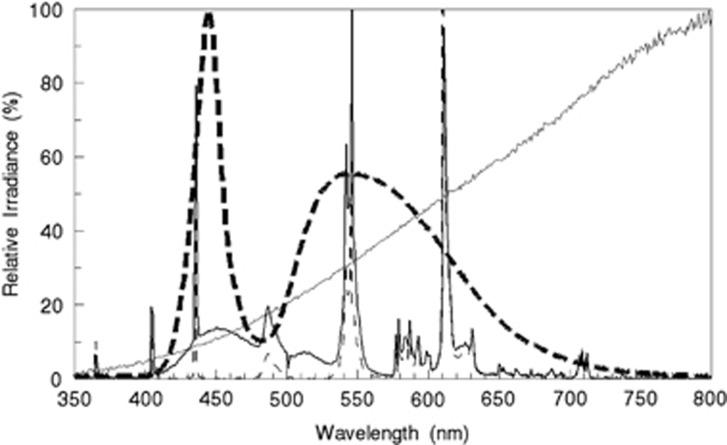
Relative spectral power distributions. Traditional tungsten lamps (······) had little shortwavelength light emission compared with ‘white' fluorescent (–––) and LED (——) lamps. Most white LEDs have an absence of deep red and near-infrared emissions.
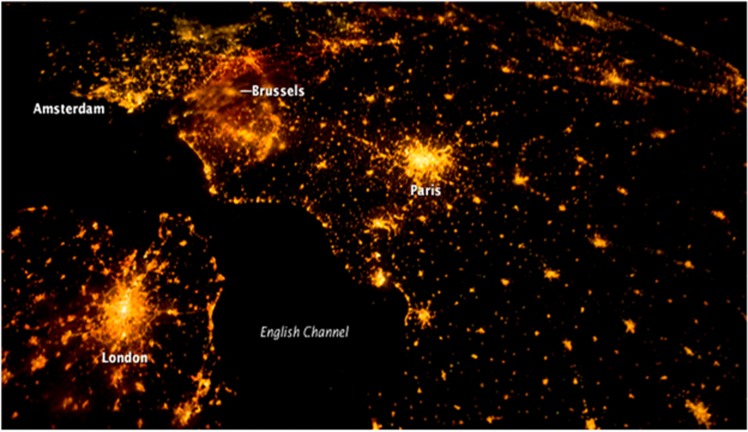
The nighttime lights of Western Europe can be seen from outer space, showing the enormous impact of artificial lighting on the night sky (from NASA).
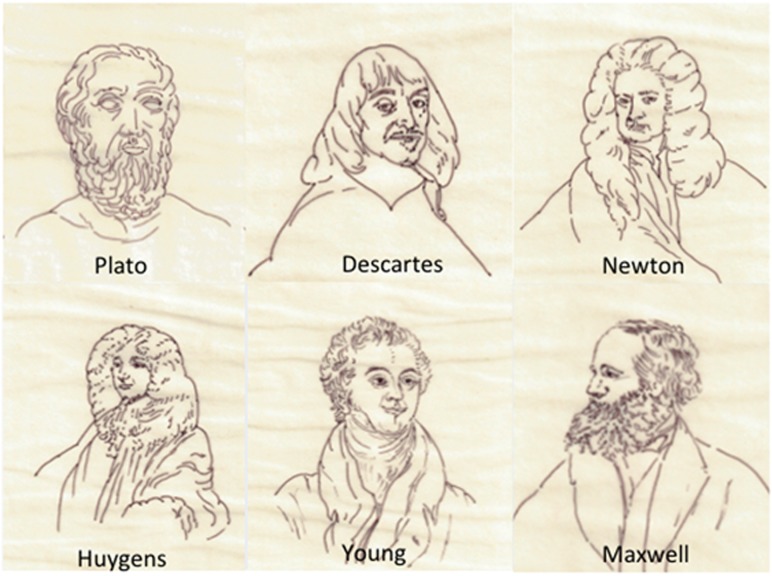
Many great minds have theorized on the nature of light from Plato to Maxwell and Einstein. Of course, Einstein need not be shown as his image is universally known.
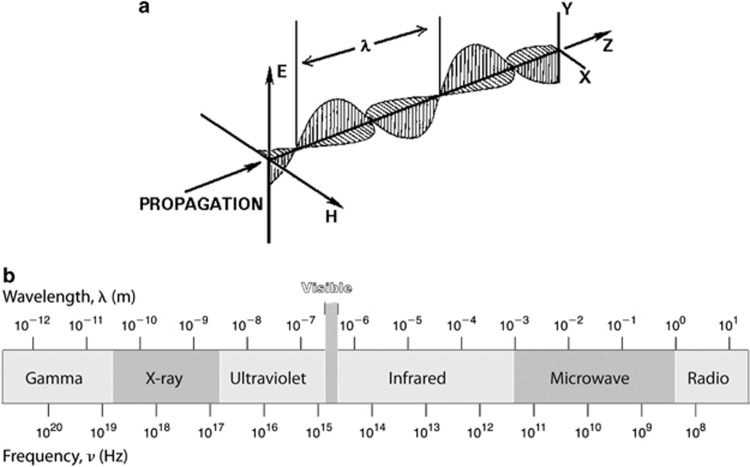
Electromagnetic waves and the electromagnetic (E–M) spectrum. (a) (top) A geometrical representation of an oscillating E–M wave with E (electric) and H (magnetic) fields. (b) (below) Familiar regions of the E–M spectrum.
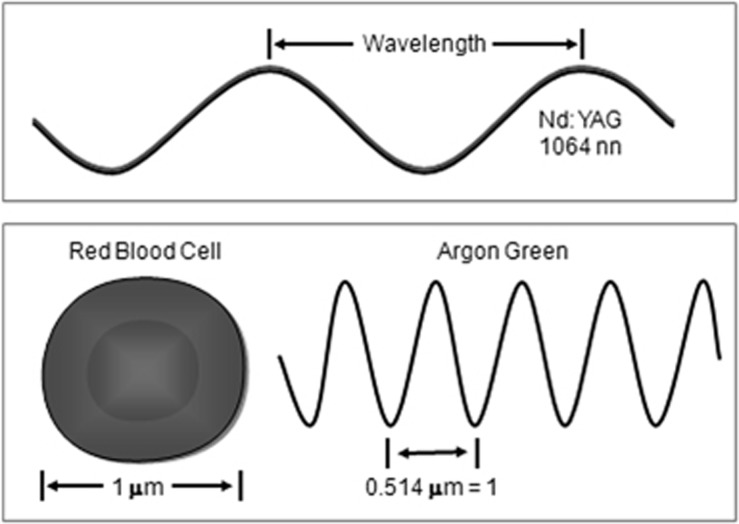
Wavelength as a matter of scale. A single retinal melanin granule or red blood cell has dimensions of the order of one wavelength from a neodymium laser (1.064 μm=1064 nm).
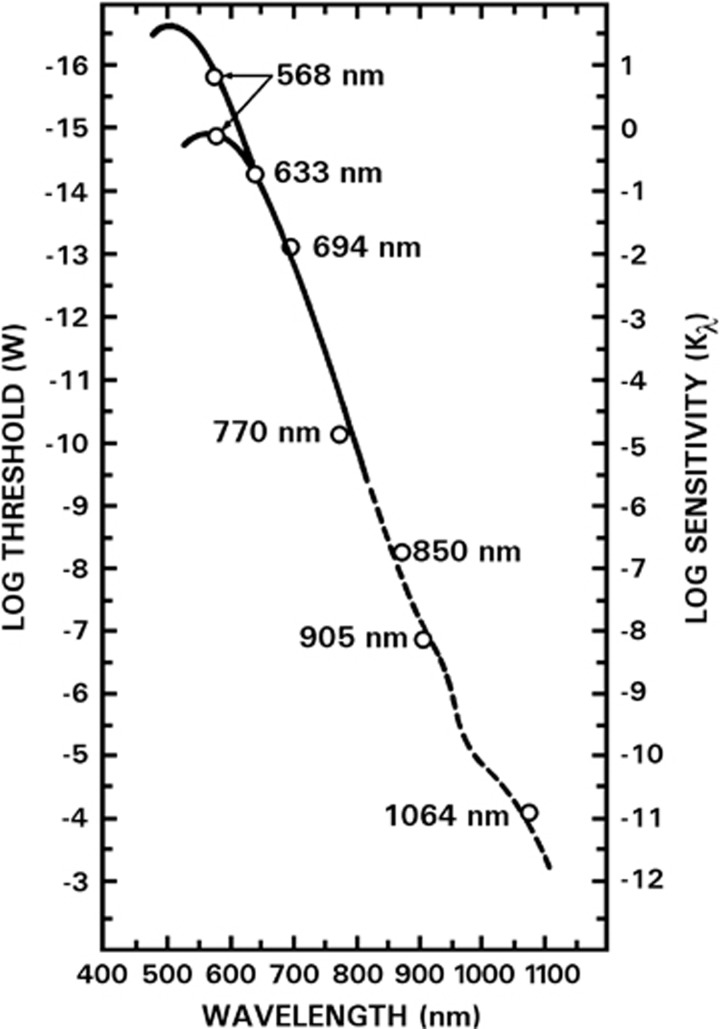
Photopic spectral sensitivity of the human eye V(λ) extended into the infrared (after Sliney et al). The circles are larger than the SD of measured thresholds for detecting a point source.
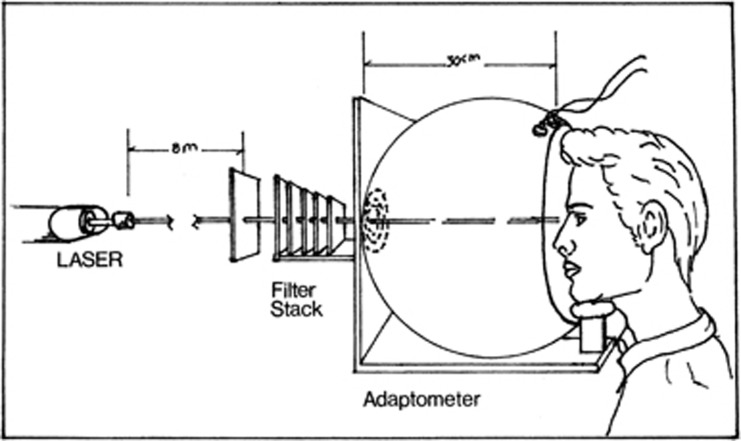
Experimental arrangement used in 1970 experiments of infrared visual sensitivity (Sliney et al).
References
-
- 1Sliney DH. Exposure geometry and spectral environment determine photobiological effects on the human eye. Photochem Photobiol 2005; 81: 483–489. - PubMed
-
- 2Berson DM. Ganglion cells and ganglion-cell photoreceptors. The Friednwald Lecture, Association for Vision and Ophthalmology, Annual Meeting, paper 5234, Denver, CO, USA, 2015.
-
- 3Young AT, Kattawar GW, Parviainen P. Sunset science I, the mock mirage. Appl Opt 1997; 36: 2689–2700. - PubMed
-
- 4Young T. A Course of Lectures on Natural Philosophy and the Mechanical Arts. vol. 1 William Savage: Bedford, UK, 1807, pp 463–464 (lecture 39).
-
- 5Ritter JW. Versuche über das sonnenlicht. Ann Phys 1802; 12: 409–415.
Publication types
MeSH terms
LinkOut - more resources
Full Text Sources
Other Literature Sources
