. 2016 Mar;36(3):510-7.
doi: 10.1161/ATVBAHA.115.307034. Epub 2016 Jan 14.

Coagulation Factor XI Promotes Distal Platelet Activation and Single Platelet Consumption in the Bloodstream Under Shear Flow

Affiliations

Coagulation Factor XI Promotes Distal Platelet Activation and Single Platelet Consumption in the Bloodstream Under Shear Flow

Jevgenia Zilberman-Rudenko et al. Arterioscler Thromb Vasc Biol. 2016 Mar.

Abstract

Objective: Coagulation factor XI (FXI) has been shown to contribute to thrombus formation on collagen or tissue factor-coated surfaces in vitro and in vivo by enhancing thrombin generation. Whether the role of the intrinsic pathway of coagulation is restricted to the local site of thrombus formation is unknown. This study was aimed to determine whether FXI could promote both proximal and distal platelet activation and aggregate formation in the bloodstream.

Approach and results: Pharmacological blockade of FXI activation or thrombin activity in blood did not affect local platelet adhesion, yet reduced local platelet aggregation, thrombin localization, and fibrin formation on immobilized collagen and tissue factor under shear flow, ex vivo. Downstream of the thrombus formed on immobilized collagen or collagen and 10 pmol/L tissue factor, platelet CD62P expression, microaggregate formation, and progressive platelet consumption were significantly reduced in the presence of FXI function-blocking antibodies or a thrombin inhibitor in a shear rate- and time-dependent manner. In a non-human primate model of thrombus formation, we found that inhibition of FXI reduced single platelet consumption in the bloodstream distal to a site of thrombus formation.

Conclusions: This study demonstrates that the FXI-thrombin axis contributes to distal platelet activation and procoagulant microaggregate formation in the blood flow downstream of the site of thrombus formation. Our data highlight FXI as a novel therapeutic target for inhibiting distal platelet consumption without affecting proximal platelet adhesion.

Keywords: blood coagulation; blood platelets; factor XI; hemodynamics; platelet activation.


Figures

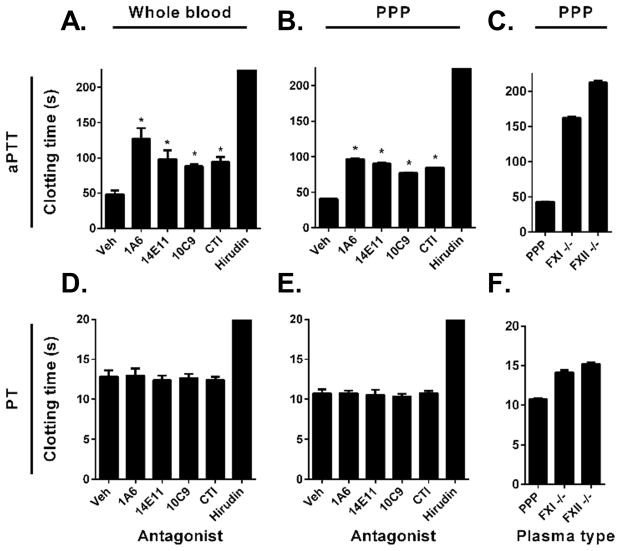
Figure 1
Figure 1. Role of FXII and FXI in clotting times
Recalcified whole blood (A, D), pooled human plasma (PPP; B, E) or coagulation-factor depleted plasma (C, F) was incubated with indicated FXI function blocking antibody, FXII inhibitor (CTI) or direct thrombin inhibitor (hirudin). aPTT (A–C) or PT (D–F) was recorded as described in Methods. *indicates significantly different, p < 0.05, clotting time vs. vehicle (mean±SEM).
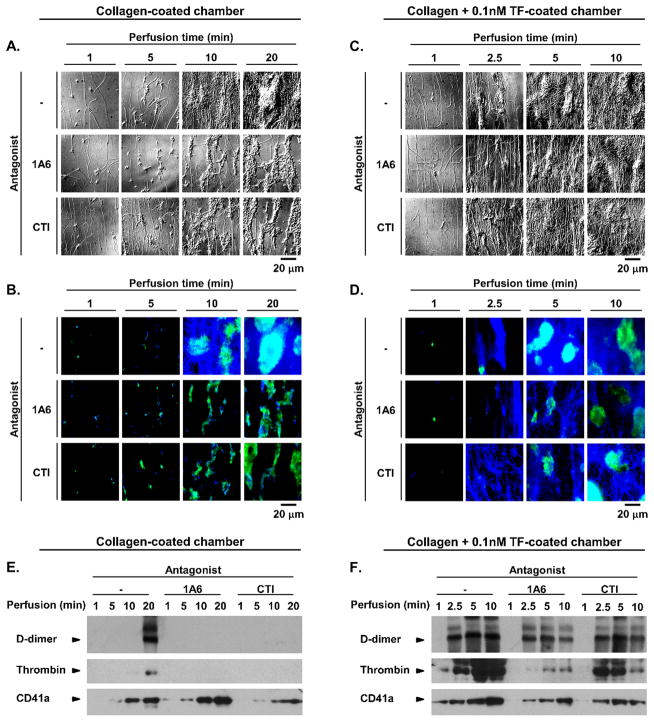
Figure 2
Figure 2. FXIa activity promotes local fibrin formation under shear
Recalcified whole blood was perfused over collagen (A&B) or collagen and 0.1nM TF (C&D) for indicated times at a shear rate of 300 s−1. Images of local thrombi formed at each time point in the presence of vehicle control, 50 μg/mL 1A6 or 40 μg/mL CTI were recorded using differential interference contrast (A&C) or fluorescent light microscopy (B&D) after staining for fibrin (blue) and P-selectin (green). In parallel experiments, thrombi were lysed and immunoblotted for the fibrin degradation product, D-dimer, thrombin and the platelet surface receptor, CD41a (E&F).
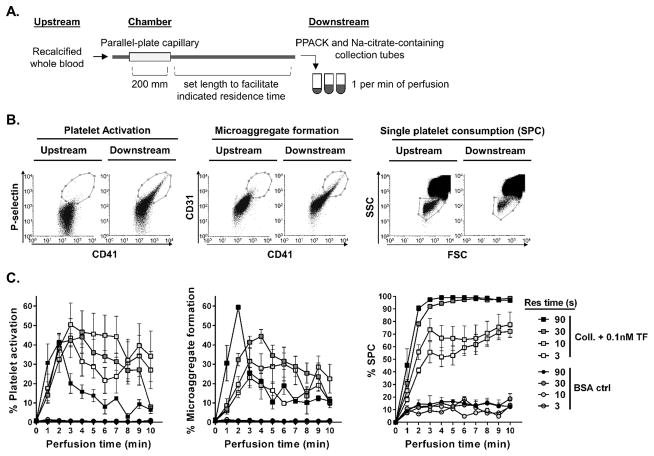
Figure 3
Figure 3. Propagation of distal platelet activation and single platelet consumption under shear in flow
Recalcified whole blood was perfused through a 200 mm chamber (coated with either BSA or 150 μg/mL collagen + 0.1 nM TF) before being collected downstream after indicated residence time in flow (A). Downstream samples were collected into a reaction quenching solution at 1 min intervals, immunostained and evaluated by FACS flow cytometry for percent platelet activation (CD41a+/CD62P+ events), platelet microaggregate formation (high fluorescence intensity CD41a+/CD31+ evets) and single platelet consumption (loss of single platelet population gate on FSC by SSC scatter). Representative raw FACS scatter plots (B) and quantification (C) for at least three experiments are reported (mean±SEM).
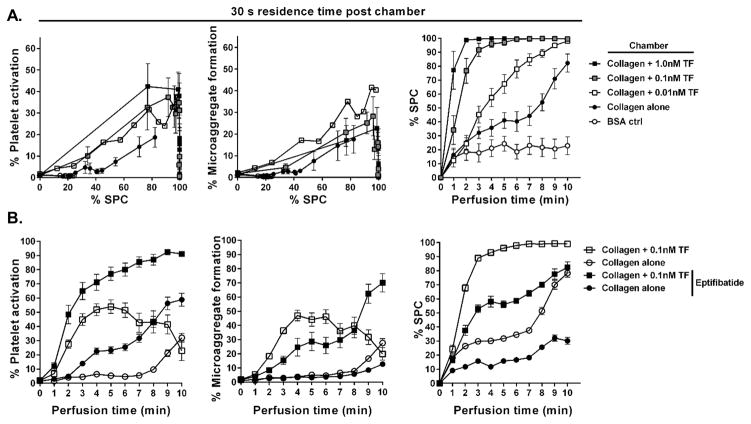
Figure 4
Figure 4. Presence of collagen and TF promotes distal platelet consumption
Recalcified whole blood was perfused through a 200 mm chamber (coated with either BSA, collagen or collagen + 0.01 – 1.0 nM TF) and allowed to react in flow for 30 sec (residence time) before being collected into a reaction quenching solution at 1 min intervals. Quantification of platelet activation, microaggregate formation and single platelet consumption using FACS (A) for at least five experiments are reported (mean±SEM). In parallel experiments, whole blood was pretreated with a GPIIb-IIIa inhibitor, Eptifibatide (B).
Figure 5
Figure 5. FXIa activity promotes distal platelet activation and consumption in the presence of collagen and low levels of TF
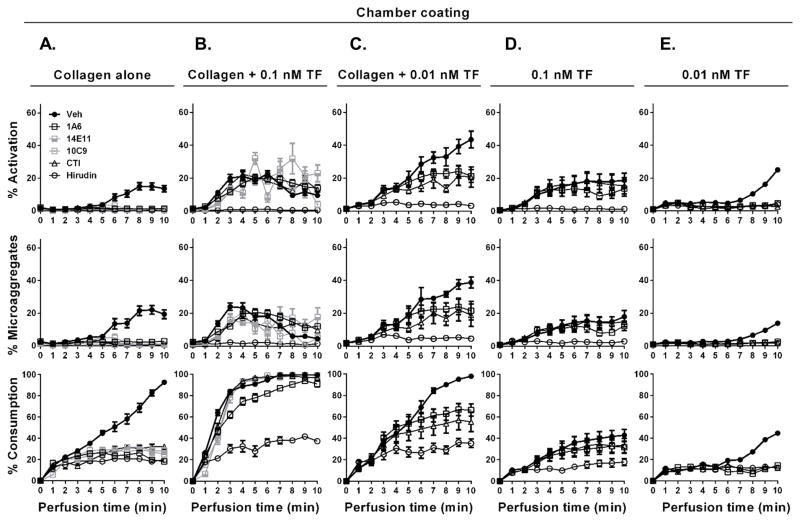
Recalcified whole blood pretreated with either vehicle, 1A6, 14E11, 10C9, CTI or hirudin was perfused over chambers coated with collagen, collagen + 0.01 – 0.1 nM TF, or 0.01 – 0.1 nM TF alone at shear rate of 300 s−1. Samples were collected downstream of the chamber; distal microaggregate formation and single platelet consumption was assessed by FACS (A–E). Results (mean±SEM) from at least 4 experiments.
Figure 6
Figure 6. Protection of 1A6-treated baboons from collagen-initiated distal single platelet consumption
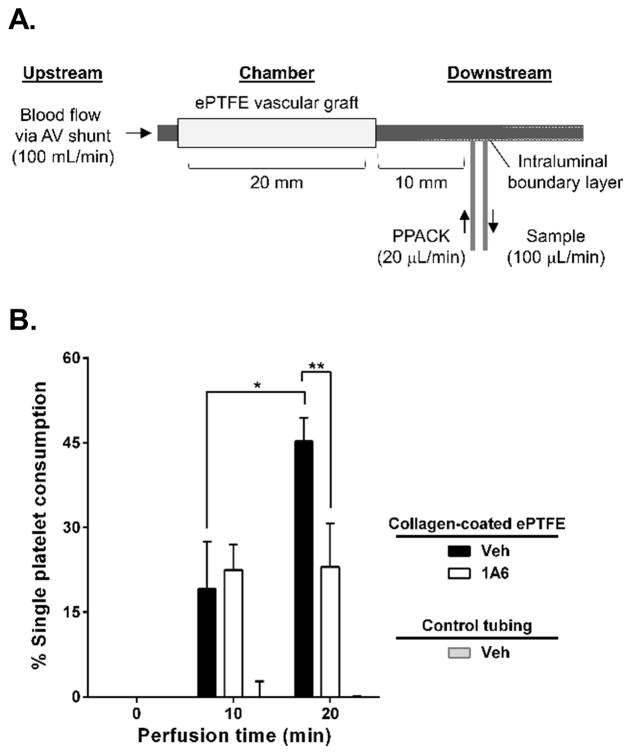
4-mm internal diameter expanded-polytetrafluoroethylene (ePTFE) vascular graft coated with collagen was deployed into a chronic high flow arteriovenous (AV) shunt in healthy baboons. In parallel, control experiments were performed with tubing alone. Samples were drawn from the intraluminal coagulation marker concentration boundary layer by a syringe pump 1 cm downstream from acutely developing thrombi. 1 mM PPACK anticoagulant was infused at 1/5th of the sample extraction rate 3 mm proximal to the sample port to prevent the sample port from occluding during the 1-hour study. Blood flow through the graft was maintained at a fixed rate of 100 mL/min for the entirety of each study by proximal clamping (A). Quantification of the six separate animal experiments for each treatment (mean±SEM) are reported (B). Significant rise in percent single platelet consumption immediately distal to collagen-coated ePTFE was seen between 10 to 20 min of perfusion in control animals (*, p = 0.0283; n = 6). 1A6-treated baboons maintained same single platelet levels at 20 min as at 10 min of perfusion (p = 0.9530; n = 6) significantly different from control at 20 min of perfusion (**, p = 0.0180; n = 6).

References

    1. Andrews RK, Berndt MC. Platelet physiology and thrombosis. Thromb Res. 2004;114(5–6):447–453. - PubMed
    1. Oliver JA, Monroe DM, Roberts HR, Hoffman M. Thrombin Activates Factor XI on Activated Platelets in the Absence of Factor XII. Arterioscler Thromb Vasc Biol. 1999;19(1):170–177. - PubMed
    1. Kravtsov DV, Matafonov A, Tucker EI, et al. Factor XI contributes to thrombin generation in the absence of factor XII. Blood. 2009;114(2):452–458. - PMC - PubMed
    1. Maas C, Meijers JCM, Marquart JA, et al. Activated factor V is a cofactor for the activation of factor XI by thrombin in plasma. Proc Natl Acad Sci U S A. 2010;107(20):9083–9087. - PMC - PubMed
    1. Salomon O, Steinberg DM, Seligshon U. Variable bleeding manifestations characterize different types of surgery in patients with severe factor XI deficiency enabling parsimonious use of replacement therapy. Haemoph Off J World Fed Hemoph. 2006;12(5):490–493. - PubMed

Publication types

MeSH terms