. 2016 Jan;17(2):164-73.
doi: 10.1002/cbic.201500467. Epub 2015 Dec 23.

The Phormidolide Biosynthetic Gene Cluster: A trans-AT PKS Pathway Encoding a Toxic Macrocyclic Polyketide

Affiliations

The Phormidolide Biosynthetic Gene Cluster: A trans-AT PKS Pathway Encoding a Toxic Macrocyclic Polyketide

Matthew J Bertin et al. Chembiochem. 2016 Jan.

Abstract

Phormidolide is a polyketide produced by a cultured filamentous marine cyanobacterium and incorporates a 16-membered macrolactone. Its complex structure is recognizably derived from a polyketide synthase pathway, but possesses unique and intriguing structural features that prompted interest in investigating its biosynthetic origin. Stable isotope incorporation experiments confirmed the polyketide nature of this compound. We further characterized the phormidolide gene cluster (phm) through genome sequencing followed by bioinformatic analysis. Two discrete trans-type acyltransferase (trans-AT) ORFs along with KS-AT adaptor regions (ATd) within the polyketide synthase (PKS) megasynthases, suggest that the phormidolide gene cluster is a trans-AT PKS. Insights gained from analysis of the mode of acetate incorporation and ensuing keto reduction prompted our reevaluation of the stereochemistry of phormidolide hydroxy groups located along the linear polyketide chain.

Keywords: biosynthesis; macrolactones; phormidolide; polyketide synthase; trans-AT.


Figures

Figure 1
Figure 1
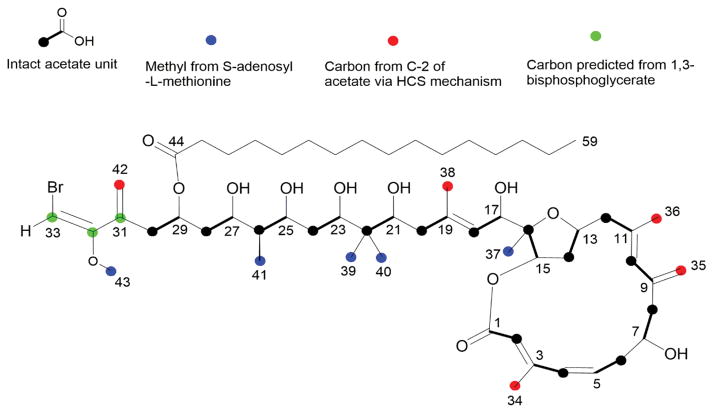
Biosynthetic subunits of phormidolide (1). Results of feeding experiments using various stable isotope labeled substrates which demonstrated the origin of carbon atoms in phormidolide.
Figure 2
Figure 2
Orientation of the phormidolide (1, phm) gene cluster. For further explanation of ORFs see Table S2.
Figure 3
Figure 3
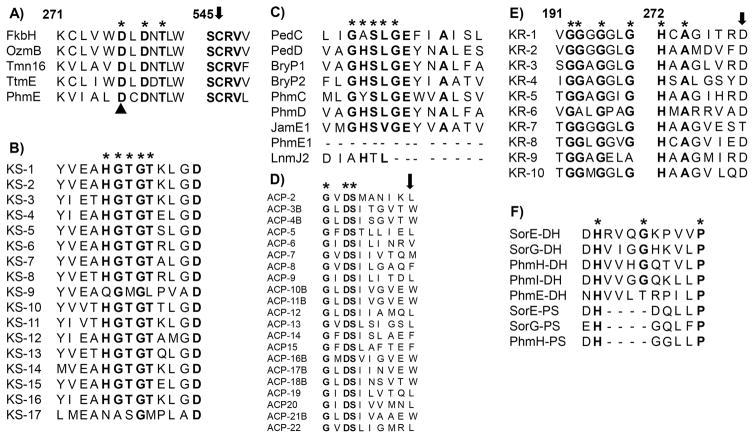
Sequence alignments of conserved domains of the deduced amino acid sequence of genes in the phormidolide gene cluster. A) Domain alignment of FkbH-like phosphatases. PhmE FkbH domain contains the DXDX(T/V) consensus sequence * and catalytic aspartate (black triangle) and cysteine (black arrow) proposed to dephosphorylate and attach the phosphoglyceryl starter unit. Numbering based on the Tmn16 (AB193609) sequence. OzmB, ABA39082; TtmE, DQ088168; FkbH, AAF86387. B) Domain alignment of 17 KS domains from Phm pathway. The conserved sequence with catalytic His HGTGT is denoted by *, which is absent from predicted non-elongating KS0 (KS-9, KS-17). C) AT domain alignment of trans-ATs from the pederin (PedC, AAS47559; PedD, AAS47563) and bryostatin (BryP, ABM63531) pathways, a cis-AT from the jamaicamide A pathway (JamE, AAS98777) and a predicted AT-docking domain from the leinamycin (Lnm, AAN85523) pathway. Predicted trans-ATs PhmC and PhmD align well with trans- and cis-ATs, while the predicted AT-docking domain (PhmE-AT1) is truncated. The malonate-specific motif GHS[LVIFAM]G is denoted by *. D) ACP domain alignment. The active site sequence GXDS is denoted by * and the conserved tryptophan in ACPs associated with β-branching is identified with a black arrow. A “B” denotes ACPs predicted to be involved in β-branched methylation. E) KR domain alignment, including the conserved D1758 in B-type KRs. The conserved NADPH binding motif CGGXGXXG is denoted by *. The conserved motif HXAXXXXD is denoted by * and a black arrow indicates an amino acid motif of B-type KRs that generates the D-3-hydroxyacyl moiety. F) Phm DH and PS domains aligned to DH and PS domains from sorangicin (SorE, ADN68480; SorG, ADN68482). The conserved DH active-site motif HXXXGXXXXP is denoted by *.
Figure 4
Figure 4
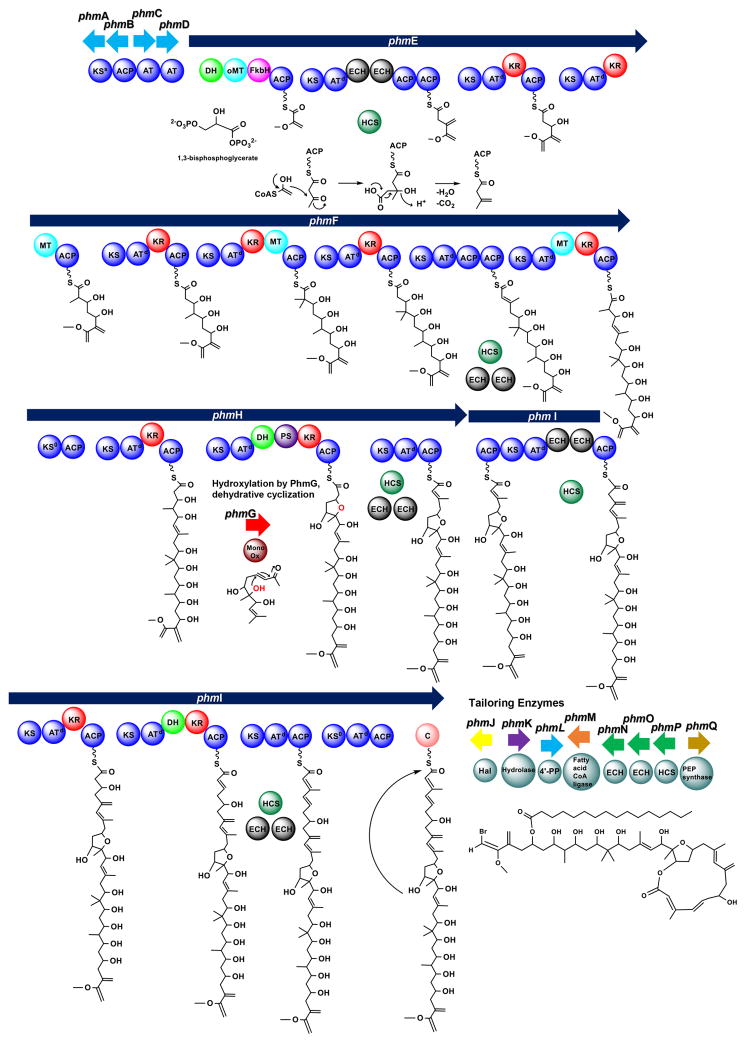
Model of phormidolide (1) biosynthesis with 1,3-bisphosphoglycerate as the starter unit. The proposed mechanism of the β-branched methylation by the HCS cassette is detailed only for the first branching event. Subsequent β-branching events are indicated by the presence of HCS cassette enzymes.
Scheme 1
Scheme 1
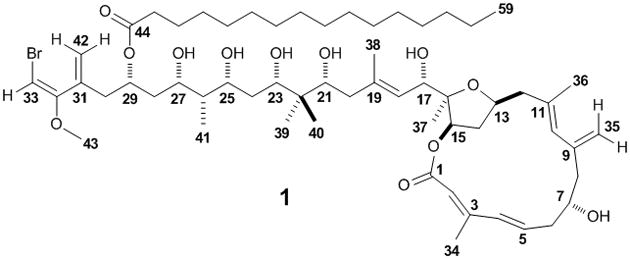
Structure of phormidolide (1).

References

    1. Jones AC, Monroe EA, Eisman EB, Gerwick L, Sherman DH, Gerwick WH. Nat Prod Rep. 2010;27:1048–1065. - PubMed
    1. Williamson RT, Boulanger A, Vulpanovici A, Roberts MA, Gerwick WH. J Org Chem. 2002;67:7927–7936. - PubMed
    1. Thornburg CC. PhD thesis. Oregon State University; USA: 2013.
    1. Carreras CW, Pieper R, Khosla C. Topics Curr Chem. 1997;188:85–126.
    1. Bentley R, Bennett JW. Annu Rev Microbiol. 1999;53:411–446. - PubMed

Publication types