Bicarbonate Concentration, Acid-Base Status, and Mortality in the Health, Aging, and Body Composition Study
- PMID: 26769766
- PMCID: PMC4741040
- DOI: 10.2215/CJN.06200615
Bicarbonate Concentration, Acid-Base Status, and Mortality in the Health, Aging, and Body Composition Study
Abstract
Background and objectives: Low serum bicarbonate associates with mortality in CKD. This study investigated the associations of bicarbonate and acid-base status with mortality in healthy older individuals.
Design, setting, participants, & measurements: We analyzed data from the Health, Aging, and Body Composition Study, a prospective study of well functioning black and white adults ages 70-79 years old from 1997. Participants with arterialized venous blood gas measurements (n=2287) were grouped into <23.0 mEq/L (low), 23.0-27.9 mEq/L (reference group), and ≥28.0 mEq/L (high) bicarbonate categories and according to acid-base status. Survival data were collected through February of 2014. Mortality hazard ratios (HRs; 95% confidence intervals [95% CIs]) in the low and high bicarbonate groups compared with the reference group were determined using Cox models adjusted for demographics, eGFR, albuminuria, chronic obstructive pulmonary disease, smoking, and systemic pH. Similarly adjusted Cox models were performed according to acid-base status.
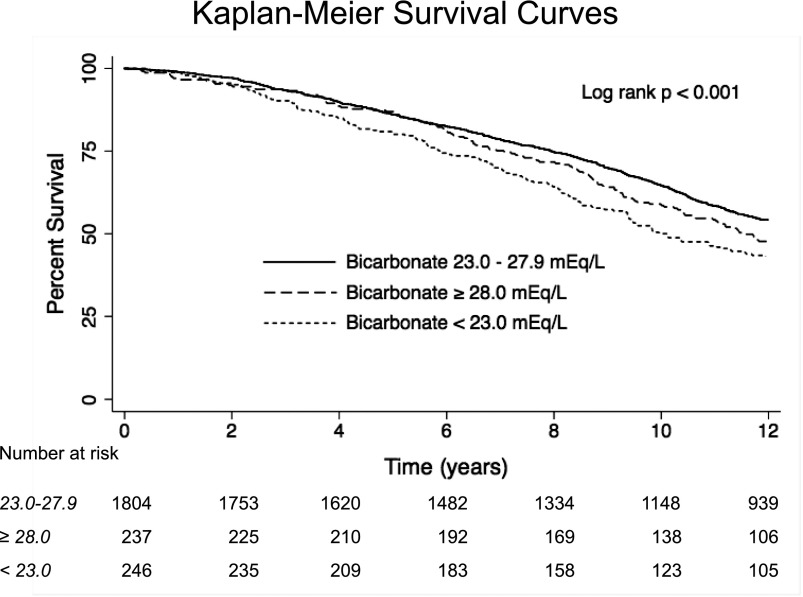
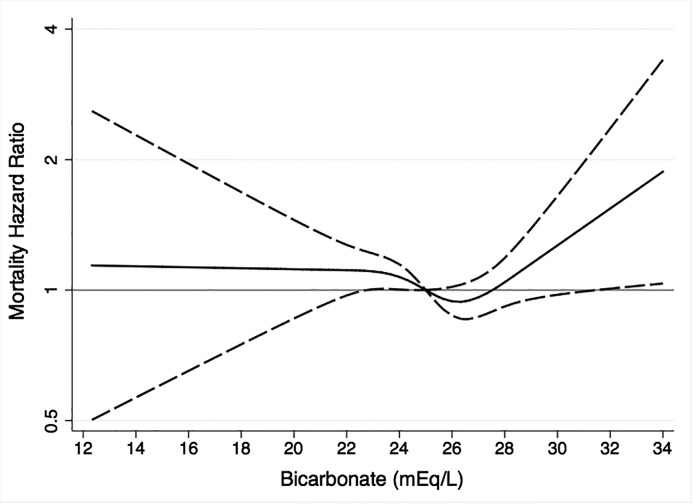
Results: The mean age was 76 years, 51% were women, and 38% were black. Mean pH was 7.41, mean bicarbonate was 25.1 mEq/L, 11% had low bicarbonate, and 10% had high bicarbonate. Mean eGFR was 82.1 ml/min per 1.73 m(2), and 12% had CKD. Over a mean follow-up of 10.3 years, 1326 (58%) participants died. Compared with the reference group, the mortality HRs were 1.24 (95% CI, 1.02 to 1.49) in the low bicarbonate and 1.03 (95% CI, 0.84 to 1.26) in the high bicarbonate categories. Compared with the normal acid-base group, the mortality HRs were 1.17 (95% CI, 0.94 to 1.47) for metabolic acidosis, 1.21 (95% CI, 1.01 to 1.46) for respiratory alkalosis, and 1.35 (95% CI, 1.08 to 1.69) for metabolic alkalosis categories. Respiratory acidosis did not associate with mortality.
Conclusions: In generally healthy older individuals, low serum bicarbonate associated with higher mortality independent of systemic pH and potential confounders. This association seemed to be present regardless of whether the cause of low bicarbonate was metabolic acidosis or respiratory alkalosis. Metabolic alkalosis also associated with higher mortality.
Keywords: acid-base equilibrium; acidosis; bicarbonate; body composition; follow-up studies; glomerular filtration rate; humans; mortality; prospective studies; renal insufficiency, chronic.
Copyright © 2016 by the American Society of Nephrology.
Figures
Comment in
-
Low blood levels of bicarbonate are linked to premature death in healthy older people, study shows.BMJ. 2016 Jan 14;352:i172. doi: 10.1136/bmj.i172. BMJ. 2016. PMID: 26772188 No abstract available.
References
-
- Dobre M, Yang W, Chen J, Drawz P, Hamm LL, Horwitz E, Hostetter T, Jaar B, Lora CM, Nessel L, Ojo A, Scialla J, Steigerwalt S, Teal V, Wolf M, Rahman M, CRIC Investigators : Association of serum bicarbonate with risk of renal and cardiovascular outcomes in CKD: A report from the Chronic Renal Insufficiency Cohort (CRIC) study. Am J Kidney Dis 62: 670–678, 2013 - PMC - PubMed
Publication types
MeSH terms
Substances
Grants and funding
- R01AG027002/AG/NIA NIH HHS/United States
- U01 DK099933/DK/NIDDK NIH HHS/United States
- 1U01DK099933/DK/NIDDK NIH HHS/United States
- R01-AG028050/AG/NIA NIH HHS/United States
- N01-AG-6-2101/AG/NIA NIH HHS/United States
- R01 DK098234/DK/NIDDK NIH HHS/United States
- N01-AG-6-2103/AG/NIA NIH HHS/United States
- R01-NR012459/NR/NINR NIH HHS/United States
- R01 NR012459/NR/NINR NIH HHS/United States
- 1R01DK098234/DK/NIDDK NIH HHS/United States
- Intramural NIH HHS/United States
- R01 AG028050/AG/NIA NIH HHS/United States
- N01-AG-6-2106/AG/NIA NIH HHS/United States
- R01 AG027002/AG/NIA NIH HHS/United States
- IK2 CX000537/CX/CSRD VA/United States
LinkOut - more resources
Full Text Sources
Other Literature Sources
Medical
Research Materials
Miscellaneous