


Gaps in understanding health and engagement with healthcare providers across common long-term conditions: a population survey of health literacy in 29,473 Danish citizens
- PMID: 26769783
- PMCID: PMC4735217
- DOI: 10.1136/bmjopen-2015-009627
Gaps in understanding health and engagement with healthcare providers across common long-term conditions: a population survey of health literacy in 29,473 Danish citizens
Abstract
Objectives: To (1) quantify levels of subjective health literacy in people with long-term health conditions (diabetes, cardiovascular disease, chronic obstructive pulmonary disease, musculoskeletal disorders, cancer and mental disorders) and compare these to levels in the general population and (2) examine the association between health literacy, socioeconomic characteristics and comorbidity in each long-term condition group.
Design: Population-based survey in the Central Denmark Region (n=29,473).
Main outcome measures: Health literacy was measured using two scales from the Health Literacy Questionnaire (HLQ): (1) Ability to understand health information and (2) Ability to actively engage with healthcare providers.
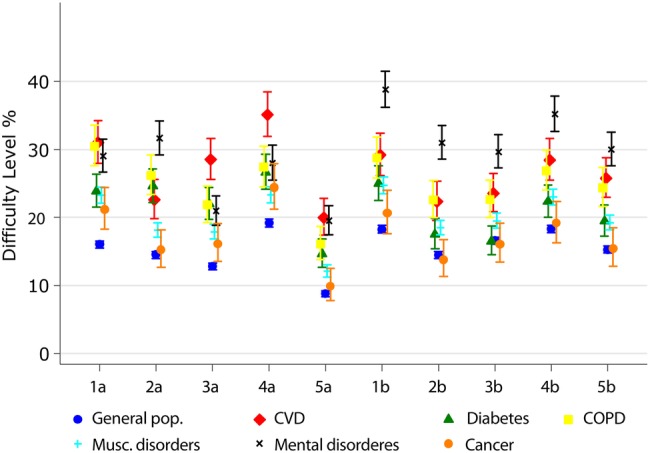
Results: People with long-term conditions reported more difficulties than the general population in understanding health information and actively engaging with healthcare providers. Wide variation was found between disease groups, with people with cancer having fewer difficulties and people with mental health disorders having more difficulties in actively engaging with healthcare providers than other long-term condition groups. Having more than one long-term condition was associated with more difficulty in engaging with healthcare providers and understanding health information. People with low levels of education had lower health literacy than people with high levels of education.
Conclusions: Compared with the general population, people with long-term conditions report more difficulties in understanding health information and engaging with healthcare providers. These two dimensions are critical to the provision of patient-centred healthcare and for optimising health outcomes. More effort should be made to respond to the health literacy needs among individuals with long-term conditions, multiple comorbidities and low education levels, to improve health outcomes and to reduce social inequality in health.
Keywords: CARDIOLOGY; MENTAL HEALTH.
Published by the BMJ Publishing Group Limited. For permission to use (where not already granted under a licence) please go to http://www.bmj.com/company/products-services/rights-and-licensing/
Figures
References
-
- Dodson S, Good S, Osborne R. Health literacy toolkit for low and middle-income countries: a series of information sheets to empower communities and strengthen health systems. New Delhi: World Health Organization, Regional Office for South-East Asia, 2015.
Publication types
MeSH terms
LinkOut - more resources
Full Text Sources
Other Literature Sources
Medical
