


Association between toothbrushing and risk factors for cardiovascular disease: a large-scale, cross-sectional Japanese study
- PMID: 26769787
- PMCID: PMC4735199
- DOI: 10.1136/bmjopen-2015-009870
Association between toothbrushing and risk factors for cardiovascular disease: a large-scale, cross-sectional Japanese study
Abstract
Objectives: To clarify the association between toothbrushing and risk factors for cardiovascular disease--namely, hypertension (HT), diabetes mellitus (DM), dyslipidaemia (DL), hyperuricaemia (HUA) and chronic kidney disease (CKD).
Design: A large-scale, single-centre, cross-sectional study.
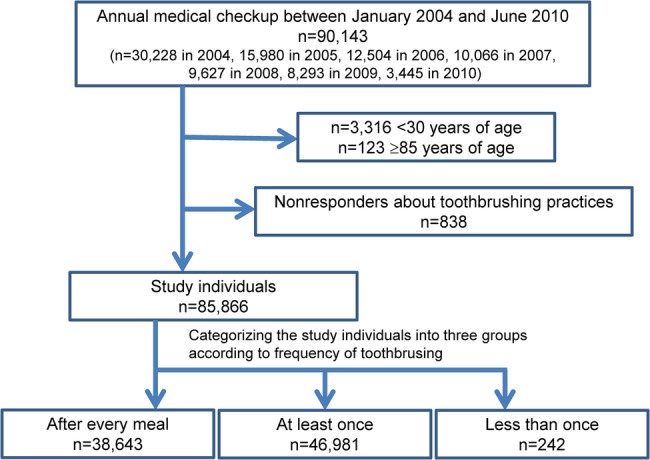
Setting: St Luke's International Hospital, Center for Preventive Medicine, Tokyo, Japan, between January 2004 and June 2010.
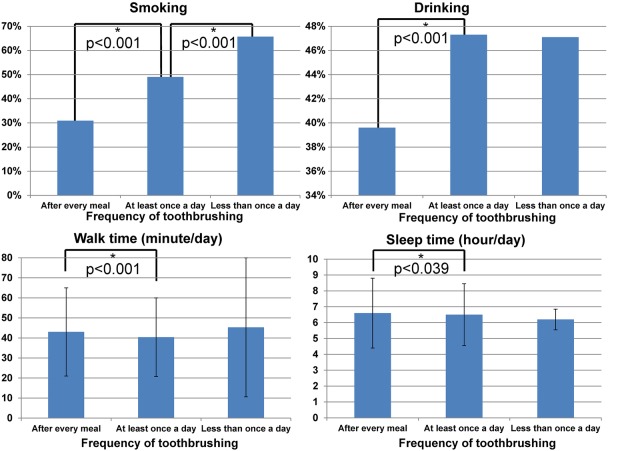
Participants: This study examined the toothbrushing practices of 85,866 individuals according to the 3-category frequency criterion: 'after every meal', 'at least once a day' and 'less than once a day'. The ORs by frequency were calculated for the prevalences of HT, DM, DL, HUA and CKD according to binominal logistic regression analyses adjusted for age, gender, body mass index and lifestyle habits--smoking, drinking, walk time and sleep time.
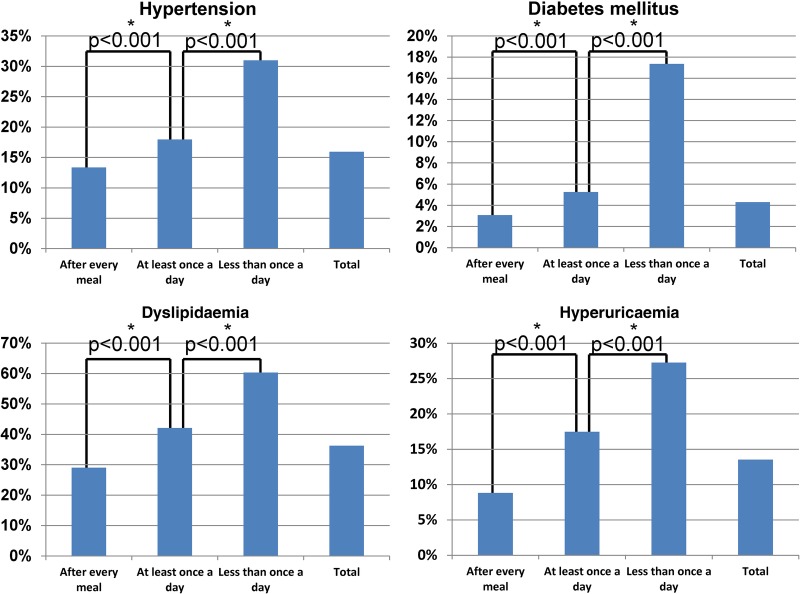
Results: The prevalences of the risk factors were as follows: HT ('after every meal': 13.3%, 'at least once a day': 17.9% and 'less than once a day': 31.0%), DM (3.1%, 5.3% and 17.4%, respectively), DL (29.0%, 42.1% and 60.3%, respectively), HUA (8.6%, 17.5% and 27.2%, respectively) and CKD (3.8%, 3.1% and 8.3%, respectively). The prevalences were significantly higher in the 'less than once a day' group than in the 'after every meal' group for DM (OR=2.03; 95% CI 1.29 to 3.21) and DL (OR=1.50; 95% CI 1.06 to 2.14), but not for HT, HUA and CKD.
Conclusions: Even taking into account lifestyle habits, a lower frequency of toothbrushing was associated with high prevalences of DM and DL. Toothbrushing practices may be beneficial for oral health improvement and also for prevention of certain systemic diseases.
Keywords: Diabetes mellitus; Dyslipidemia; Toothbrushing.
Published by the BMJ Publishing Group Limited. For permission to use (where not already granted under a licence) please go to http://www.bmj.com/company/products-services/rights-and-licensing/
Figures
References
-
- Stefanovska E, Nakova M, Radojkova-Nikolovska V et al. . Tooth-brushing intervention programme among children with mental handicap. Bratisl Lek Listy 2010;111:299–302. - PubMed
Publication types
MeSH terms
LinkOut - more resources
Full Text Sources
Other Literature Sources
Medical
