


Decellularized Extracellular Matrix as an In Vitro Model to Study the Comprehensive Roles of the ECM in Stem Cell Differentiation
- PMID: 26770210
- PMCID: PMC4684892
- DOI: 10.1155/2016/6397820
Decellularized Extracellular Matrix as an In Vitro Model to Study the Comprehensive Roles of the ECM in Stem Cell Differentiation
Abstract
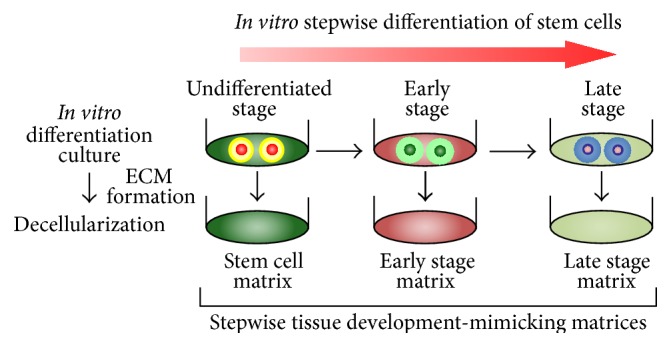
Stem cells are a promising cell source for regenerative medicine. Stem cell differentiation must be regulated for applications in regenerative medicine. Stem cells are surrounded by extracellular matrix (ECM) in vivo. The ECM is composed of many types of proteins and glycosaminoglycans that assemble into a complex structure. The assembly of ECM molecules influences stem cell differentiation through orchestrated intracellular signaling activated by many ECM molecules. Therefore, it is important to understand the comprehensive role of the ECM in stem cell differentiation as well as the functions of the individual ECM molecules. Decellularized ECM is a useful in vitro model for studying the comprehensive roles of ECM because it retains a native-like structure and composition. Decellularized ECM can be obtained from in vivo tissue ECM or ECM fabricated by cells cultured in vitro. It is important to select the correct decellularized ECM because each type has different properties. In this review, tissue-derived and cell-derived decellularized ECMs are compared as in vitro ECM models to examine the comprehensive roles of the ECM in stem cell differentiation. We also summarize recent studies using decellularized ECM to determine the comprehensive roles of the ECM in stem cell differentiation.
Figures


References
Publication types
LinkOut - more resources
Full Text Sources
Other Literature Sources
