Nationwide statistical analysis of myeloid malignancies in Korea: incidence and survival rate from 1999 to 2012
- PMID: 26770948
- PMCID: PMC4705046
- DOI: 10.5045/br.2015.50.4.204
Nationwide statistical analysis of myeloid malignancies in Korea: incidence and survival rate from 1999 to 2012
Abstract
Background: Large-scale epidemiologic analysis for hematologic malignancies will be helpful to understand the trends in incidence and survival.
Methods: The Korea Central Cancer Registry (KCCR) updated the nationwide analysis on the incidence and survival of myeloid malignancies, from the Korean National Cancer Incidence Database between 1999 and 2012. Myeloid malignancies were classified based on the International Classification of Diseases for Oncology 3(rd) edition (ICD-O-3).
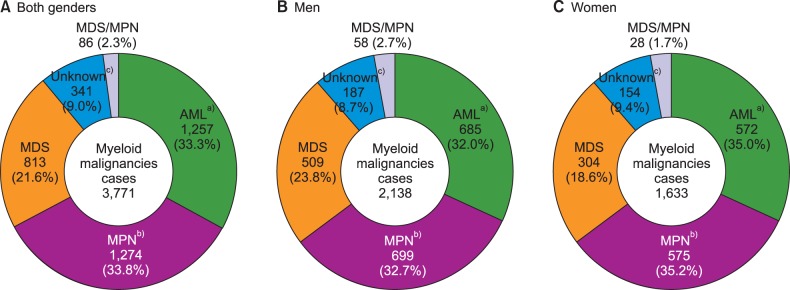
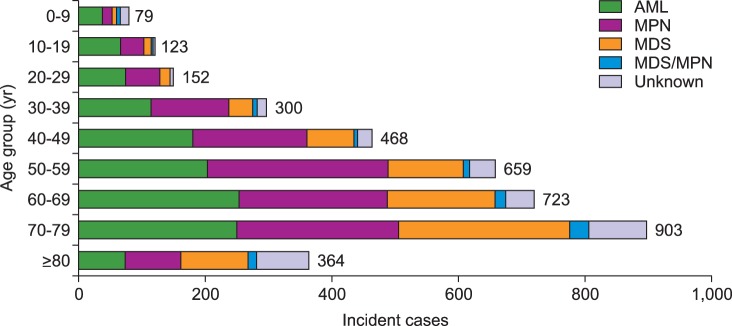
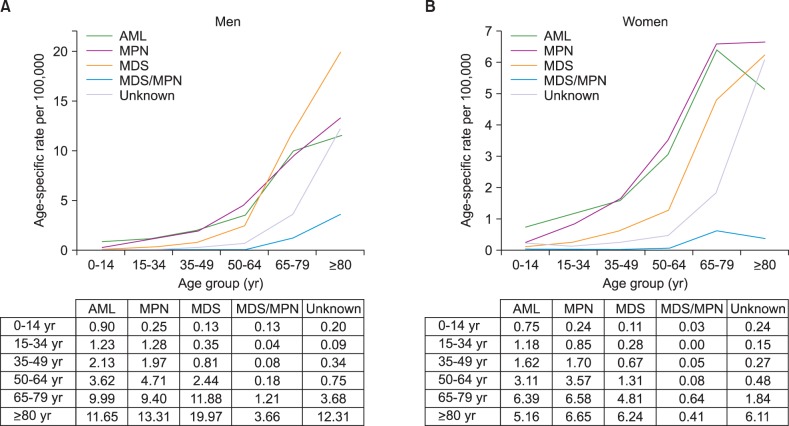
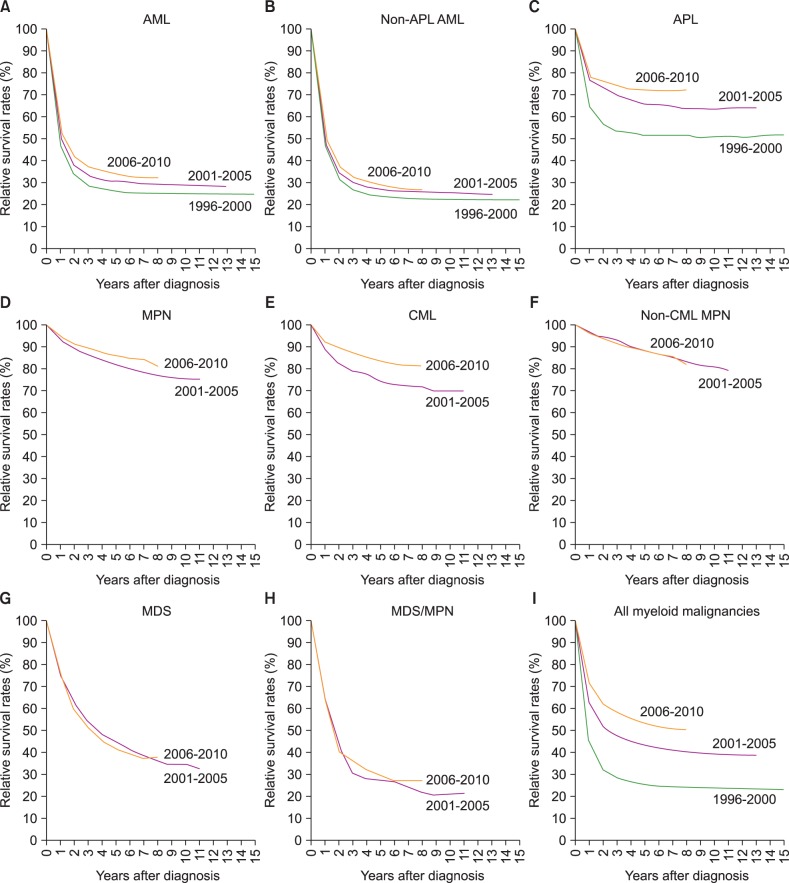
Results: Overall 3,771 cases of myeloid diseases, which was 1.7% of all cancers, were identified in 2012. The highest incidence of myeloid malignancies was observed in age 70s and male predominance was noted (1.3:1). Acute myeloid leukemia (AML) was the most frequent subtype, followed by myeloproliferative neoplasms (MPN), myelodysplastic syndrome (MDS) and MDS/MPN: age-standardized incidence rates (ASR) in 2012 for each disease were 2.02, 1.95, 1.13, and 0.12 per 100,000 persons, respectively. The ASR for all myeloid malignancies was increased from 3.31 in 1999 to 5.70 in 2012 with the annual percentage change (APC) of 5.4 %. Five-year relative survival rate (RS) for myeloid malignancies has gradually improved for decades. RS changed from 26.3% to 34.8% in AML, specifically from 51.6% to 69.6% in acute promyelocytic leukemia (APL) and from 23.8% to 29.9% in non-APL AML, between 1996-2000 and 2008-2012. RS also increased from 81.8% to 87.1% in MPN, with a significant improvement in CML (from 74.5% to 85.5%), and from 27.3% to 31.7% in MDS/MPN between 2001-2005 and 2008-2012. However, there was no survival improvement in MDS during the study period (45.6% in 2001-2005 to 44.4% in 2008-2012).
Conclusion: This report updated the nationwide statistical analysis on myeloid malignancies since 2008, showing increasing incidence and improving trends in survival.
Keywords: Incidence; Korea; Myeloid malignancy; Survival.
Conflict of interest statement
Figures
References
-
- Swerdlow SH, Campo E, Harris NL, et al., editors. WHO classification of tumours of haematopoietic and lymphoid tissues. 4th ed. Lyon, France: IARC Press; 2008.
-
- Vardiman JW, Thiele J, Arber DA, et al. The 2008 revision of the World Health Organization (WHO) classification of myeloid neoplasms and acute leukemia: rationale and important changes. Blood. 2009;114:937–951. - PubMed
-
- Percy CL, Fritz AG, Jack A, et al., editors. International classification of diseases for oncology (ICD-O) 3rd ed. Geneva, Switzerland: World Health Organization; 2013.
-
- Sant M, Allemani C, Tereanu C, et al. Incidence of hematologic malignancies in Europe by morphologic subtype: results of the HAEMACARE project. Blood. 2010;116:3724–3734. - PubMed
LinkOut - more resources
Full Text Sources
Other Literature Sources
Research Materials
Miscellaneous