


Small Heat Shock Proteins Are Novel Common Determinants of Alcohol and Nicotine Sensitivity in Caenorhabditis elegans
- PMID: 26773049
- PMCID: PMC4788107
- DOI: 10.1534/genetics.115.185025
Small Heat Shock Proteins Are Novel Common Determinants of Alcohol and Nicotine Sensitivity in Caenorhabditis elegans
Abstract
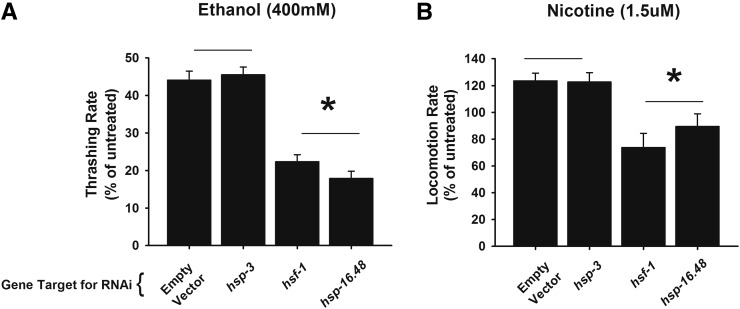
Addiction to drugs is strongly determined by multiple genetic factors. Alcohol and nicotine produce distinct pharmacological effects within the nervous system through discrete molecular targets; yet, data from family and twin analyses support the existence of common genetic factors for addiction in general. The mechanisms underlying addiction, however, are poorly described and common genetic factors for alcohol and nicotine remain unidentified. We investigated the role that the heat shock transcription factor, HSF-1, and its downstream effectors played as common genetic modulators of sensitivity to addictive substances. Using Caenorhabditis elegans, an exemplary model organism with substance dose-dependent responses similar to mammals, we demonstrate that HSF-1 altered sensitivity to both alcohol and nicotine. Using a combination of a targeted RNAi screen of downstream factors and transgenic approaches we identified that these effects were contingent upon the constitutive neuronal expression of HSP-16.48, a small heat shock protein (HSP) homolog of human α-crystallin. Furthermore we demonstrated that the function of HSP-16.48 in drug sensitivity surprisingly was independent of chaperone activity during the heat shock stress response. Instead we identified a distinct domain within the N-terminal region of the HSP-16.48 protein that specified its function in comparison to related small HSPs. Our findings establish and characterize a novel genetic determinant underlying sensitivity to diverse addictive substances.
Keywords: HSF1; alcohol; alpha crystallin; heat shock proteins; nicotine.
Copyright © 2016 by the Genetics Society of America.
Figures




References
-
- Anckar J., Sistonen L., 2011. Regulation of HSF1 function in the heat stress response: implications in aging and disease. Annu. Rev. Biochem. 80: 1089–1115. - PubMed
-
- Arrigo A. P., Simon S., Gibert B., Kretz-Remy C., Nivon M., et al. , 2007. Hsp27 (HspB1) and alphaB-crystallin (HspB5) as therapeutic targets. FEBS Lett. 581: 3665–3674. - PubMed
Publication types
MeSH terms
Substances
Grants and funding
LinkOut - more resources
Full Text Sources
Other Literature Sources
Research Materials
