


Genome-Wide Association Study of a Varroa-Specific Defense Behavior in Honeybees (Apis mellifera)
- PMID: 26774061
- PMCID: PMC4885239
- DOI: 10.1093/jhered/esw005
Genome-Wide Association Study of a Varroa-Specific Defense Behavior in Honeybees (Apis mellifera)
Abstract
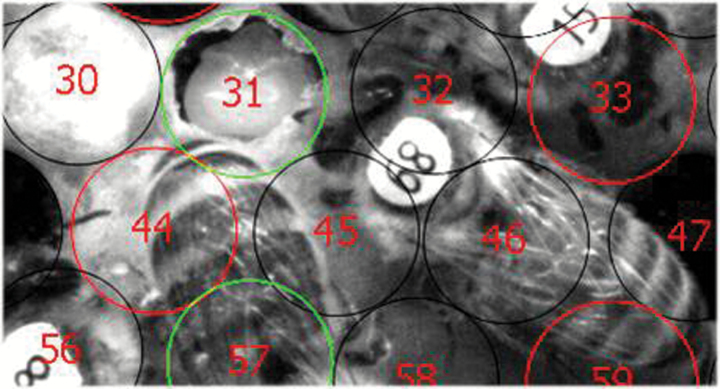
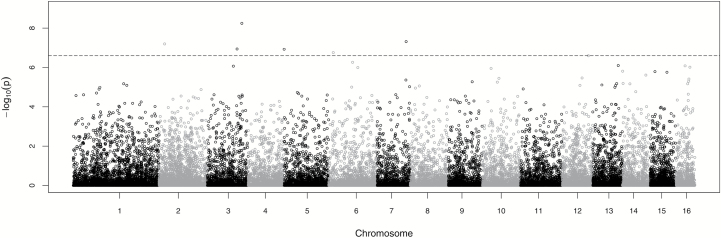
Honey bees are exposed to many damaging pathogens and parasites. The most devastating is Varroa destructor, which mainly affects the brood. A promising approach for preventing its spread is to breed Varroa-resistant honey bees. One trait that has been shown to provide significant resistance against the Varroa mite is hygienic behavior, which is a behavioral response of honeybee workers to brood diseases in general. Here, we report the use of an Affymetrix 44K SNP array to analyze SNPs associated with detection and uncapping of Varroa-parasitized brood by individual worker bees (Apis mellifera). For this study, 22 000 individually labeled bees were video-monitored and a sample of 122 cases and 122 controls was collected and analyzed to determine the dependence/independence of SNP genotypes from hygienic and nonhygienic behavior on a genome-wide scale. After false-discovery rate correction of the P values, 6 SNP markers had highly significant associations with the trait investigated (α < 0.01). Inspection of the genomic regions around these SNPs led to the discovery of putative candidate genes.
Keywords: Candidate genes; SNP array; Varroa destructor; Varroa resistance.; hygienic behavior.
© The American Genetic Association. 2016. All rights reserved. For permissions, please e-mail: journals.permissions@oup.com.
Figures
References
-
- Allen MF, Ball BV. 1996. The incidence and world distribution of honey bee viruses. Bee World. 77:141–162.
-
- Allen MF, Ball BV, White RF, Antoniw JF. 1986. The detection of acute paralysis virus in Varroa jacobsoni by the use of a simple indirect ELISA. J Apic Res. 25:100–105.
-
- Altschul SF, Gish W, Miller W, Myers EW, Lipman DJ. 1990. Basic local alignment search tool. J Mol Biol. 215:403–410. - PubMed
-
- Baker CS. 2013. Journal of heredity adopts joint data archiving policy. J Hered. 104:1. - PubMed
-
- Bakonyi T, Farkas R, Szendroi A, Dobos-Kovács M, Rusvai M. 2002. Detection of acute bee paralysis virus by RT-PCR in honey bee and Varroa destructor field samples: rapid screening of representative Hungarian apiaries. Apidologie. 33:63–74.
Publication types
MeSH terms
Associated data
LinkOut - more resources
Full Text Sources
Other Literature Sources
