


Assessment of Background Parenchymal Enhancement and Lesion Kinetics in Breast MRI of BRCA 1/2 Mutation Carriers Compared to Matched Controls Using Quantitative Kinetic Analysis
- PMID: 26774741
- PMCID: PMC5893133
- DOI: 10.1016/j.acra.2015.11.011
Assessment of Background Parenchymal Enhancement and Lesion Kinetics in Breast MRI of BRCA 1/2 Mutation Carriers Compared to Matched Controls Using Quantitative Kinetic Analysis
Abstract
Rationale and objectives: To investigate whether quantitative kinetic analysis of lesions and background parenchyma in breast magnetic resonance imaging can elucidate differences between BRCA carriers and sporadic controls with high risk for breast cancer.
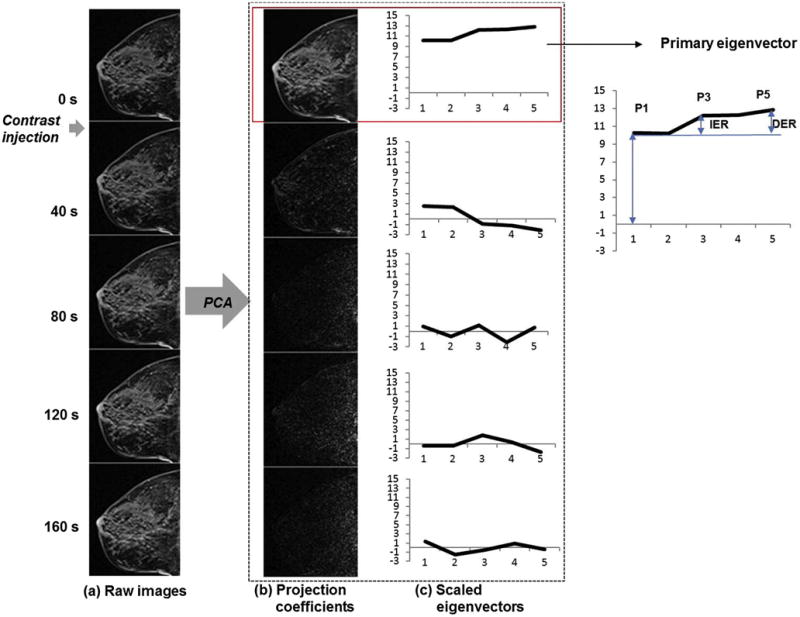
Materials and methods: Fifty-nine BRCA and 59 control cases (49 benign, 10 malignant) were examined in this study. Principal component analysis was applied for quantitative analysis of dynamic signal in background parenchyma (B) and lesion (L) in terms of initial enhancement ratio (IER) and delayed enhancement ratio (DER).
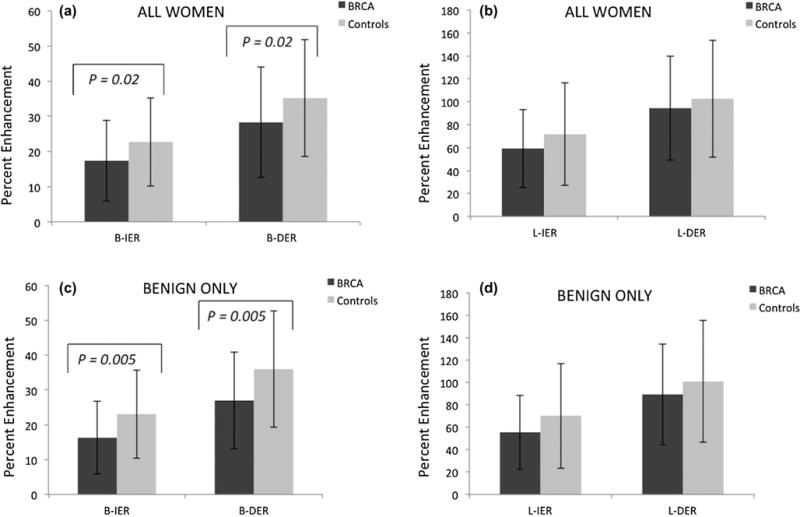
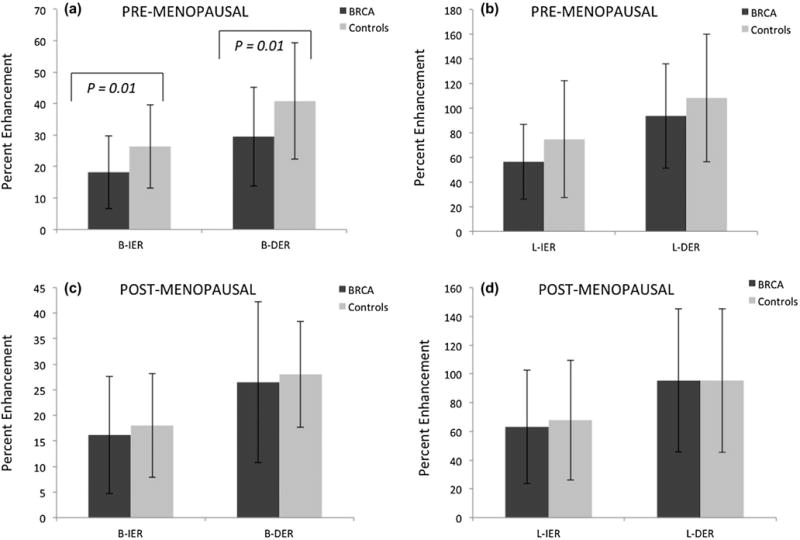
Results: Control B-IER, B-DER, L-IER, and L-DER were higher than BRCA cases in all women and in women with benign lesions; statistically significant differences in B-IER and B-DER (all women: P = 0.02 and P = 0.02, respectively; benign only: P = 0.005 and P = 0.005, respectively). In the control cohort, B-IER and B-DER were higher in the premenopausal women than in the postmenopausal women (P = 0.013 and 0.003, respectively), but not in the BRCA cohort; this led to significant differences in B-IER and B-DER between the control and the BRCA groups in the premenopausal women (P = 0.01 and 0.01, respectively) but not in the postmenopausal women.
Conclusion: Results suggest possible differences in the vascular properties of background parenchyma between BRCA carriers and noncarriers and its association with menopausal status.
Keywords: BRCA 1/2 mutation carrier; background parenchymal enhancement (BPE); dynamic contrast-enhanced magnetic resonance imaging (DCE-MRI); principal component analysis (PCA).
Copyright © 2015 The Association of University Radiologists. Published by Elsevier Inc. All rights reserved.
Figures
References
-
- Whittemore AS, Gong G, John EM, McGuire V, Li FP, Ostrow KL, et al. Prevalence of BRCA1 mutation carriers among U.S. non-Hispanic Whites. Cancer epidemiology, biomarkers & prevention: a publication of the American Association for Cancer Research, cosponsored by the American Society of Preventive Oncology. 2004;13(12):2078–83. - PubMed
-
- Antoniou A, Pharoah PD, Narod S, Risch HA, Eyfjord JE, Hopper JL, et al. Average risks of breast and ovarian cancer associated with BRCA1 or BRCA2 mutations detected in case Series unselected for family history: a combined analysis of 22 studies. American journal of human genetics. 2003;72(5):1117–30. doi: 10.1086/375033. - DOI - PMC - PubMed
-
- Gilliland FD, Joste N, Stauber PM, Hunt WC, Rosenberg R, Redlich G, et al. Biologic characteristics of interval and screen-detected breast cancers. Journal of the National Cancer Institute. 2000;92(9):743–9. - PubMed
Publication types
MeSH terms
Substances
Grants and funding
LinkOut - more resources
Full Text Sources
Other Literature Sources
Medical
Miscellaneous
