. 2016 Jan 18:6:19638.
doi: 10.1038/srep19638.

Chlamydia gallinacea, not C. psittaci, is the endemic chlamydial species in chicken (Gallus gallus)

Affiliations

Chlamydia gallinacea, not C. psittaci, is the endemic chlamydial species in chicken (Gallus gallus)

Weina Guo et al. Sci Rep. .

Abstract

To investigate the prevalence and diversity of Chlamydia spp. in domestic birds in China, oral and cloacal swabs of healthy chickens, ducks, geese and pigeons were collected nationwide from live-animal markets and examined by Chlamydia spp. 23 S rRNA gene FRET-PCR followed by high-resolution melting curve analysis and confirmatory sequencing. Overall, 26.2% of the birds (602/2,300) were positive for Chlamydia spp. and five Chlamydia spp. were identified. While occasional detection of C. suis and C. muridarum in poultry is reported here for the first time, the predominant chlamydial agent was C. gallinacea representing 63.8% of all positives (384/602) and 81.2% of positive chickens (359/442). Analysis of the C. gallinacea ompA phylogeny revealed at least 13 well segregated variants (serovars). Seven-month monitoring of C. gallinacea-infected chickens indicated that the infection was persistent. C. gallinacea-infected chickens remained without overt clinical disease, but showed body weight gains significantly reduced by 6.5-11.4% beginning in week 3 post-infection. This study indicates that C. gallinacea is the endemic chlamydial species in chickens, whereas C. psittaci dominates only in pigeons. Further studies are required to address the specific conditions under which C. gallinacea could act as an avian pathogen and possibly also a zoonotic agent.


Figures
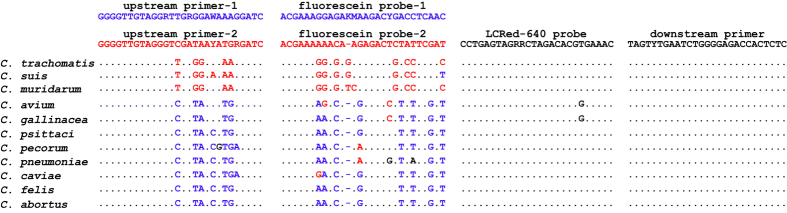
Figure 1
Figure 1. Alignment of primers and probes for 11 Chlamydia species.
Nucleotide sequences of the primers and probes (two upstream primers, one downstream primer, two fluorescein probes and one LCRed-640 probe) are shown above the corresponding nucleotide sequences of 11 Chlamydia species. The LCRed-640 probe and downstream primer show 0 or 1 mismatches with all 11 Chlamydia species. Upstream primer-1 and fluorescein probe-1 are specific for C. trachomatis, C. suis and C. muridarum, and mismatches of chlamydial species are indicated by blue or black font. Upstream primer-2 and fluorescein probe-2 are specific for the remaining 8 Chlamydia species, and mismatches are indicated by red or black font. The upstream primer and probes were used as shown while the downstream primer was used as reverse complement. Dots indicate that nucleotides are identical to those of primers/probes, and dashes indicate deletion of nucleotides.
Figure 2
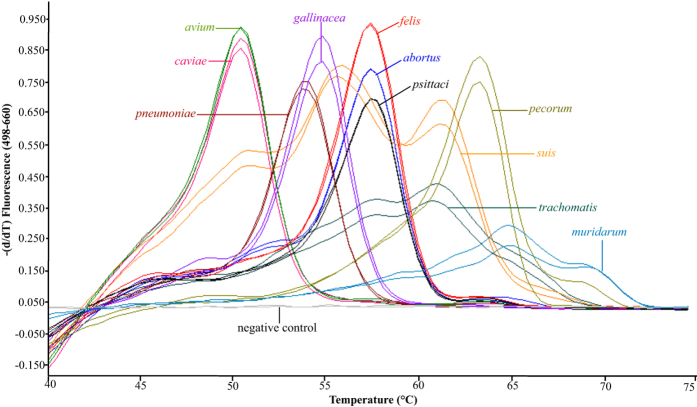
Figure 2. Tm differentiation of 11 Chlamydia species into eight groups through HRM genotyping analysis.
Following the completion of PCR, the Tm of probe hybridization to the targets was determined by high-resolution melting (HRM) curve analysis as the peak of the second derivative of the fluorescence released during a temperature increase from 38–85 °C. Based on the unique Tm distributions, 11 Chlamydia species are differentiated into 8 distinct groups: 50.6 °C for C. avium and C. caviae; 53.8 °C for C. pneumoniae; 54.9 °C for C. gallinacea; dual peaks of 55.8 °C and 61.4 °C for C. suis, 57.6 °C for C. felis, C. abortus and C. psittaci; a flat peak of 61.0 °C for C. trachomatis; 63.3 °C for C. pecorum; a flat peak of 65.0 °C for C. muridarum. For each Chlamydia species, five concentrations of the targets were used (only 100 and 10 copies of the gene/20 μl reaction system are shown here) and peaks and curve shape were consistent at all dilutions.
Figure 3
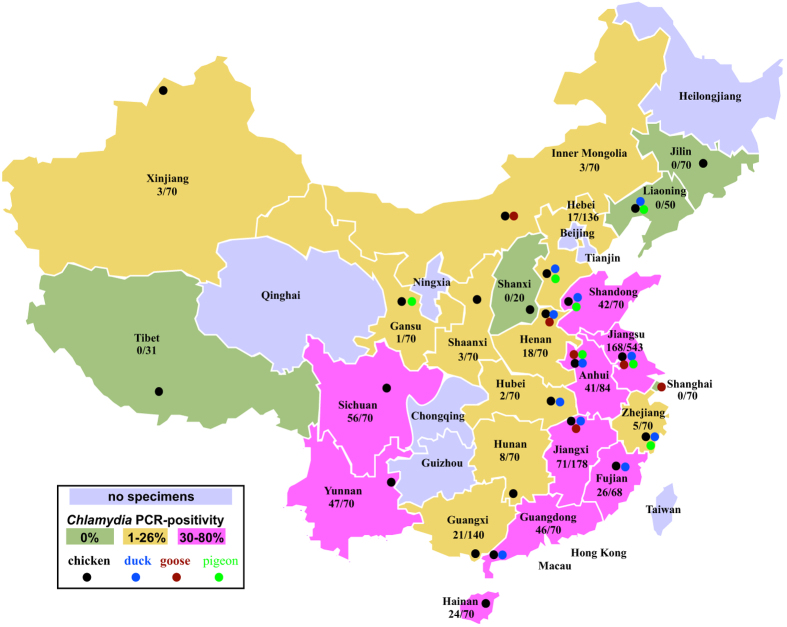
Figure 3. Chlamydia spp. prevalence in 24 provinces of China.
Overall, 26.2% (602/2,300) of apparently healthy poultry from the live-poultry markets in 24 provinces of China were positive for Chlamydia spp. While Chlamydia spp. were not detected in 5 provinces (green: Shanxi, Tibet, Jilin, Liaoning and Shanghai), the PCR prevalences were between 1–26% in 10 provinces (yellow: Henan, Guangxi, Hebei, Hunan, Zhejiang, Xinjiang, Shaanxi, Inner Mongolia, Hubei and Gansu), and above 30% in 9 provinces (pink: Sichuan, Yunnan, Guangdong, Shandong, Anhui, Jiangxi, Fujian, Hainan and Jiangsu). Grey color was used to show the provinces where specimens were not available for this study. The colors (formula image for chicken, formula image for duck, formula image for goose, formula image for pigeon) and positions of filled circles indicate different poultry species and the sampling cities. This map was created by YY and CW using Adobe Illustrator CS5 (http://www.adobe.com/products/illustrator.html).
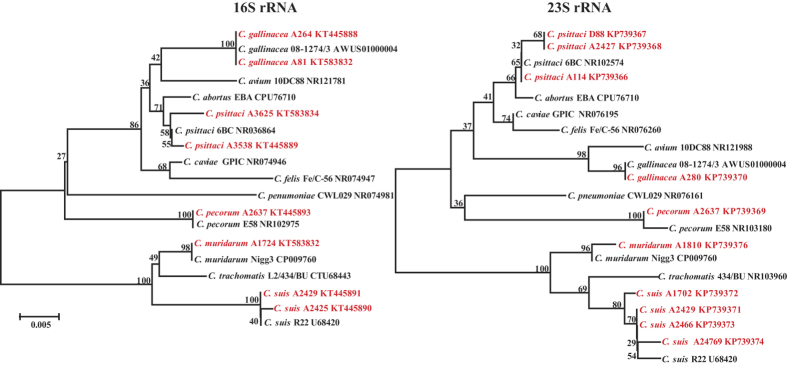
Figure 4
Figure 4. Phylogeny of Chlamydia species and strains identified in this study.
A 697 bp variable region of the 16S rRNA gene is shown in the left panel, and a 329 bp variable region of the 23S rRNA gene in the right panel. All 11 Chlamydia spp. type strains are shown in black font (Chlamydia sp, name of strain and sequence accession number), and the Chlamydia spp. identified in this study are shown in red font. Branch lengths are measured in nucleotide substitutions and numbers show branching percentages in bootstrap replicates. Scale bar shows the percentage sequence diversity.
Figure 5
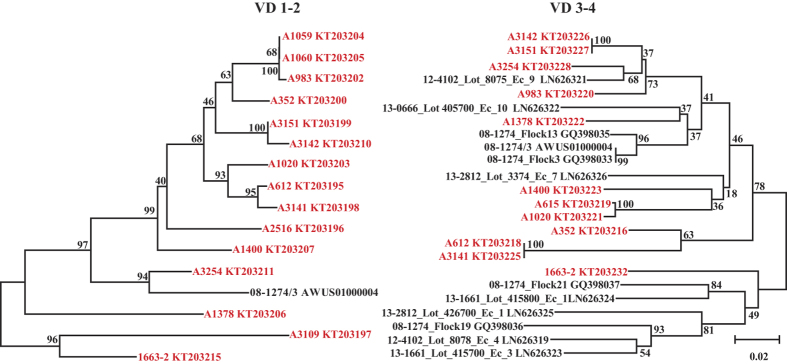
Figure 5. Phylogeny of ompA variable domains 1–2 and VD 3–4.
A 421 bp region encompassing VD 1–2 is shown on the left panel, and a 435 bp region encompassing VD 3–4 on the right panel. European C. gallinacea sequences deposited in GenBank are shown in black font (name of strain and accession number) and strains identified in this study in red font. The inability to amplify every target from every swab specimen resulted in strain differences between the phylograms. Branch lengths are measured in nucleotide substitutions and numbers show branching percentages in bootstrap replicates. Scale bar represents the percentage sequence diversity.
Figure 6
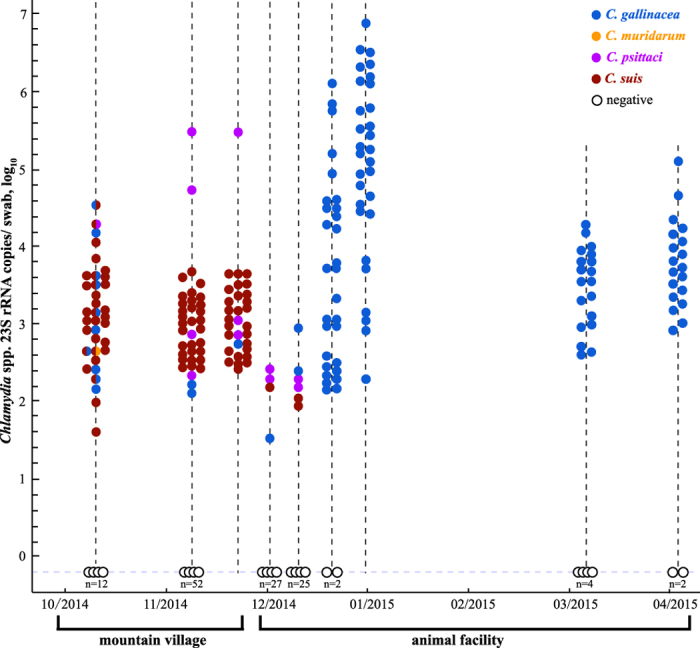
Figure 6. A seven-month monitoring of Chlamydia spp. in naturally infected chickens moved from mountain village to animal facility.
FRET-qPCR was used to detect DNAs of Chlamydia spp. in oral and cloacal swabs of chickens which were moved from a mountain village in Jiangxi province (first three samplings) to a containment animal facility in Jiangsu province (last six samplings). Of the chickens tested in the mountain village, 74.4% (35/47) and 40.9% (36/88) were positive for Chlamydia spp. Thirty-one randomly-selected Chlamydia spp.-positive chickens (third sampling) were moved to the animal facility on November 27, 2014. Interestingly, four Chlamydia species were detected in the first three samplings when the chickens were in mountain village, and the most prevalent species was C. suis [31/35 (88.6%), 30/36 (83.3%), 28/31 (90.3%)]. In the first two sampling time points in the animal facility, chlamydial positivity declined precipitously. In the final 4 sampling time points C. suis and C. psittaci had disappeared from the chickens, but C. gallinacea had completely overtaken as the only chlamydial species detected. While no signs of disease were observed, C. gallinacea-positivity became very high during the time (29/31, 30/30, 19/23, and 19/21).
Figure 7
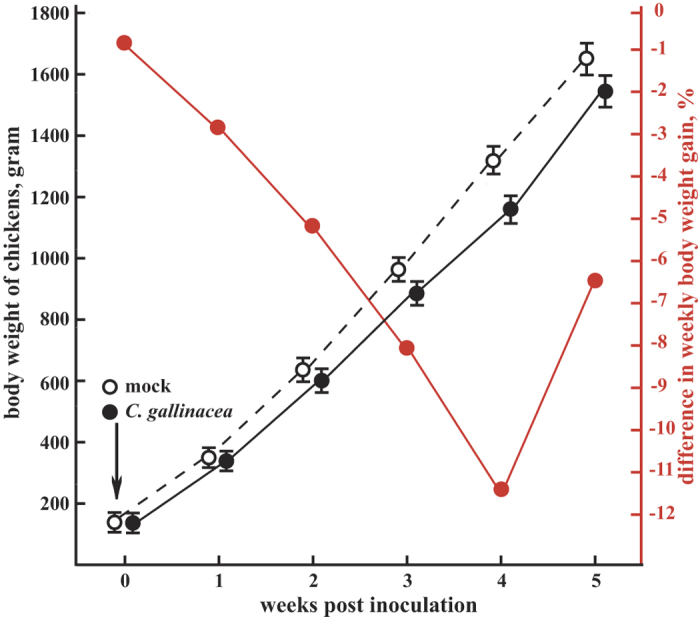
Figure 7. C. gallinacea reduces body weight of chickens by up to 11.4%.
Body weight (±SEM, left ordinate, in black) is shown for C. gallinacea-inoculated AA broiler chickens (filled circle) and mock-inoculated chickens (open circle). The difference in weekly body weight gain is shown in the right ordinate (in red). Compared to mock-inoculated chickens, C. gallinacea-inoculated chickens had significantly lower body weights (883 ± 54 [SEM] vs. 962 ± 61 g; 1165 ± 80 vs. 1315 ± 93 g; 1539 ± 120 g vs. 1645 ± 133 g) and lower body weight increase (8.2%, 11.4%, 6.5%, p < 0.0009) at 3, 4, and 5 weeks post inoculation.

References

    1. Laroucau K. et al. Isolation of a new chlamydial agent from infected domestic poultry coincided with cases of atypical pneumonia among slaughterhouse workers in France. Infect. Genet. Evol. 9, 1240–1247 (2009). - PubMed
    1. Rohde G., Straube E., Essig A., Reinhold P. & Sachse K. Chlamydial zoonoses. Dtsch. Ärztebl. Int. 107, 174–180 (2010). - PMC - PubMed
    1. Reinhold P., Hartmann H. & Constable P. D. Characterization of acid-base abnormalities in pigs experimentally infected with Chlamydia suis. Vet. J. 184, 212–218 (2010). - PubMed
    1. Dean D., Rothschild J., Ruettger A., Kandel R. P. & Sachse K. Zoonotic Chlamydiaceae species associated with trachoma, Nepal. Emerg. Infect. Dis. 19, 1948–1955 (2013). - PMC - PubMed
    1. Knittler M. R. & Sachse K. Chlamydia psittaci: update on an underestimated zoonotic agent. Pathog. Dis. 73, 1–15 (2015). - PubMed

Publication types