Review
. 2016 Feb;22(2):151-163.
doi: 10.1016/j.molmed.2015.12.002. Epub 2016 Jan 7.

The Changing Landscape of Renal Inflammation

Affiliations
Review

The Changing Landscape of Renal Inflammation

Thomas Ernandez et al. Trends Mol Med. 2016 Feb.

Abstract

Kidney inflammation is a major contributor to progressive renal injury, leading to glomerulonephritis (GN) and chronic kidney disease. We review recent advances in our understanding of leukocyte accumulation in the kidney, emphasizing key chemokines involved in GN. We discuss features of renal inflammation such as the evolving concept of immune cell plasticity. We also describe certain aspects of organ-specific tissue microenvironments in shaping immune cell responses, as well as the current knowledge of how regulatory T lymphocytes impact on other immune effector cell populations to control inflammation. It is clear that present and future research in these areas may contribute to the development of novel targeted therapeutics, with the hope of alleviating the burden of end-stage renal disease (ESRD).

Keywords: chemokines; effector immune cells; environmental triggers; glomerulus; leukocyte recruitment; local inflammation; phenotype stability; regulatory immune cells.


Figures

Key Figure, Figure 1
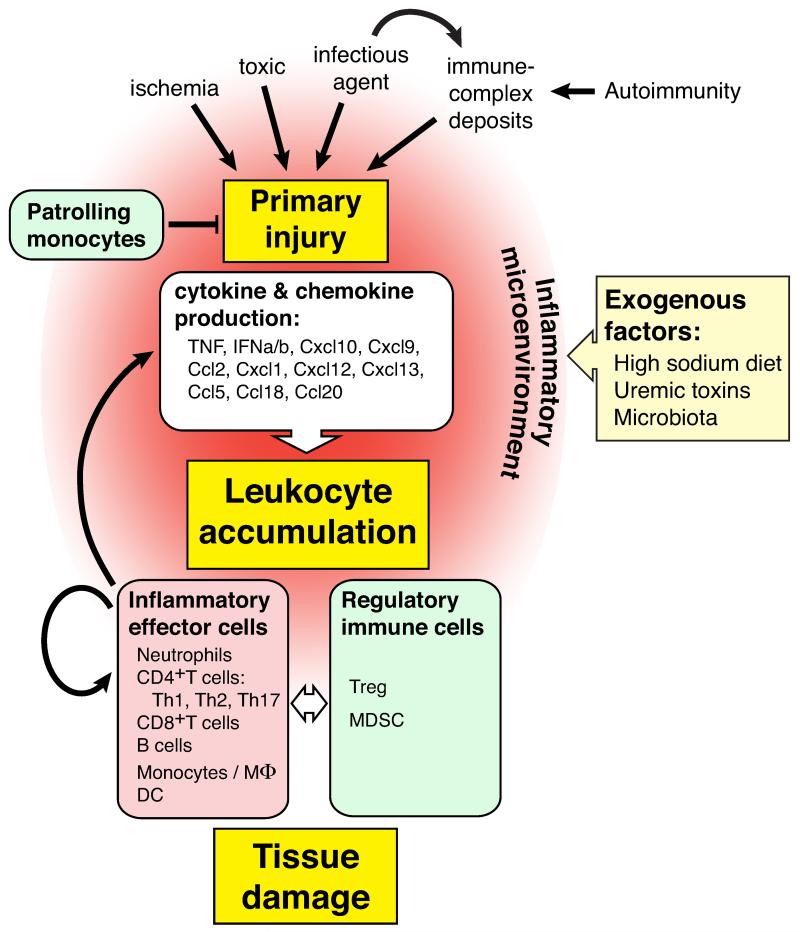
Key Figure, Figure 1. Mechanisms Controlling Leukocyte Accumulation During Kidney Inflammation
Various triggers induce primary renal tissue injury that subsequently lead to the production of cytokines and chemokines from intrinsic renal cells. These inflammatory cues, dictated by the nature and the site of the initiating injury, coordinate leukocyte accumulation and the temporal infiltration of leukocyte subsets. Recruited leukocytes, in turn, influence the recruitment and activation of other immune cells. As well as the responses from renal cells. Recruited immunoregulatory cells eventually terminate the inflammatory response. Patrolling monocytes may also control inflammatory responses by maintaining endothelial integrity. Finally, the inflammatory microenvironment, influenced by exogenous factors such as high sodium diet, uremic toxins and microbiota (see text), define the inflammatory landscape and thus, leukocyte influx.

References

    1. Saran R, et al. US Renal Data System 2014 Annual Data Report: Epidemiology of Kidney Disease in the United States. Am J Kidney Dis. 2015;65(6 Suppl 1):A7. - PMC - PubMed
    1. Ley K, et al. Getting to the site of inflammation: the leukocyte adhesion cascade updated. Nat Rev Immunol. 2007;7(9):678–89. - PubMed
    1. Thomas G, et al. Nonclassical patrolling monocyte function in the vasculature. Arterioscler Thromb Vasc Biol. 2015;35(6):1306–16. - PMC - PubMed
    1. Devi S, et al. Multiphoton imaging reveals a new leukocyte recruitment paradigm in the glomerulus. Nat Med. 2013;19(1):107–12. - PubMed
    1. Block H, et al. Crucial role of SLP-76 and ADAP for neutrophil recruitment in mouse kidney ischemia-reperfusion injury. J Exp Med. 2012;209(2):407–21. - PMC - PubMed

MeSH terms