


Trends in Cohabitation Outcomes: Compositional Changes and Engagement Among Never-Married Young Adults
- PMID: 26778851
- PMCID: PMC4712741
- DOI: 10.1111/jomf.12123
Trends in Cohabitation Outcomes: Compositional Changes and Engagement Among Never-Married Young Adults
Abstract
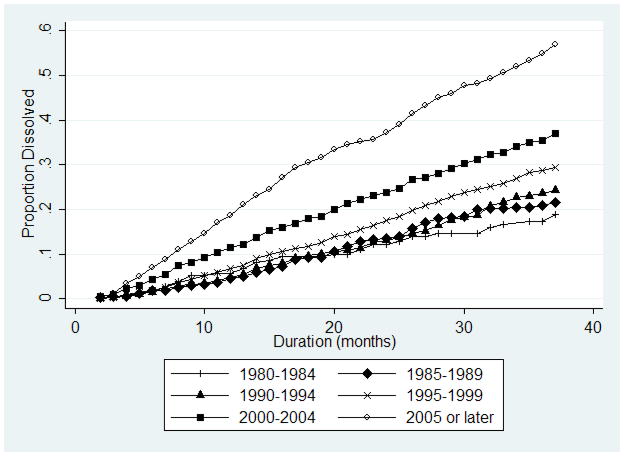
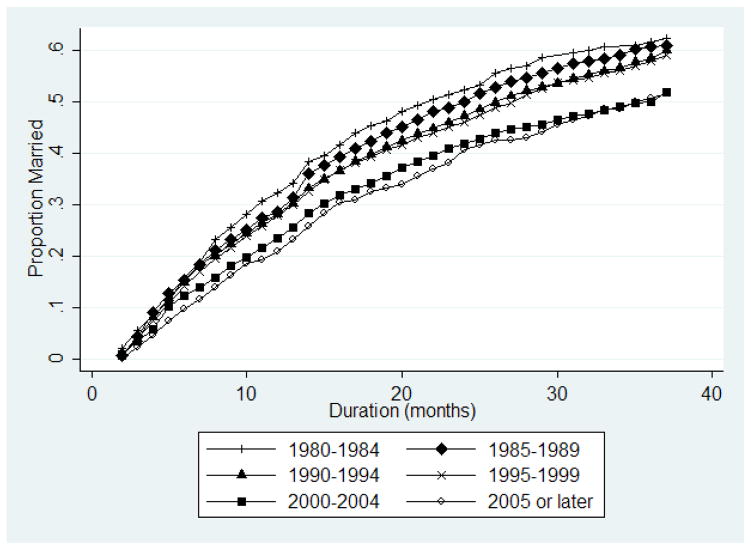
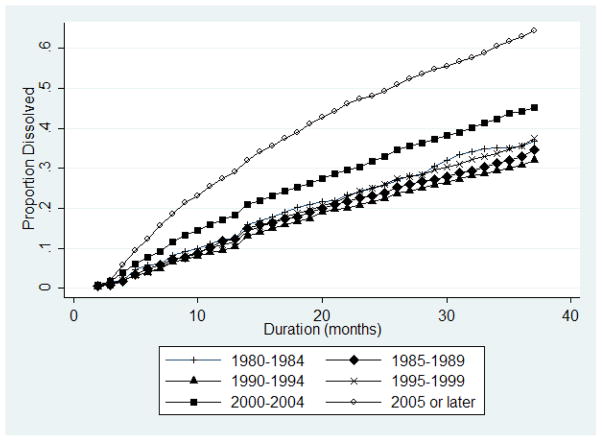
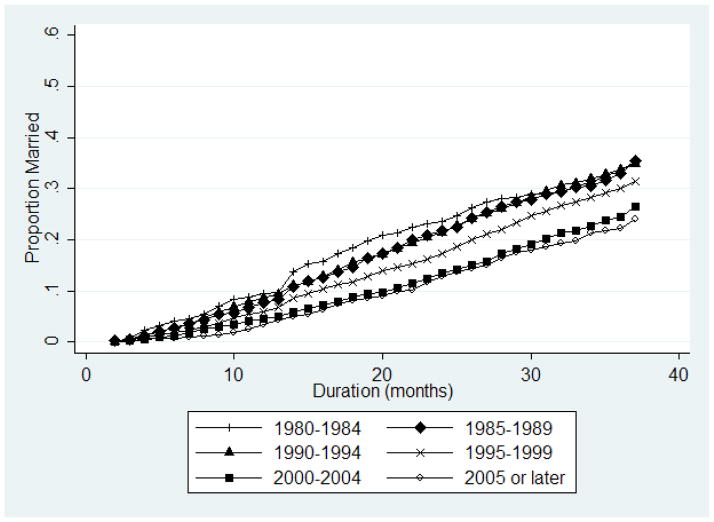
Cohabitation is now the modal first union for young adults, and most marriages are preceded by cohabitation even as fewer cohabitations transition to marriage. These contrasting trends may be due to compositional shifts among cohabiting unions, which are increasingly heterogeneous in terms of cohabitation order, engagement, and the presence of children, as well as across socioeconomic and demographic characteristics. The author constructs 5-year cohabitation cohorts for 18- to 34-year-olds from the 2002 and 2006-2010 cycles of the National Survey of Family Growth (n = 17,890 premarital cohabitations) to examine the outcomes of cohabitations over time. Compared to earlier cohabitations, those formed after 1995 were more likely to dissolve, and those formed after 2000 were less likely to transition to marriage even after accounting for the compositional shifts among individuals in cohabiting unions. Higher instability and decreased chances of marriage occurred among both engaged and non-engaged individuals, suggesting society-wide changes in cohabitation over time.
Keywords: adolescence; close relationships; cohabitation; demography; family structure; marriage.
Figures
References
-
- Bramlett MD, Mosher WD. Vital and Health Statistics, Series 23. 22. Hyattsville, MD: National Center for Health Statistics; 2002. Cohabitation, marriage, divorce, and remarriage in the United States. Retrieved from http://www.cdc.gov/nchs/data/series/sr_23/sr23_022.pdf. - PubMed
-
- Brown SL. Union transitions among cohabitors: The significance of relationship assessments and expectations. Journal of Marriage and the Family. 2000;62:833–846.
-
- Brown SL, Lee GR, Bulanda JR. Cohabitation among older adults: A national portrait. Journals of Gerontology Series B: Psychological Sciences and Social Sciences. 2006;61:S71–S79. - PubMed
-
- Bumpass L, Lu HH. Trends in cohabitation and implications for children’s family contexts in the United States. Population Studies. 2000;54:29–41. - PubMed
-
- CDC/NCHS National Vital Statistics System. National marriage and divorce rates and trends. 2012 Retrieved from http://www.cdc.gov/nchs/nvss/marriage_divorce_tables.htm.
Grants and funding
LinkOut - more resources
Full Text Sources
Other Literature Sources